


The Oxford study of Calcium channel Antagonism, Cognition, Mood instability and Sleep (OxCaMS): study protocol for a randomised controlled, experimental medicine study
- PMID: 30755265
- PMCID: PMC6373140
- DOI: 10.1186/s13063-019-3175-0
The Oxford study of Calcium channel Antagonism, Cognition, Mood instability and Sleep (OxCaMS): study protocol for a randomised controlled, experimental medicine study
Abstract
Background: The discovery that voltage-gated calcium channel genes such as CACNA1C are part of the aetiology of psychiatric disorders has rekindled interest in the therapeutic potential of L-type calcium channel (LTCC) antagonists. These drugs, licensed to treat hypertension and angina, have previously been used in bipolar disorder, but without clear results. Neither is much known about the broader effects of these drugs on the brain and behaviour.
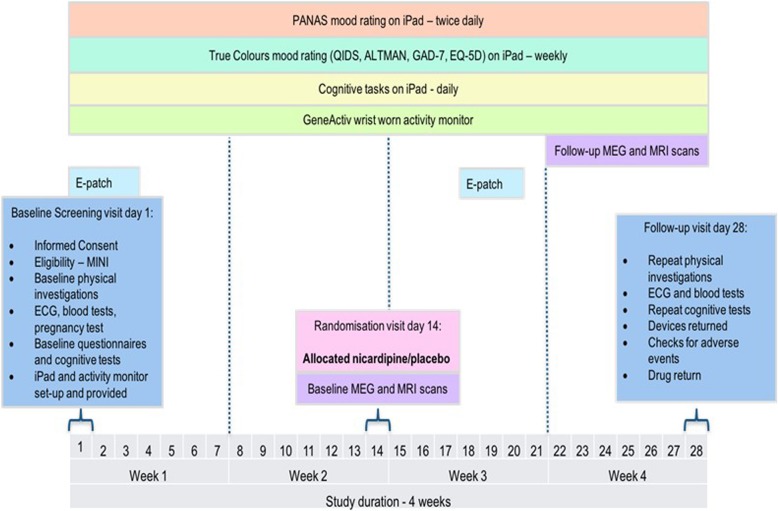
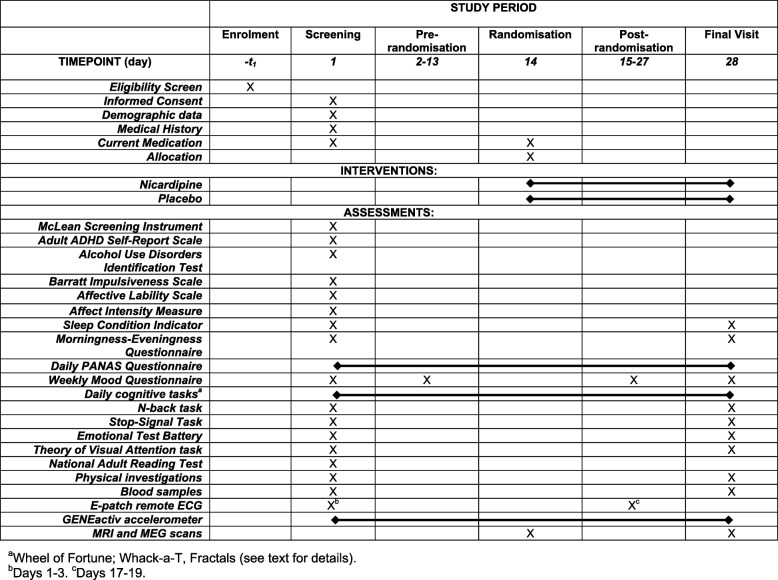
Methods: The Oxford study of Calcium channel Antagonism, Cognition, Mood instability and Sleep (OxCaMS) is a high-intensity randomised, double-blind, placebo-controlled experimental medicine study on the effect of the LTCC antagonist nicardipine in healthy young adults with mood instability. An array of cognitive, psychiatric, circadian, physiological, biochemical and neuroimaging (functional magnetic resonance imaging and magnetoencephalography) parameters are measured during a 4-week period, with randomisation to drug or placebo on day 14. We are interested in whether nicardipine affects the stability of these measures, as well as its overall effects. Participants are genotyped for the CACNA1C risk polymorphism rs1006737.
Discussion: The results will clarify the potential of LTCC antagonists for repurposing or modification for use in psychiatric disorders in which cognition, mood and sleep are affected.
Trial registration: ISRCTN, ISRCTN33631053 . Retrospectively registered on 8 June 2018 (applied 17 May 2018).
Keywords: Bipolar disorder; Calcium blockers; Calcium channel antagonists; Depression; Functional magnetic resonance imaging; Magnetoencephalography; Mood instability; Sleep; Working memory.
Conflict of interest statement
Ethics approval and consent to participate
Study approved by NHS Oxford Research Ethics Committee C (17/SC/0029, IRAS 213212). Latest amendment approved 23 May 2018 (protocol version 1.5). (Additional file 3).
Consent for publication
Not applicable.
Competing interests
The authors declare that they have no competing interests.
Publisher’s Note
Springer Nature remains neutral with regard to jurisdictional claims in published maps and institutional affiliations.
Figures
References
-
- Pazzaglia PJ, Post RM, Ketter TA, George MS, Marangell LB. Preliminary controlled trial of nimodipine in ultra-rapid cycling affective dysregulation. Psychiatry Res. 1993;49:257–272. - PubMed
-
- Levy NA, Janicak PG. Calcium channel antagonists for the treatment of bipolar disorder. Bipolar Disord. 2000;2:108–119. - PubMed
-
- Warsh JJ, Andreopoulos S, Li PP. Role of intracellular calcium signaling in the pathophysiology and pharmacotherapy of bipolar disorder: current status. Clin Neurosci Res. 2004;4:201–213.
-
- Wasserman MJ, Corson TW, Sibony D, Cooke RG, Parikh SV, Pennefather PS, et al. Chronic lithium treatment attenuates intracellular calcium mobilization. Neuropsychopharmacology. 2004;29:759–769. - PubMed
Publication types
MeSH terms
Substances
Grants and funding
LinkOut - more resources
Full Text Sources
Medical
