


Spontaneous Cirrhosis Regression in an IFN-beta-induced AIH-like Syndrome Following Drug Withdrawal: Art of Facts or Artifacts?
- PMID: 30755872
- PMCID: PMC6346866
- DOI: 10.12890/2016_000396
Spontaneous Cirrhosis Regression in an IFN-beta-induced AIH-like Syndrome Following Drug Withdrawal: Art of Facts or Artifacts?
Abstract
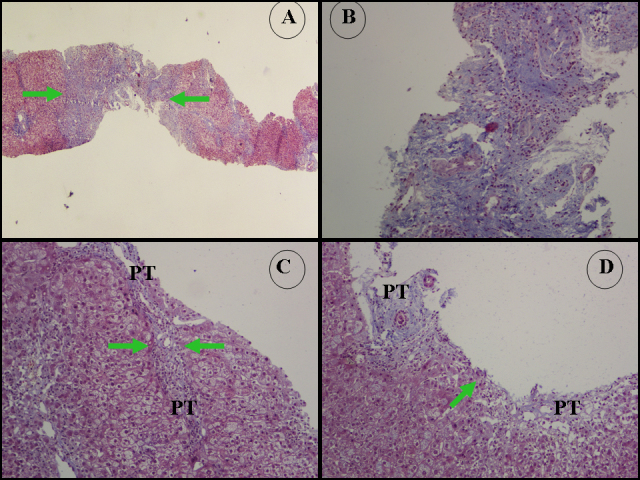
Autoimmune hepatitis (AIH) is a disease of unknown aetiology with drug-induced AIH being the most complex and not fully understood type. We present the case of a 57-year-old female patient with acute icteric hepatitis after interferon-beta-1b (IFNβ-1b) administration for multiple sclerosis (MS). Based on liver autoimmune serology, histology and appropriate exclusion of other liver diseases, a diagnosis of AIH-related cirrhosis was established. Following discontinuation of IFNβ-1b, a complete resolution of biochemical activity indices was observed and the patient remained untreated on her own decision. However, 3 years later, after a course of intravenous methylprednisolone for MS, a new acute transaminase flare was recorded which subsided again spontaneously after 3 weeks. Liver biopsy and elastography showed significant fibrosis regression (F2 fibrosis). To our knowledge, this is the first report showing spontaneous cirrhosis regression in an IFNβ-1b-induced AIH-like syndrome following drug withdrawal, suggesting that cirrhosis might be reversible if the offending fibrogenic stimulus is withdrawn.
Learning points: Autoimmune hepatitis (AIH) is a very heterogeneous liver disease of unknown aetiology, with drug-induced AIH being the most complex and not fully understood type.Intravenous methylprednisolone pulse administration may reactivate or unmask previously unrecognised or misdiagnosed AIH and therefore liver autoimmune serology should be sought for every patient with acute or chronic hepatitis in the absence of viral, metabolic, genetic and alcoholic causes of liver disease.Spontaneous regression of cirrhosis, although controversial, may occur if the offending fibrogenic stimuli are immediately withdrawn as shown in this case of IFNβ-1b-induced AIH.
Keywords: Autoimmune hepatitis; cirrhosis; drug-induced liver injury; interferon-beta; multiple sclerosis.
Conflict of interest statement
Conflicts of Interests: The Authors declare that there are no competing interests.
Figures
References
-
- Zachou K, Muratori P, Koukoulis GK, Granito A, Gatselis N, Fabbri A, et al. Review article: autoimmune hepatitis - current management and challenges. Aliment Pharmacol Ther. 2013;38:887–913. - PubMed
-
- EASL Clinical Practice Guidelines: Autoimmune hepatitis. J Hepatol. 2015;63:971–1004. - PubMed
-
- Hytiroglou P, Snover DC, Alves V, Balabaud C, Bhathal PS, Bioulac-Sage P, et al. Beyond “cirrhosis”: a proposal from the International Liver Pathology Study Group. Am J Clin Pathol. 2012;137:5–9. - PubMed
-
- Zachou K, Gatselis N, Papadamou G, Rigopoulou EI, Dalekos GN. Mycophenolate for the treatment of autoimmune hepatitis: prospective assessment of its efficacy and safety for induction and maintenance of remission in a large cohort of treatment-naive patients. J Hepatol. 2011;55:636–646. - PubMed
LinkOut - more resources
Full Text Sources
Miscellaneous