


Do professional facial image comparison training courses work?
- PMID: 30759105
- PMCID: PMC6373902
- DOI: 10.1371/journal.pone.0211037
Do professional facial image comparison training courses work?
Abstract
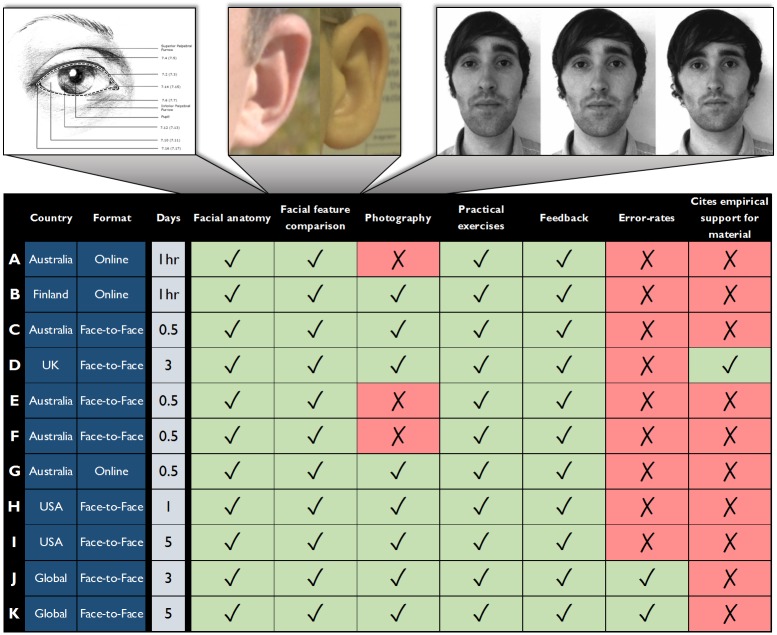
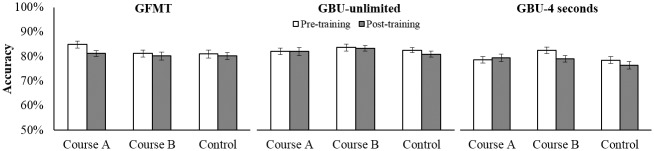
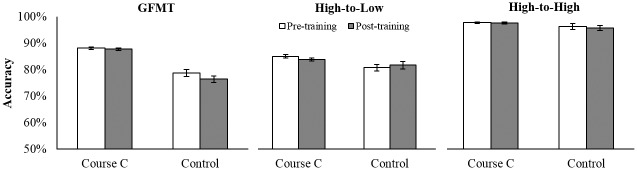
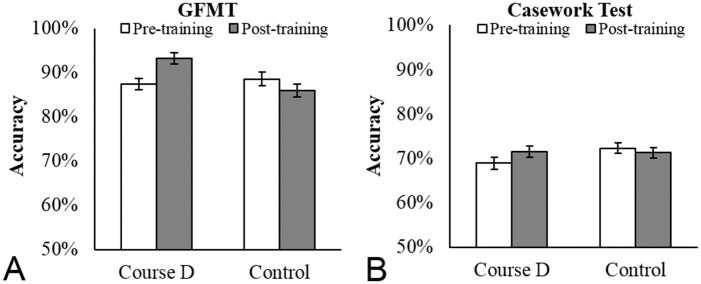
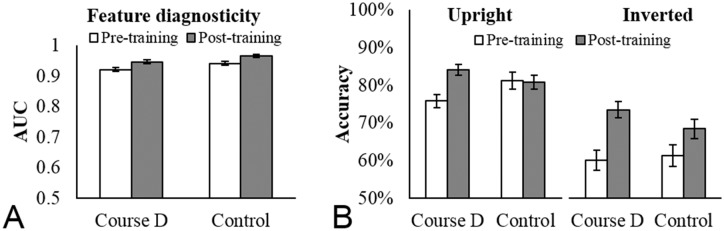
Facial image comparison practitioners compare images of unfamiliar faces and decide whether or not they show the same person. Given the importance of these decisions for national security and criminal investigations, practitioners attend training courses to improve their face identification ability. However, these courses have not been empirically validated so it is unknown if they improve accuracy. Here, we review the content of eleven professional training courses offered to staff at national security, police, intelligence, passport issuance, immigration and border control agencies around the world. All reviewed courses include basic training in facial anatomy and prescribe facial feature (or 'morphological') comparison. Next, we evaluate the effectiveness of four representative courses by comparing face identification accuracy before and after training in novices (n = 152) and practitioners (n = 236). We find very strong evidence that short (1-hour and half-day) professional training courses do not improve identification accuracy, despite 93% of trainees believing their performance had improved. We find some evidence of improvement in a 3-day training course designed to introduce trainees to the unique feature-by-feature comparison strategy used by facial examiners in forensic settings. However, observed improvements are small, inconsistent across tests, and training did not produce the qualitative changes associated with examiners' expertise. Future research should test the benefits of longer examination-focussed training courses and incorporate longitudinal approaches to track improvements caused by mentoring and deliberate practice. In the absence of evidence that training is effective, we advise agencies to explore alternative evidence-based strategies for improving the accuracy of face identification decisions.
Conflict of interest statement
The authors of this manuscript have read the journal’s policy and have the following competing interests: RM was the instructor for the 3-day training course evaluation but was not involved in the data analysis. See author contributions. This does not alter the authors’ adherence to PLOS ONE policies on sharing data and materials.
Figures
References
-
- Prince J. To examine emerging police use of facial recognition systems and facial image comparison procedures—Israel, Netherlands, UK, USA, Canada 2012. https://www.churchilltrust.com.au/media/fellows/2012_Prince_Jason.pdf.
-
- Facial Identification Scientific Working Group. Guidelines and recommendations for facial comparison training to competency (Version 1.1) 2011. https://fiswg.org/FISWG_Training_Guidelines_Recommendations_v1.1_2010_11....
-
- Spaun NA. Facial comparisons by subject matter experts: Their role in biometrics and their training In: Tistarelli M, Nixon MS, editors. Advances in Biometrics. Heidelberg: Springer-Verlag; 2009. p. 161–8.
-
- Woodhead MM, Baddeley AD, Simmonds DCV. On training people to recognize faces. Ergonomics. 1979;22(3):333–43.
-
- Bruce V, Henderson Z, Greenwood K, Hancock PJB, Burton AM, Miller P. Verification of face identities from images captured on video. Journal of Experimental Psychology: Applied. 1999;5(4):339–60.
