


A cluster randomised controlled trial of an intervention to increase the implementation of school physical activity policies and guidelines: study protocol for the physically active children in education (PACE) study
- PMID: 30760243
- PMCID: PMC6375171
- DOI: 10.1186/s12889-019-6492-z
A cluster randomised controlled trial of an intervention to increase the implementation of school physical activity policies and guidelines: study protocol for the physically active children in education (PACE) study
Abstract
Background: In an attempt to improve children's physical activity levels governments have introduced policies specifying the minimum time schools are to schedule physical activity each week. Despite this, the majority of schools in many jurisdictions fail to implement these policies. This study will assess the effectiveness of a multi-component implementation strategy on increasing the minutes of planned physical activity scheduled by primary school teachers each week.
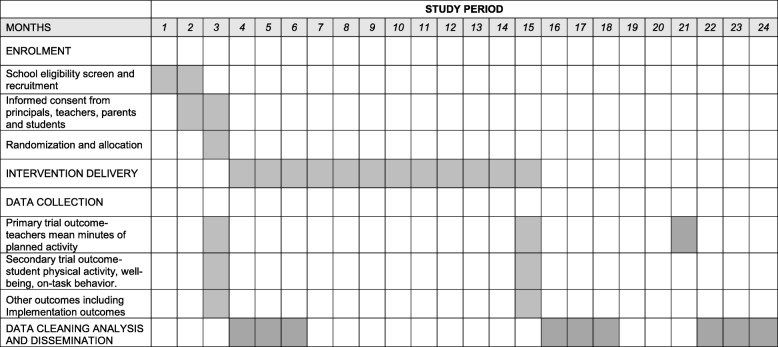
Methods: A cluster randomised controlled trial will be conducted in 62 primary schools in the Hunter New England region of New South Wales, Australia. Schools will be randomly allocated to receive either a multi-component implementation strategy that includes; obtaining executive support, training in-school champions, provision of tools and resources, implementation prompts, reminders and feedback; or usual practice. The study will employ an effectiveness-implementation hybrid design, assessing both policy implementation and individual (student) behavioural outcomes. The primary trial outcome of mean minutes of physical activity scheduled by classroom teachers across the school week will be measured via teacher log-book at baseline and approximately 12 and 18 months post baseline. A nested evaluation of the impact of policy implementation on child physical activity will be undertaken of students in Grades 2 and 3. Analyses will be performed using an intention to treat framework. Linear mixed effects regression models will be used to assess intervention effects on the primary outcome at both follow-up periods.
Discussion: This study will be the one of the first well powered randomised trials internationally to examine the impact of an implementation strategy for a physical activity policy in primary schools and will address a fundamental research translation gap. Given the dearth of research, the findings will be important in informing future implementation efforts in this setting.
Trial registration: ANZCTR ACTRN12617001265369 version 1 registered 1st September 2017.
Keywords: Guidelines; Implementation; Physical activity; Policy; Schools.
Conflict of interest statement
Ethics approval and consent to participate
Ethical approval was obtained from the Hunter New England Human Research Ethics Committee (no. 06/07/26/4.04), The University of Newcastle Human Research Ethics Committee (H-2008-0343). The NSW Department of Education and the Maitland-Newcastle Catholic Schools Offices provided consent to conduct research in their schools. Consent has been provided by all schools, teachers and the parent/guardians of students participating.
Consent for publication
Not applicable.
Competing interests
Authors NN, RS, KG, NM, MP, RJ, VA, JW and LW, receive salary support from Hunter New England Local Health District, which contributes funding to the project outlined in this protocol. Similarly, Author CR and receive salary support from the New South Wales Health Office of Preventive Health which have also contributed funding to this project. None of these agencies were involved in the peer review of this grant. NN is an Associate Editor for BMC Public Health. All other authors declare that they have no competing interests.
Publisher’s Note
Springer Nature remains neutral with regard to jurisdictional claims in published maps and institutional affiliations.
Figures
References
-
- World Health Organization (WHO) Global action plan on physical activity 2018–2030: more active people for a healthier world. Geneva: Licence: CC BY-NC-SA 3.0 IGO; 2018.
-
- Townsend N, Wickramasinghe K, Williams J, Bhatnagar P. M R. Physical activity statistics 2015. In. London: British Heart Foundation; 2015.
Publication types
MeSH terms
Grants and funding
LinkOut - more resources
Full Text Sources
Medical
Miscellaneous
