. 2019 Feb 13;17(1):23.
doi: 10.1186/s12958-019-0466-y.

Activation of Nrf2/Keap1 pathway by oral Dimethylfumarate administration alleviates oxidative stress and age-associated infertility might be delayed in the mouse ovary

Affiliations

Activation of Nrf2/Keap1 pathway by oral Dimethylfumarate administration alleviates oxidative stress and age-associated infertility might be delayed in the mouse ovary

Nana Akino et al. Reprod Biol Endocrinol. .

Abstract

Background: Age-associated infertility is a problem worldwide, and management of oxidative stress is known to be essential. Nuclear factor-E2-related factor 2 (Nrf2)/Kelch-like ECH-associated protein 1 (Keap1)-antioxidant response element (ARE) signaling pathway works as an essential defense mechanism against oxidative stress, and an oral drug Dimethylfumarate (DMF) is known to activate the pathway.

Methods: We tested the hypothesis that oral DMF could alleviate oxidative stress in the ovary, resulting in salvation of age-associated infertility in a mouse model of reproductive age, and we examined the effects of DMF administration. 20 mg/kg DMF was administrated to female mice from 32 to 48 weeks, and Nrf2 levels, antioxidant levels, ovarian reserve, DNA damage, and oxidative stress were examined.

Results: DMF administration resulted in elevated mRNA and protein levels of Nrf2, antioxidants, and telomere, and serum levels of Nrf2 and anti-mullerian hormone were also elevated. Results of TUNEL assay and Immunohistochemistry of mice ovarian tissues showed that DNA damage and oxidative stress were decreased by DMF administration, and significantly more oocytes were collected along with preservation of 60% more primordial follicles.

Conclusions: Our data suggest that DMF administration activates the Nrf2/Keap1 pathway, elevate levels of antioxidants, and decrease DNA damage and oxidative stress, resulting in improved ovarian reserve in the mouse ovary.

Keywords: Dimethylfumarate; Infertility; Nrf2/Keap1; Ovarian reserve; Oxidative stress.


Conflict of interest statement

Ethics approval and consent to participate

Experimental procedures for mice were approved by the animal experiment committee of The University of Tokyo (authorization reference number: P17–009).

Consent for publication

Not applicable.

Competing interests

The authors declare that they have no competing interests.

Publisher’s Note

Springer Nature remains neutral with regard to jurisdictional claims in published maps and institutional affiliations.

Figures
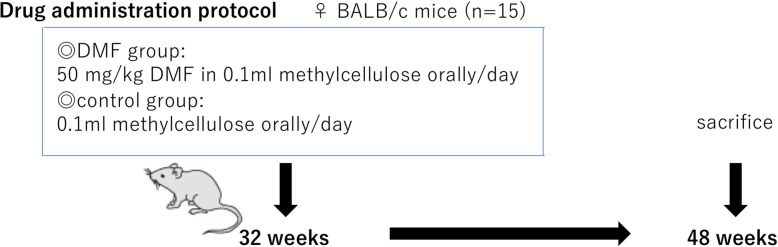
Fig. 1
Fig. 1
Drug administration protocol. DMF group mice received 20 mg/kg DMF dissolved in 0.1 ml methylcellulose orally/day, and control group mice received 0.1 ml methylcellulose orally/day, from 32 to 48 weeks until the day before sacrifice
Fig. 2
Fig. 2
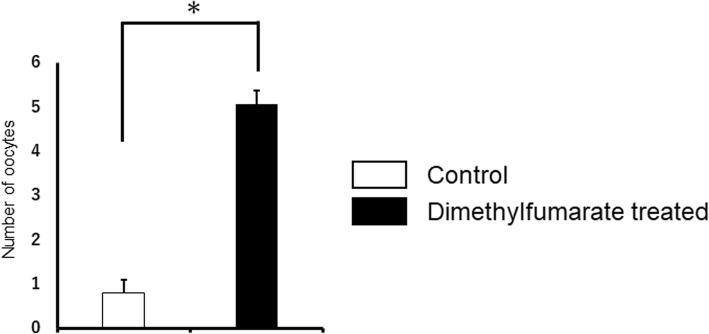
Number of oocytes collected after COS. DMF administration resulted in significant difference in number of oocyte collection (5.1 ± 0.3 oocytes per mouse), compared to the control group (0.8 ± 0.3 oocyte per mouse), indicating the positive effect of DMF on ovarian reserve. p < 0.001. The number of samples was n = 15 each
Fig. 3
Fig. 3
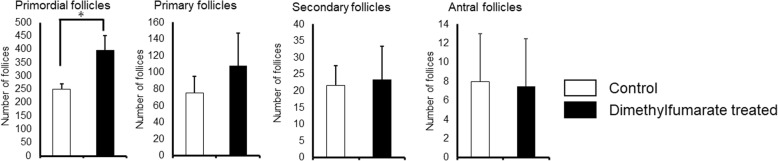
Number of follicles per ovary (H&E-stain). Number of follicles of various stages of development per ovary is shown. The number of follicles showed no significant difference in primary follicles (DMF group: 108.2 ± 38.7 vs control group: 75.2 ± 14.3, p = 0.12), secondary follicles (DMF group: 23.5 ± 10.0 vs control group: 21.6 ± 5.9, p = 0.72), and antral follicles (DMF group: 7.5 ± 3.7 vs control group: 8.0 ± 1.5, p = 0.81), but approximately 60% more primordial follicles (DMF group: 395.0 ± 15.8 vs control group: 251.2 ± 17.3, p = 0.0002) were preserved in DMF group. The number of samples was n = 6 each
Fig. 4
Fig. 4
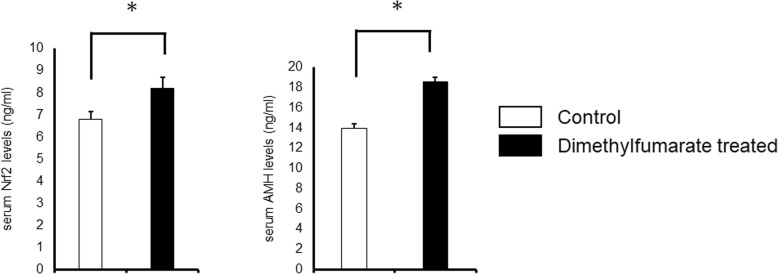
Serum Nrf2 and AMH levels. Serum Nrf2 (control group: 6.79 ± 0.12 ng/ml vs DMF group: 8.21 ± 0.11 ng/ml, p < 0.0001) and AMH (control group: 13.93 ± 0.44 ng/ml vs DMF group: 18.63 ± 0.38 ng/ml, p < 0.0001) levels were significantly higher in DMF group compared to control group. The number of samples was n = 15 each
Fig. 5
Fig. 5
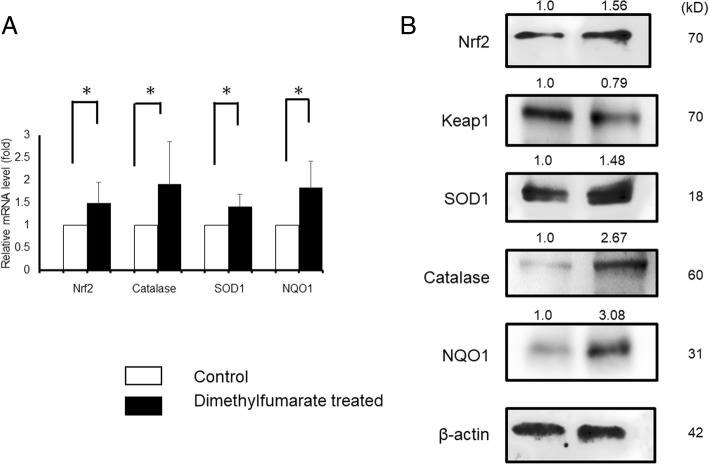
mRNA and protein levels of Nrf2 and antioxidants. Effect of DMF administration on the mRNA levels were investigated by qRT-PCR. The mRNA expression of Nrf2, catalase, SOD1, and NQO1 was normalized to RNA loading for each sample using GAPDH mRNA as an internal standard. DMF administration resulted in significant elevation of mRNA levels of Nrf2 (1.50-fold compared to control group, p < 0.05), catalase (1.91-fold compared to control group, p < 0.05), SOD1 (1.42-fold compared to control group, p < 0.05), and NQO1 (1.84-fold compared to control group, p < 0.05). The results are shown as the mean ± SD (bars) of 3 or 4 independent experiments. Simultaneously, DMF administration increased expression of Nrf2, catalase, SOD1, and NQO1 proteins in WB analysis. The protein levels of Keap1 was conversely decreased by DMF administration
Fig. 6
Fig. 6
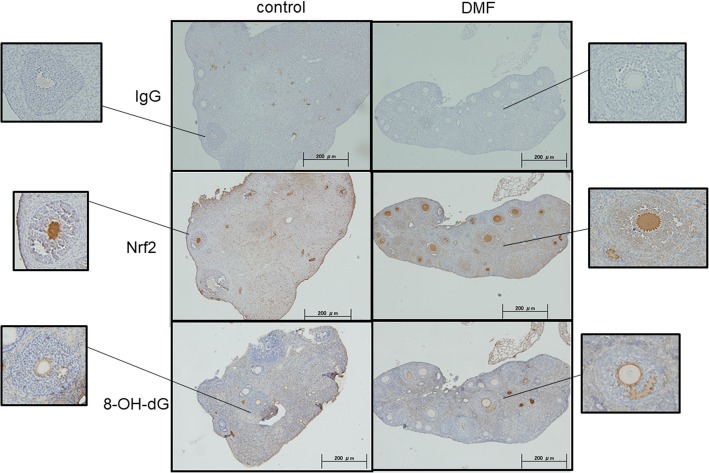
Expression of Nrf2 and 8-OHdG in mouse ovarian tissues. Immunohistochemical detection of Nrf2 and 8-OHdG proteins. Representative data from 6 specimens are shown. DMF administration increased expression in Nrf2, and conversely 8-OHdG expression was decreased
Fig. 7
Fig. 7
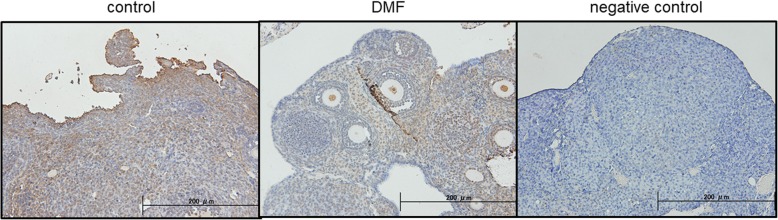
DNA damage in mouse ovarian tissues analyzed by TUNEL assay. Control group showed increased number of DNA damaged TUNEL-positive cells compared to DMF group. Representative data from 6 specimens are shown
Fig. 8
Fig. 8
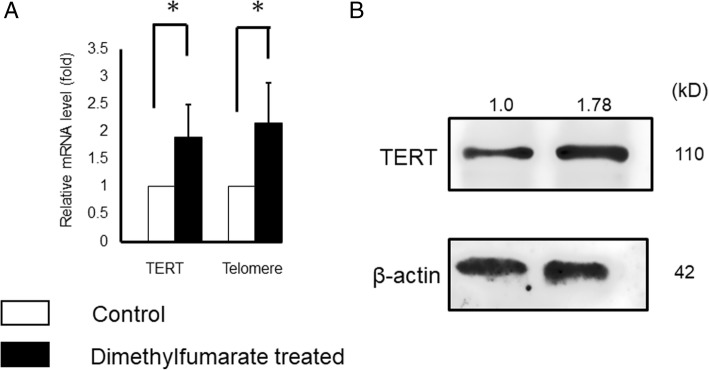
mRNA and protein levels of TERT and Telomere. Effect of DMF administration on the mRNA levels were investigated by qRT-PCR. The mRNA expression of Telomere and TERT was normalized to RNA loading for each sample using GAPDH mRNA as an internal standard. DMF administration resulted in significant elevation of mRNA levels of TERT (1.90-fold compared to control group, p < 0.05) and Telomere (2.15-fold compared to control group, p < 0.05). The results are shown as the mean ± SD (bars) of 3 or 4 independent experiments Simultaneously, DMF administration increased expression of TERT protein levels in WB analysis.

References

    1. Ziebe S, Devroey P. Assisted reproductive technologies are an integrated part of national strategies addressing demographic and reproductive challenges. Hum Reprod Update. 2008;14(6):583–592. doi: 10.1093/humupd/dmn038. - DOI - PubMed
    1. Lean SC, Derricott H, Jones RL, Heazell AEP. Advanced maternal age and adverse pregnancy outcomes: a systematic review and meta-analysis. PLoS One. 2017;12(10):e0186287. doi: 10.1371/journal.pone.0186287. - DOI - PMC - PubMed
    1. Carolan M, Frankowska D. Advanced maternal age and adverse perinatal outcome: a review of the evidence. Midwifery. 2011;27(6):793–801. doi: 10.1016/j.midw.2010.07.006. - DOI - PubMed
    1. Inhorn MC, Patrizio P. Infertility around the globe: new thinking on gender, reproductive technologies and global movements in the 21st century. Hum Reprod Update. 2015;21(4):411–426. doi: 10.1093/humupd/dmv016. - DOI - PubMed
    1. Baird DT, Collins J, Egozcue J, Evers LH, Gianaroli L, Leridon H, et al. Fertility and ageing. Hum Reprod Update. 2005;11(3):261–276. doi: 10.1093/humupd/dmi006. - DOI - PubMed

MeSH terms