Trends in survival after a diagnosis of heart failure in the United Kingdom 2000-2017: population based cohort study
- PMID: 30760447
- PMCID: PMC6372921
- DOI: 10.1136/bmj.l223
Trends in survival after a diagnosis of heart failure in the United Kingdom 2000-2017: population based cohort study
Erratum in
-
Trends in survival after a diagnosis of heart failure in the United Kingdom 2000-2017: population based cohort study.BMJ. 2019 Oct 8;367:l5840. doi: 10.1136/bmj.l5840. BMJ. 2019. PMID: 31594775 Free PMC article. No abstract available.
Abstract
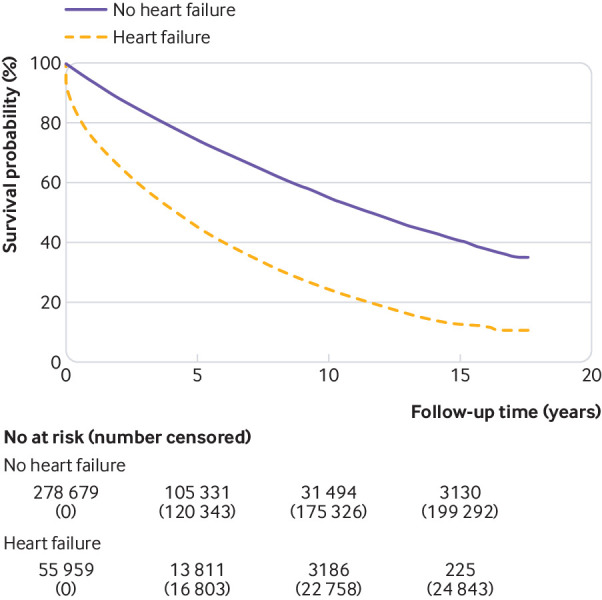
Objectives: To report reliable estimates of short term and long term survival rates for people with a diagnosis of heart failure and to assess trends over time by year of diagnosis, hospital admission, and socioeconomic group.
Design: Population based cohort study.
Setting: Primary care, United Kingdom.
Participants: Primary care data for 55 959 patients aged 45 and overwith a new diagnosis of heart failure and 278 679 age and sex matched controls in the Clinical Practice Research Datalink from 1 January 2000 to 31 December 2017 and linked to inpatient Hospital Episode Statistics and Office for National Statistics mortality data.
Main outcome measures: Survival rates at one, five, and 10 years and cause of death for people with and without heart failure; and temporal trends in survival by year of diagnosis, hospital admission, and socioeconomic group.
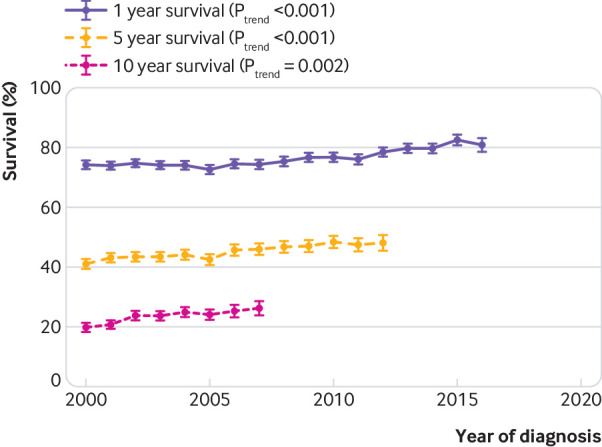
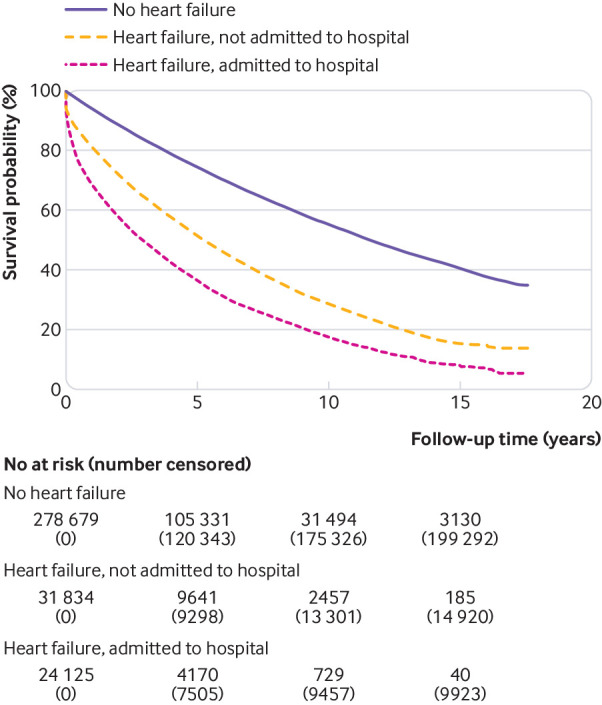
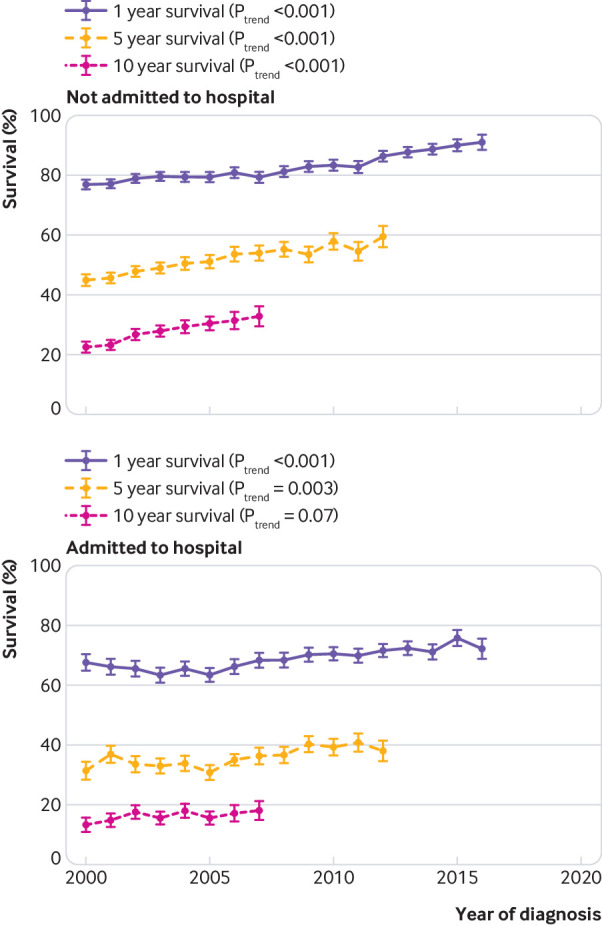
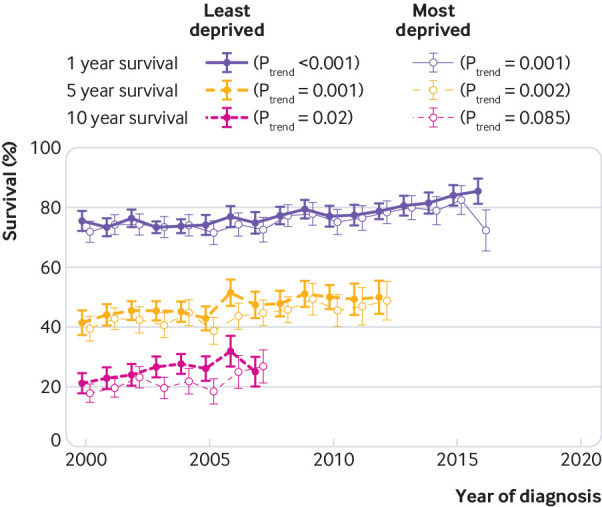
Results: Overall, one, five, and 10 year survival rates increased by 6.6% (from 74.2% in 2000 to 80.8% in 2016), 7.2% (from 41.0% in 2000 to 48.2% in 2012), and 6.4% (from 19.8% in 2000 to 26.2% in 2007), respectively. There were 30 906 deaths in the heart failure group over the study period. Heart failure was listed on the death certificate in 13 093 (42.4%) of these patients, and in 2237 (7.2%) it was the primary cause of death. Improvement in survival was greater for patients not requiring admission to hospital around the time of diagnosis (median difference 2.4 years; 5.3 v 2.9 years, P<0.001). There was a deprivation gap in median survival of 0.5 years between people who were least deprived and those who were most deprived (4.6 v 4.1 years, P<0.001) [corrected].
Conclusions: Survival after a diagnosis of heart failure has shown only modest improvement in the 21st century and lags behind other serious conditions, such as cancer. New strategies to achieve timely diagnosis and treatment initiation in primary care for all socioeconomic groups should be a priority for future research and policy.
Published by the BMJ Publishing Group Limited. For permission to use (where not already granted under a licence) please go to http://group.bmj.com/group/rights-licensing/permissions.
Conflict of interest statement
Competing interests: All authors have completed the ICMJE uniform disclosure form at www.icmje.org/coi_disclosure.pdf and declare: All authors report grants from NIHR CLAHRC Oxford during the conduct of the study; CJT reports speaker fees from Vifor and Novartis and non-financial support from Roche outside the submitted work. JMOM, AKR, and SL-F report grants from the NIHR BRC Oxford. NRJ reports a grant from the Wellcome Trust. TM reports a grant from CLAHRC West Midlands. FDRH reports personal fees and other from Novartis, personal fees and other from Boehringer Ingelheim, and grants from Pfizer outside the submitted work.
Figures
References
MeSH terms
Grants and funding
LinkOut - more resources
Full Text Sources
Medical
Miscellaneous