. 2019 Feb 12;9(2):e023731.
doi: 10.1136/bmjopen-2018-023731.

Multimorbidity, eHealth and implications for equity: a cross-sectional survey of patient perspectives on eHealth

Affiliations

Multimorbidity, eHealth and implications for equity: a cross-sectional survey of patient perspectives on eHealth

Dee Mangin et al. BMJ Open. .

Abstract

Objective: There is increasing awareness of the burden of medical care experienced by those with multimorbidity. There is also increasing interest and activity in engaging patients with chronic disease in technology-based health-related activities ('eHealth') in family practice. Little is known about patients' access to, and interest in eHealth, in particular those with a higher burden of care associated with multimorbidity. We examined access and attitudes towards eHealth among patients attending family medicine clinics with a focus on older adults and those with polypharmacy as a marker for multimorbidity.

Design: Cross-sectional survey of consecutive adult patients attending consultations with family physicians in the McMaster University Sentinel and Information Collaboration practice-based research network. We used univariate and multivariate analyses for quantitative data, and thematic analysis for free text responses.

Setting: Primary care clinics.

Participants: 693 patients participated (response rate 70%).

Inclusion criteria: Attending primary care clinic.

Exclusions: Too ill to complete survey, cannot speak English.

Results: The majority of participants reported access to the internet at home, although this decreased with age. Participants 70 years and older were less comfortable using the internet compared with participants under 70. Univariate analyses showed age, multimorbidity, home internet access, comfort using the internet, privacy concerns and self-rated health all predicted significantly less interest in eHealth. In the multivariate analysis, home internet access and multimorbidity were significant predictors of disinterest in eHealth. Privacy and loss of relational connection were themes in the qualitative analysis.

Conclusion: There is a significant negative association between multimorbidity and interest in eHealth. This is independent of age, computer use and comfort with using the internet. These findings have important implications, particularly the potential to further increase health inequity.

Keywords: ehealth; multimorbidity; primary care.


Conflict of interest statement

Competing interests: None declared.

Figures
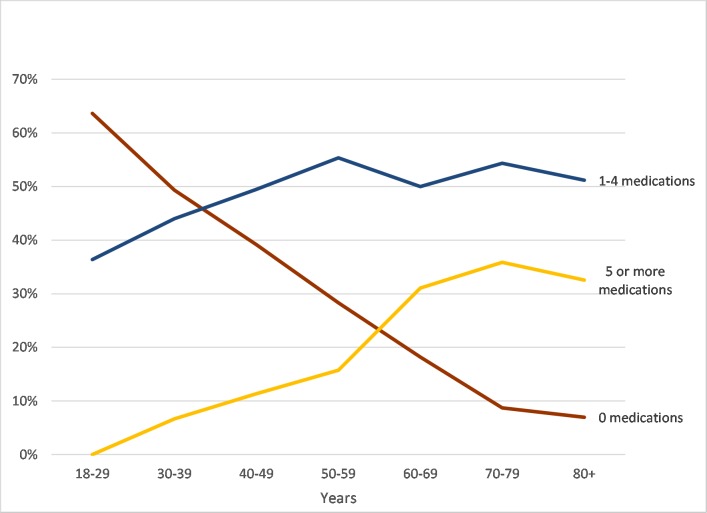
Figure 1
Figure 1
Relationship between age and medication number. Data are shown from 2014 to 2015. The graph indicates the relationship between a participant’s age and number of medications taken. The x-axis indicates age and the y-axis indicates the proportion of the study population. The red line indicates participants taking 0 medications, the blue line indicates participants taking 1–4 medications and the yellow line indicates participants taking five or more medications.
Figure 2
Figure 2
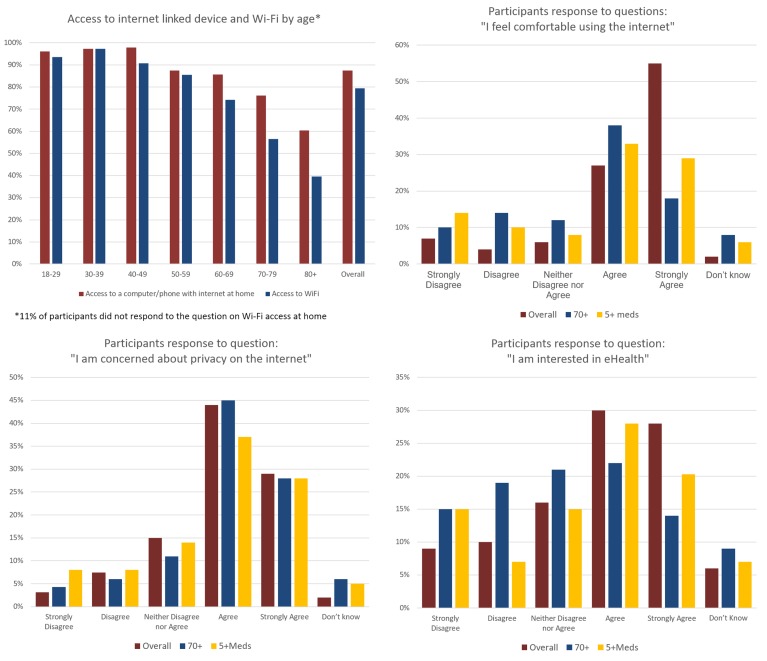
Survey analysis results. Data are shown from 2014 to 2015. The graph on the top left represents the association between access to internet-linked device at home, such as a phone or computer, and Wi-Fi according to age band. The x-axis indicates age band and the y-axis indicates proportion of the defined age band expressed as a percentage. The red bar indicates access to a computer/phone with internet at home and the blue bar indicates access to Wi-Fi. The graph on the top right represents the association between comfort using the internet, and the two study subpopulations of interest: those aged 70 years and over, and those taking five or more medications. The x-axis represents the response categories for the statement, ‘I feel comfortable using the internet’. The y-axis indicates proportion, expressed as a percentage of the relevant study (sub) group. The red bar represents the overall study population. The blue bar represents those aged 70 and over. The yellow bar represents those taking five or more medications. The graph on the bottom left represents the association between participants concern about privacy on the internet and the two subpopulations of interest: those aged 70 years and over, and those taking five or more medications. The x-axis represents the response categories for the statement, ‘I am concerned about privacy on the internet.’ The y-axis indicates proportion, expressed as a percentage of the relevant study (sub) group. The red bar represents the overall study population. The blue bar represents those aged 70 and over. The yellow bar represents those taking five or more medications. The graph on the bottom right represents the association between participant’s interest in eHealth overall and in the two subpopulations of interest. The x-axis represents the response categories for the statement, ‘I am interested in eHealth.’ The y-axis indicates proportion, expressed as a percentage of the relevant study (sub) group. The red bar represents the overall study population. The bar represents those aged 70 and over. The yellow bar represents those taking five or more medications.

References

    1. World Health Organization. eHealth report by the secretariat. Fifty-eighth world health assembly. Geneva: World Health Organization.
    1. Archer N, Fevrier-Thomas U, Lokker C, et al. Personal health records: a scoping review. J Am Med Inform Assoc 2011;18:515–22. 10.1136/amiajnl-2011-000105 - DOI - PMC - PubMed
    1. Starfield B, Gérvas J, Mangin D. Clinical care and health disparities. Annu Rev Public Health 2012;33:89–106. 10.1146/annurev-publhealth-031811-124528 - DOI - PubMed
    1. May C, Montori VM, Mair FS. We need minimally disruptive medicine. BMJ 2009;339:b2803 10.1136/bmj.b2803 - DOI - PubMed
    1. Tudor Hart J. The inverse care law. The Lancet 1971;297:405–12. 10.1016/S0140-6736(71)92410-X - DOI - PubMed

MeSH terms