. 2019 Feb 13;9(1):1948.
doi: 10.1038/s41598-019-38521-x.

Exploring cold quarantine to mango fruit against fruit fly using artificial ripening

Affiliations

Exploring cold quarantine to mango fruit against fruit fly using artificial ripening

Abhinandan S Patil et al. Sci Rep. .

Abstract

Mango quarantine is based mainly on heat treatment, with a possible deterioration of fruit quality. We studied the effects of cold quarantine (19 days storage at 2 °C) on fruit quality of commercial mango cvs. Keitt and Shelly for three consecutive years. Chilling injury (CI) occurs in mango fruit stored at temperatures lower than 12 °C. By reanalysing our previous transcriptome, we found that under sub-optimal temperature storage (5 °C), the fruit increases its ethylene biosynthesis and osmolarity by activating sugar metabolism, thereby probably reducing its freezing point. Similarly, ripe fruit with higher sugar concentration should be more resistant to cold-storage stress. Here, mango fruit was artificially ripened with 150 ppm ethylene. The control group, stored at 2 °C, suffered from severe CI, whereas the combined treatment of artificial ripening, modified atmosphere (fruit were enclosed in perforated bags) and subsequent low-temperature conditioning resulted in a significant reduction in CI to satisfactory levels for consumer acceptance (taste, aroma and texture). The combined treatment reduced lipid peroxidation and maintained flavour, leading to a novel cold-quarantine treatment for mango fruit. Thus, by reversing the supply chain and storing ripe and ready-to-eat fruit, cold quarantine was enabled for mango, and possibly other chilling-susceptible fruits.


Conflict of interest statement

The authors declare no competing interests.

Figures
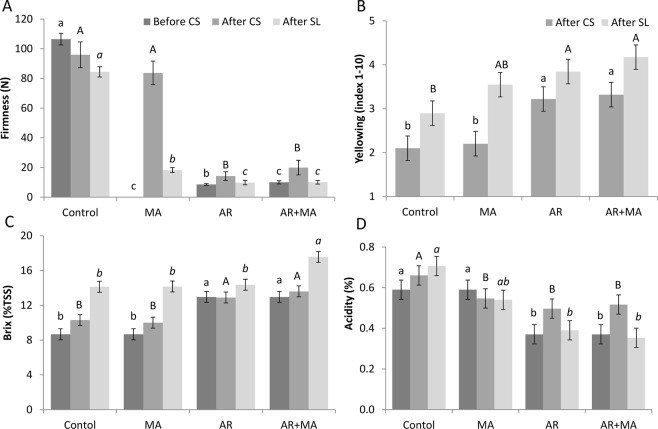
Figure 1
Figure 1
Ripening parameters for ‘Keitt’ mango fruit (2017). Treated (modified atmosphere [MA], artificial ripening [AR] at 150 ppm for 24 hours and the combination of AR + MA) or untreated control mango fruit before cold storage (CS), after CS at 2 °C for 19 days and after a further 4 days of shelf-life at 20 °C (SL) storage were measured for ripening parameters. (A) Firmness presented in Newton (N). (B) Yellowing (index 1–10). (C) Brix (%TSS). (D) Acid (% acetic acid). Presented are average values ± SE. Different letters indicating a significant difference at P < 0.05.
Figure 2
Figure 2
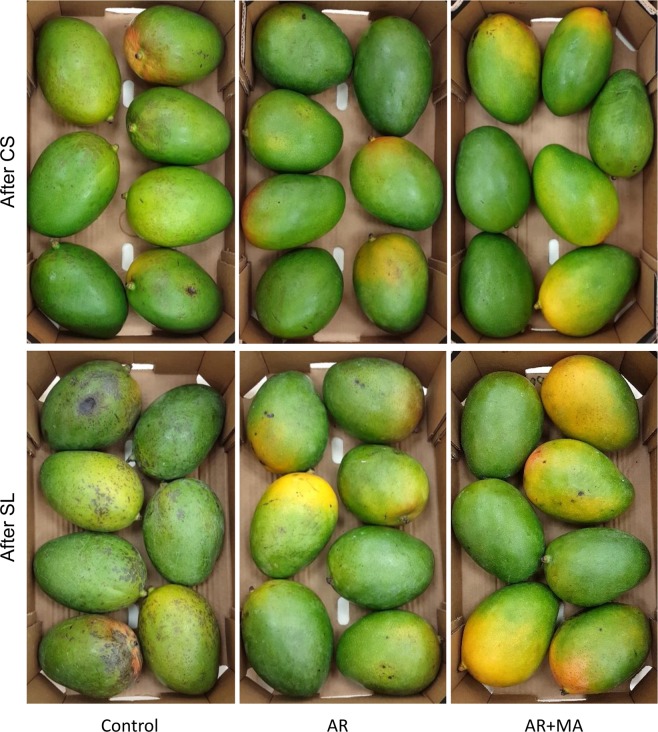
Representative pictures of boxes of cv. ‘Keitt’ mango fruit after cold storage (CS) (upper panel) and after an additional 4 days of shelf life (SL) (lower panel) of untreated controls, fruit treated with artificial ripening (AR) at 150 ppm for 24 hours and those treated with a combination of artificial ripening and modified atmosphere (AR + MA).
Figure 3
Figure 3
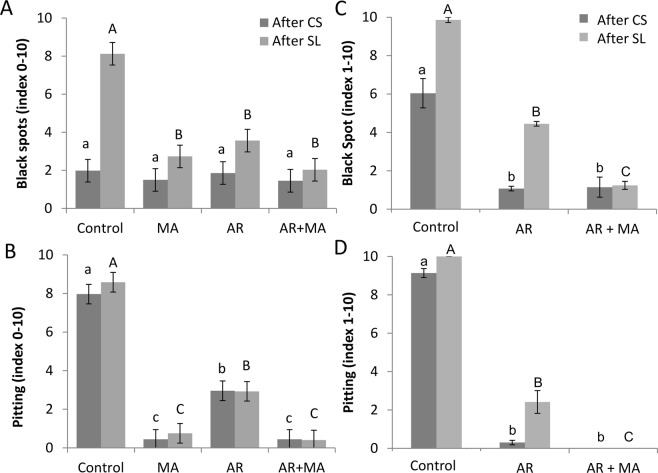
Chilling injury (CI) parameters after cold quarantine of cvs. ‘Keitt’ (2017) and ‘Shelly’ (2016) mango fruit. Treated or untreated mango fruit after cold storage (CS) at 2 °C for 19 days and a further 4 days of shelf-life at 20 °C (SL) storage were measured for CI severity in control, modified atmosphere (MA), artificial ripening (AR) at 150 ppm for 24 hours and AR + MA groups. (A) Black spots (index 0–10) and (B) Pitting (index 0–10) of ‘Keitt’ (2017) mango fruit. (C) Black spots (index 0–10) and (D) Pitting (index 0–10) of ‘Shelly’ (2016) mango fruit. Presented are average and SE. Different letters indicate a significant variance of P < 0.05.
Figure 4
Figure 4
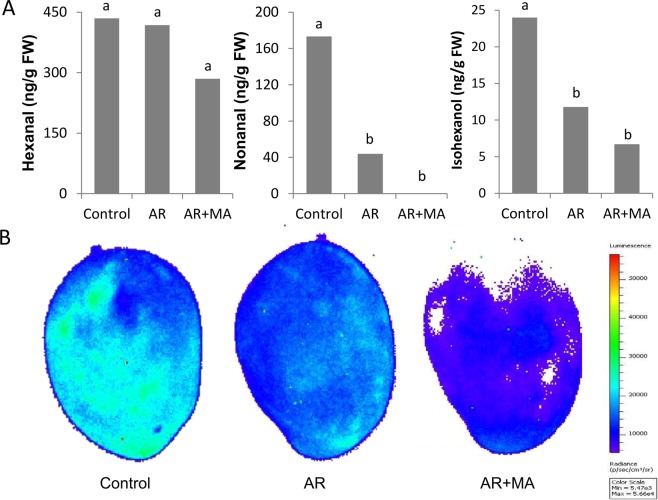
Lipid peroxidation, luminescence and volatiles after cold quarantine of cv. ‘Keitt’ mango fruit and before shelf life. (A) Production of volatiles hexanal, nonanal and isohexanol after cold quarantine in treated and untreated mango peel. (B) Luminescence over 650 nm for control fruit stored at 2 °C for 4 days (left picture) or fruit stored at 2 °C for 19 days after artificial ripening (AR) at 150 ppm for 24 hours (middle picture) and modified atmosphere combined with AR (right panel). Presented are average values ± SE. Different letters indicate a significant difference at P < 0.05.
Figure 5
Figure 5
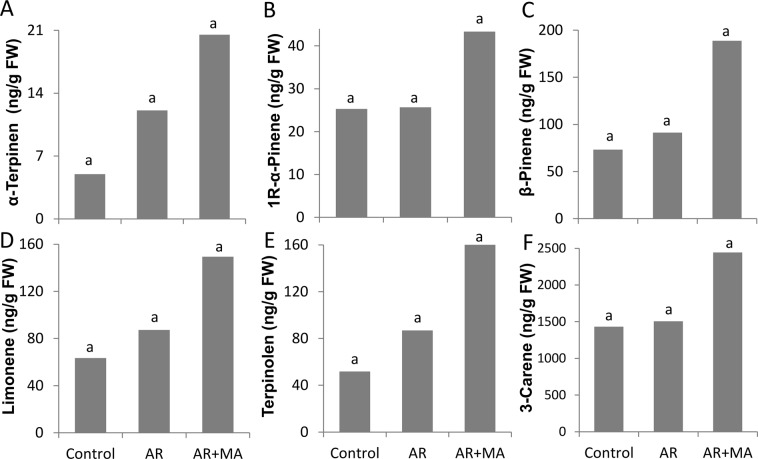
Aroma volatile compounds released after cold quarantine and before shelf life from ‘Keitt’ mango fruits peel. (A) α-Terpinen. (B) 1R-α-Pinene. (C) β-Pinene. (D) Limonene. (E) Terpinolen. (F) 3-Carene. Presented are average values ± SE. Different letters indicating a significant difference at P < 0.05.
Figure 6
Figure 6
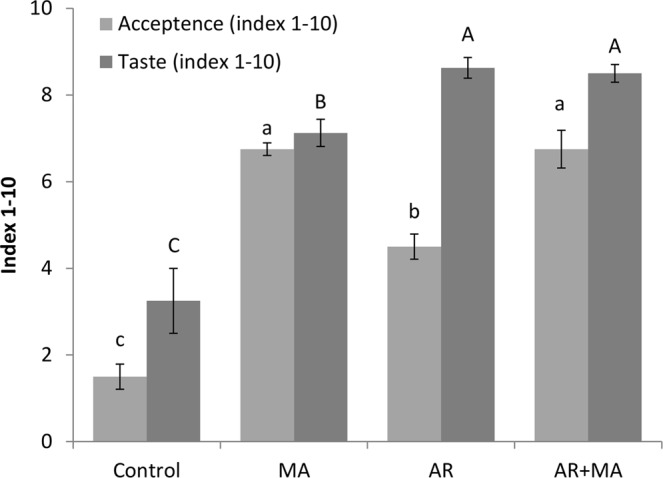
Organoleptic characteristics of cv. ‘Keitt’ mango fruit (acceptance and taste) after cold quarantine and 4 days of shelf life, presented by index 1–10. Presented are average values ± SE. Different letters indicating a significant difference at P < 0.05. MA, modified atmosphere; AR, artificial ripening.
Figure 7
Figure 7
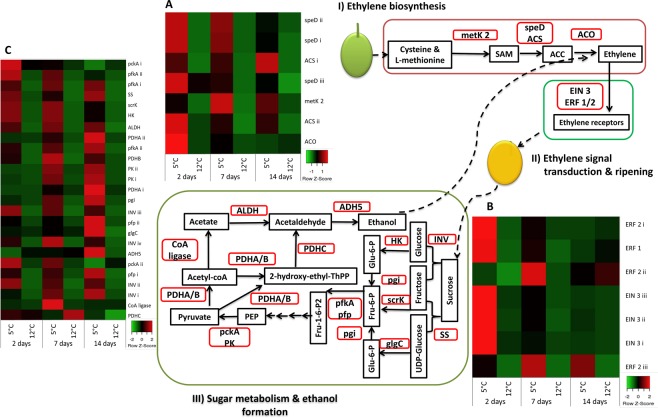
‘Keitt’ mango fruit transcriptomic response to sub-optimal storage associated with ethylene and sugar metabolism. Mango fruit chilling triggers ethylene biosynthesis and signal transduction, which leads to fruit ripening, sugar metabolism and ethanol formation. Transcripts in red rectangles were significantly up-regulated during storage at 5 °C compared to 12 °C. Heat maps for relative expression represent: (A) ethylene biosynthesis, (B) ethylene signal transduction and ripening and (C) sugar metabolism and ethanol formation. Transcript abbreviations and expression values are presented in Supplementary Info S2. Note: Transcriptomic responses studied at 5 °C compared to 12 °C, and not at 2 °C compared to 12 °C as done for cold-quarantine.

References

    1. Alkan, N. & Kumar, P. In Achieving Sustainable Cultivation of Mango (ed V. Galán Saúco, Lu, P) 377–402 (Cambridge, 2018).
    1. EPPO. EPPO (European and Mediterranean Plant Protection Organization), 2007. Data sheets on quarantine pests. Ceratitis capitata, 2007).
    1. Follett PA, Neven LG. Current trends in quarantine entomology. Annual review of entomology. 2006;51:359–385. doi: 10.1146/annurev.ento.49.061802.123314. - DOI - PubMed
    1. Follett PA. Irradiation to control insects in fruits and vegetables for export from Hawaii. Radiat Phys Chem. 2004;71:163–166. doi: 10.1016/j.radphyschem.2004.03.074. - DOI
    1. Schneider SM, et al. United States department of agriculture - Agricultural research service research on alternatives to methyl bromide: pre-plant and post-harvest. Pest Manag Sci. 2003;59:814–826. doi: 10.1002/Ps.728. - DOI - PubMed

Substances