. 2017;25(7-8):691-702.
doi: 10.1080/13506285.2017.1322652. Epub 2017 Jun 12.

Keeping Track of Where We Are: Spatial Working Memory in Navigation

Affiliations

Keeping Track of Where We Are: Spatial Working Memory in Navigation

Kara J Blacker et al. Vis cogn. 2017.

Abstract

Spatial working memory (WM) seems to include two types of spatial information, locations and relations. However, this distinction has been based on small-scale tasks. Here, we used a virtual navigation paradigm to examine whether WM for locations and relations applies to the large-scale spatial world. We found that navigators who successfully learned two routes and also integrated them were superior at maintaining multiple locations and multiple relations in WM. However, over the entire spectrum of navigators, WM for spatial relations, but not locations, was specifically predictive of route integration performance. These results lend further support to the distinction between these two forms of spatial WM and point to their critical role in individual differences in navigation proficiency.

Keywords: navigation; relations; spatial; virtual environment; working memory.


Figures
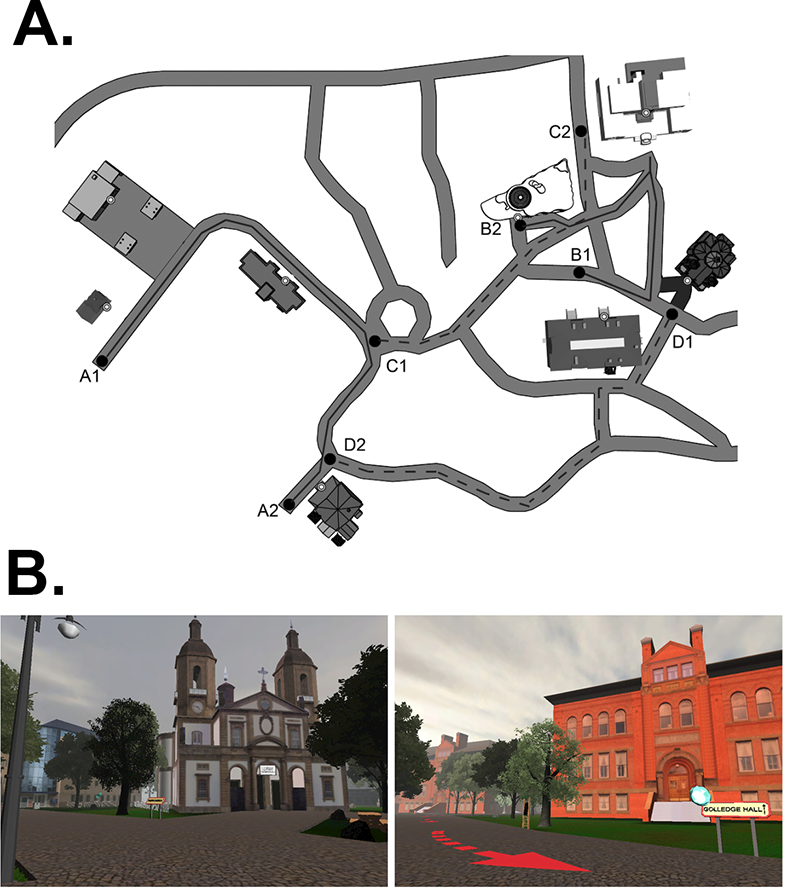
Figure 1.
Figure 1.
A) An aerial view map depicts the layout of buildings, main routes, and connecting routes for the virtual environment. Note that the spatial arrangement of buildings was identical to a real world environment (used in Schinazi et al, 2013). The letter-number combinations indicate starting and ending points along each of the routes learned. All participants began each route at 1, travelled the entire route to 2, and walked back to 1. Participants always learned the main routes (solid lines) first, but route A and route B were counter-balanced between participants. Then participants learned both connecting routes (dashed lines), and route C and route D were similarly counter-balanced. B) First-person point of view of the virtual environment.
Figure 2.
Figure 2.
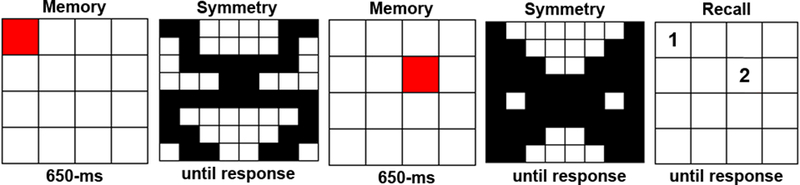
Example Symmetry Span trial. Participants are asked to remember the order and location of red squares while performing an interleaved symmetry judgment task where they were asked to decide if the image was symmetrical along its vertical axis.
Figure 3.
Figure 3.
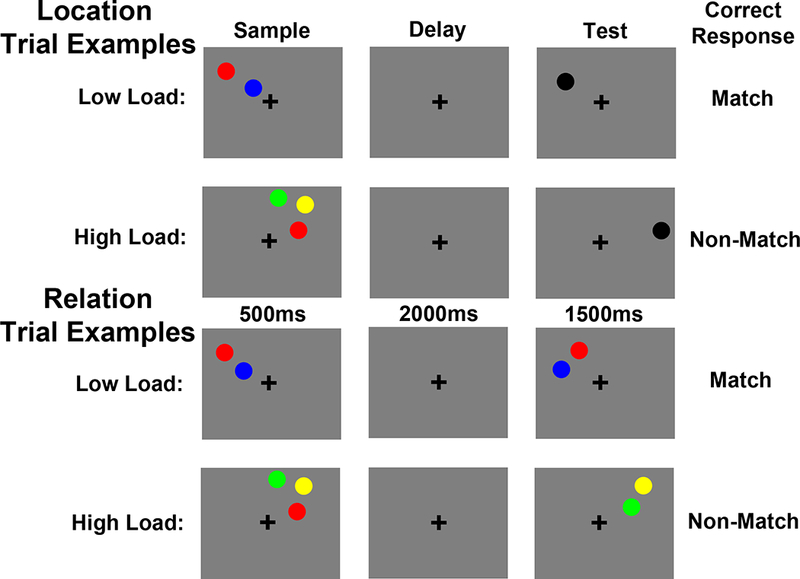
Trial examples for the Spatial Relations and Locations WM task. Under low load, Location trials required participants to imagine a line between two sample circles, hold the location of that line in memory across a delay and then decide if a test circle fell in that location or not. Under high load, Location trials required participants to maintain the locations of three circles in memory and then decide if a test circle fell in one of those locations or in a completely new location. Under low load, Relation trials required participants to maintain the vertical relationship (above/below) of two sample circles and then decide if two test circles were in the same relationship. Under high load, Relation trials required participants to maintain the three vertical relationships between three sample circles and then decide if one of those pairs were presented in the same relationship at test. See the online article for the color version of this figure.
Figure 4.
Figure 4.
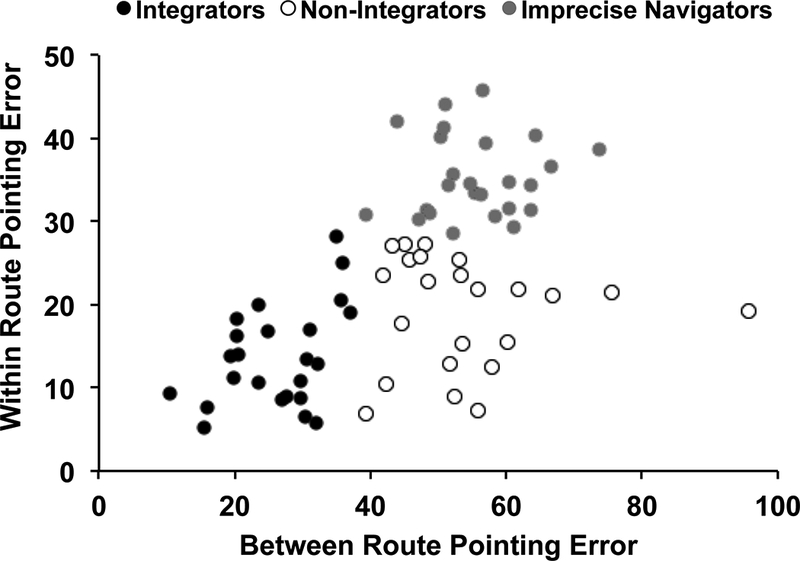
Scatterplot for Between- and Within-route pointing error, which yields three distinct groups of navigators based on the group boundaries used by Weisberg and Newcombe (2016).
Figure 5.
Figure 5.
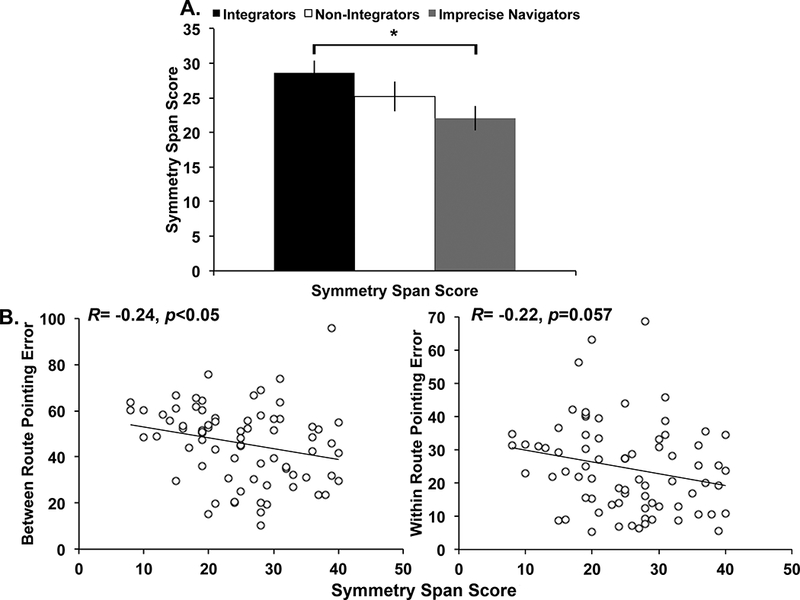
(A) Symmetry Span Scores by navigator group. The main effect of group was significant, p<0.05. (B) Scatterplots showing the relationship between Symmetry Span Score and Between (left) and Within (right) route pointing error. *p<0.05. Error bars represent standard error of the mean.
Figure 6.
Figure 6.
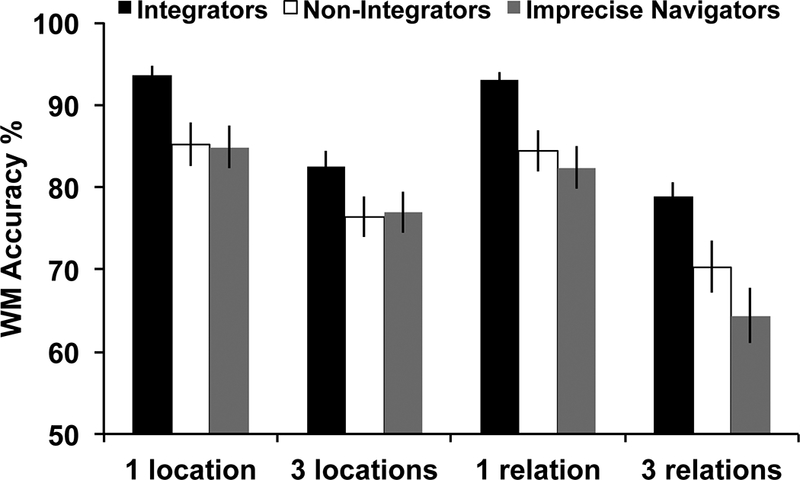
WM task accuracy for each trial type and load by navigator group. Post-hoc contrasts showed that Integrators had significantly higher accuracy than the Non-Integrators and Imprecise Navigators. Error bars represent standard error of the mean.
Figure 7.
Figure 7.
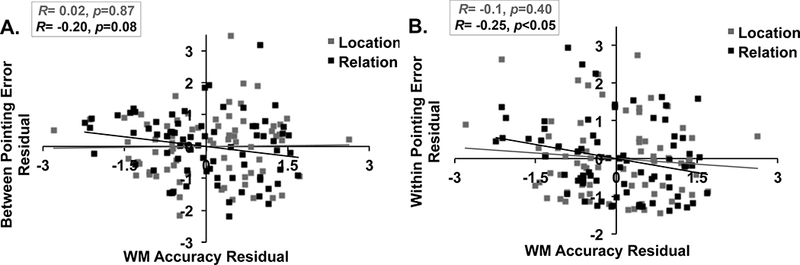
Scatterplots showing partial correlation results between spatial Relation and Location WM task and Virtual Silcton Pointing Task. (A) Relation WM (controlling for Location WM) was marginally correlated with Between-route pointing, but Location WM (controlling for Relation WM) was not. (B) Relation WM (controlling for Location WM) was significantly correlated with Within-route pointing, but Location WM (controlling for Relation WM) was not.

References

    1. Ackerman CM, & Courtney SM (2012). Spatial relations and spatial locations are dissociated within prefrontal and parietal cortex. Journal of Neurophysiology, 108(9), 2419–2429. doi: 10.1152/jn.01024.2011 - DOI - PMC - PubMed
    1. Baddeley AD, & Hitch GJ (1974). Working Memory. New York: Academic Press.
    1. Blacker KJ, & Courtney SM (2016). Distinct neural substrates for maintaining spatial locations and relations in working memory. Frontiers in Human Neuroscience, 10, 594. doi: 10.3389/fnhum.2016.00594 - DOI - PMC - PubMed
    1. Blacker KJ, & Curby KM (2013). Enhanced visual short-term memory in action video game players. Attention Perception & Psychophysics, 75(6), 1128–1136. doi: 10.3758/s13414-013-0487-0 - DOI - PubMed
    1. Blacker KJ, Curby KM, Klobusicky E, & Chein JM (2014). The effects of action video game training on visual working memory. Journal of Experimental Psychology: Human Perception and Performance, 40(5), 1992–2004. doi: 10.1037/a0037556 - DOI - PubMed

LinkOut - more resources