


Is Breast-Conserving Therapy Appropriate for Male Breast Cancer Patients? A National Cancer Database Analysis
- PMID: 30761438
- PMCID: PMC6545266
- DOI: 10.1245/s10434-019-07159-4
Is Breast-Conserving Therapy Appropriate for Male Breast Cancer Patients? A National Cancer Database Analysis
Abstract
Background: Current treatment guidelines for male breast cancer are predominantly guided by female-only clinical trials. With scarce research, it is unclear whether breast-conserving therapy (BCT) is equivalent to mastectomy in men. We sought to compare overall survival (OS) among male breast cancer patients who underwent BCT versus mastectomy.
Methods: We performed a retrospective analysis of 8445 stage I-II (T1-2 N0-1 M0) male breast cancer patients from the National Cancer Database (2004-2014). Patients were grouped according to surgical and radiation therapy (RT). BCT was defined as partial mastectomy followed by RT. Multivariable and inverse probability of treatment-weighted (IPTW) Cox proportional hazards models were used to compare OS between treatment groups, controlling for demographic and clinicopathologic characteristics.
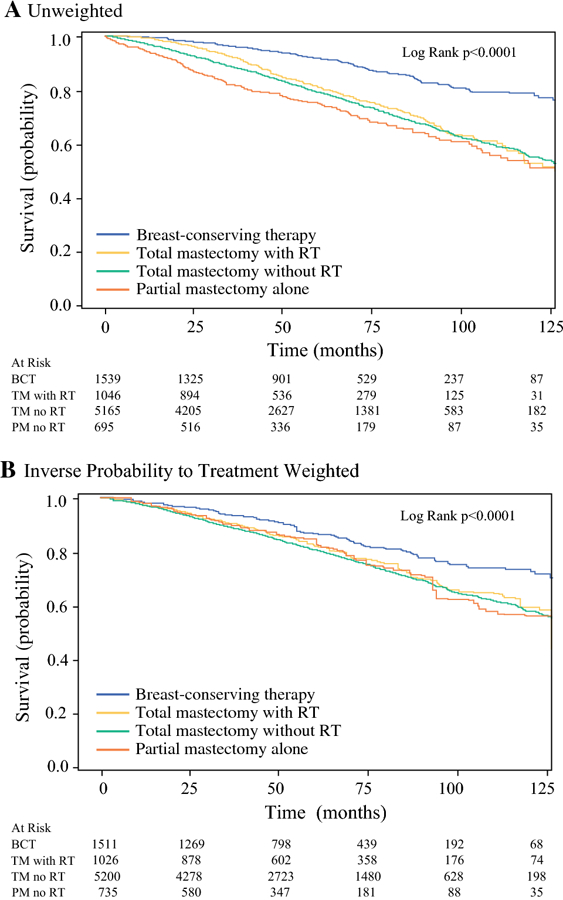
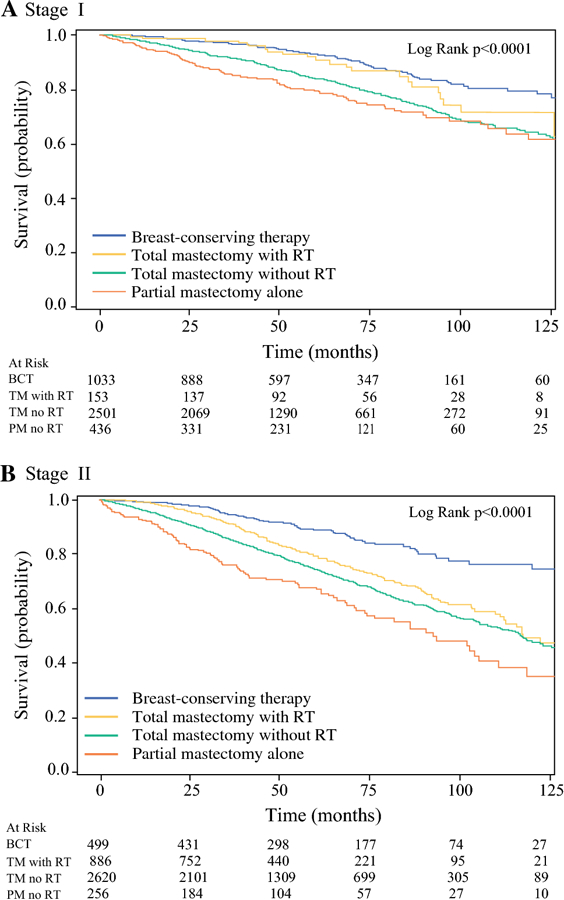
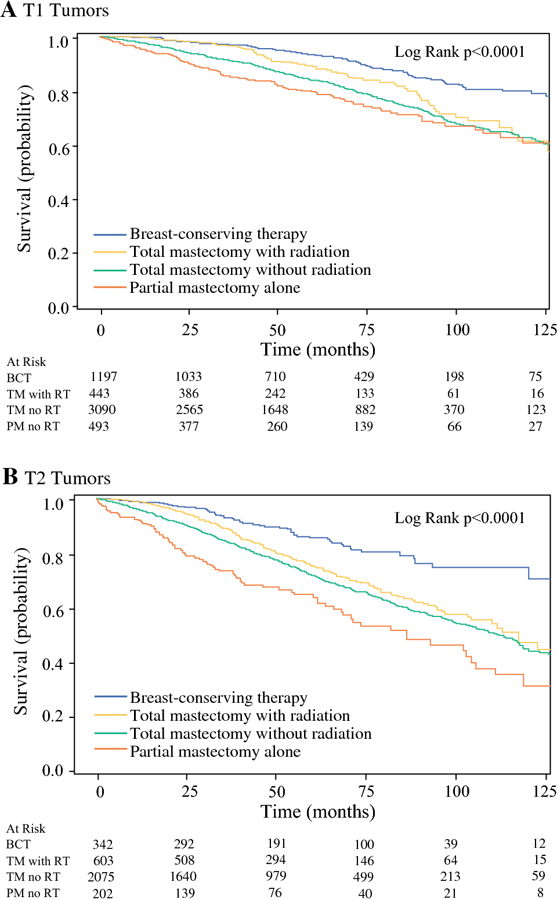
Results: Most patients underwent total mastectomy (61.2%), whereas 18.2% underwent BCT, 12.4% underwent total mastectomy with RT, and 8.2% underwent partial mastectomy alone. In multivariable and IPTW models, partial mastectomy alone, total mastectomy alone, and total mastectomy with RT were associated with worse OS compared with BCT (p < 0.001 all). Ten-year OS was 73.8% for BCT and 56.3, 58.0 and 56.3% for other treatment approaches. Older age, higher T/N stage, histological grade, and triple-negative receptor status were associated with poorer OS (p < 0.05). Subgroup analysis by stage demonstrated similar results.
Conclusions: In this national sample of male breast cancer patients, BCT was associated with greater survival. The underlying mechanisms of this association warrant further study, because more routine adoption of BCT in male breast cancer appears to translate into clinically meaningful improvements in survival.
Conflict of interest statement
Figures
References
-
- Siegel RL, Miller KD, Jemal A. Cancer Statistics, 2017. CA Cancer J Clin January 2017;67(1):7–30. - PubMed
-
- Gradishar WJ, Anderson BO, Balassanian R, et al. National Comprehensive Cancer Network. NCCN Clinical Practice Guidelines in Oncology: Breast Cancer Version 22017. https://www.nccn.org/professionals/physiciangls/pdf/breast.pdf.
-
- Fisher B, Anderson S, Bryant J, et al. Twenty-year follow-up of a randomized trial comparing total mastectomy, lumpectomy, and lumpectomy plus irradiation for the treatment of invasive breast cancer. N Engl J Med October 17 2002;347(16):1233–1241. - PubMed
-
- Aggarwal A, Liu ML, Krasnow SH. Breast cancer in male veteran population: an analysis from VA cancer registry. J Community Support Oncol August 2014;12(8):293–297. - PubMed
-
- O’Malley CD, Prehn AW, Shema SJ, Glaser SL. Racial/ethnic differences in survival rates in a population-based series of men with breast carcinoma. Cancer June 1 2002;94(11):2836–2843. - PubMed
