. 2020 Feb;23(1):71-79.
doi: 10.1007/s00737-019-0951-5. Epub 2019 Feb 14.

Dispensing patterns of selective serotonin reuptake inhibitors before, during and after pregnancy: a 16-year population-based cohort study from the Netherlands

Affiliations

Dispensing patterns of selective serotonin reuptake inhibitors before, during and after pregnancy: a 16-year population-based cohort study from the Netherlands

Nina Maren Molenaar et al. Arch Womens Ment Health. 2020 Feb.

Abstract

Management of mental illness in the perinatal period with antidepressants is controversial, since evidence emerged on potential harmful effects to the unborn child. However, over time, the dispensing of antidepressants in the perinatal period has increased. We examined perinatal dispensing patterns over time and the role of a recently issued guideline in this regard. We identified a 16-year cohort of 153,952 Dutch pregnancies with a delivery date between January 1999 and December 2014. Data included exposure to selective serotonin reuptake inhibitors (SSRIs) related to phases of pregnancy (preconception, pregnancy and delivery, post-delivery). The chi-square test for trends was used. With standard logistic regression, we explored the influence of patient characteristics on continuation of SSRIs during pregnancy. A persistent significant rise of dispensing rates in all phases was observed, with the largest increase during pregnancy (from 0.8% in 1999/2000 to 2.1% in 2013/2014, chi-square for trend = 141.735, p < 0.001). A substantial change of practice in terms of the SSRI used (less paroxetine) and the policy towards continuation into pregnancy (more continuation over time) was visible. Concomitant use of psycholeptics halved the probability of continuation of SSRIs (OR 0.50, 95%CI 0.43-0.55, p < 0.01). Dispensing rates of SSRIs steadily increased last 16 years, especially during pregnancy, caused by an increase in the proportion of women continuing their medication during pregnancy. In view of the demonstrated impact of uncertainty regarding effectiveness and safety of SSRIs in pregnancy, future research should involve more detailed outcome research of SSRIs as it is, and research into viable alternatives.

Keywords: Antidepressants; Dispensing; Pharmacoepidemiology; Pregnancy; Serotonin.


Conflict of interest statement

The authors declare that they have no conflict of interest.

Figures
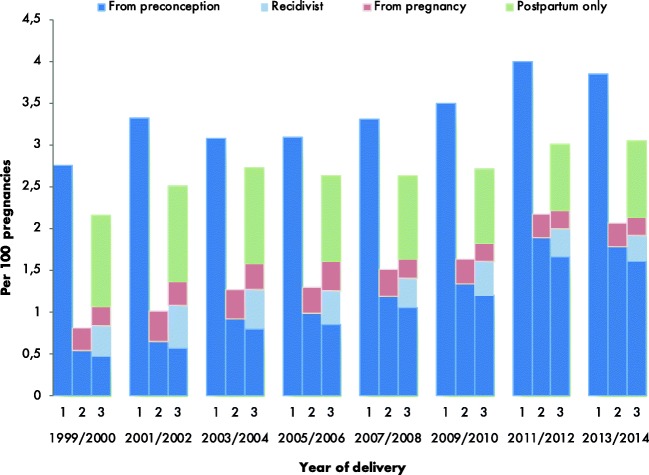
Fig. 1
Fig. 1
Selective serotonin reuptake inhibitors (SSRIs) perinatal dispensing rate per time period of interest per 100 pregnancies in the Netherlands, 1999–2014. 1 = the year before pregnancy, 2 = during pregnancy, 3 = the year after pregnancy. Complete data on all three phases was available for all women and thus the number of women at risk for each bar (1, 2 and 3) per 2 years is comparable. For example, a woman with a delivery date in 1999, who took SSRIs during all three phases (before, during, after) is represented in blue in all three bars (1, 2, 3) of the 1999 column. The dark blue bars represent the women that used their SSRI since the year before pregnancy. The pink and green bars represent the women that did not use SSRIs in the year before pregnancy but started using them during or after pregnancy respectively. The light blue bar represents those women that used SSRIs before pregnancy, discontinued during pregnancy, but restarted in the year after pregnancy
Fig. 2
Fig. 2
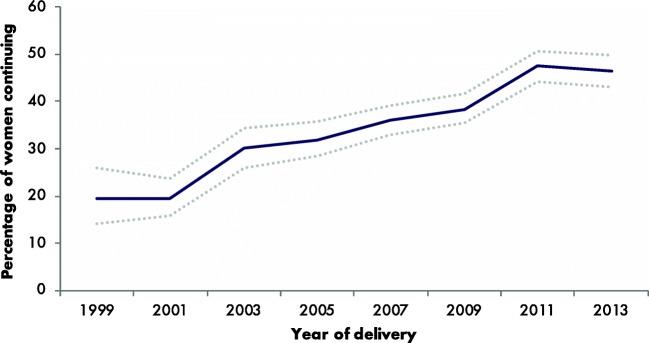
Percentage of women with selective serotonin reuptake inhibitor (SSRI) dispensing in the year before pregnancy continuing during pregnancy in the Netherlands, 1999–2014. Dotted lines represent the 95% confidence intervals
Fig. 3
Fig. 3
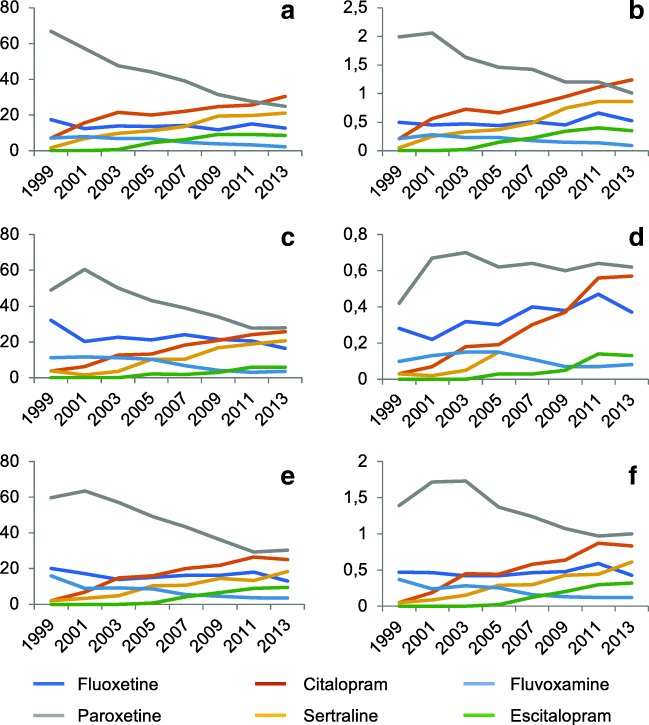
Relative and absolute dispensing rates per specific selective serotonin reuptake inhibitor (SSRI) before, during and after pregnancy in the Netherlands, 1999–2015. a Relative SSRI dispensing in the year before pregnancy. b Absolute SSRI dispensing in the year before pregnancy. c Relative SSRI dispensing during pregnancy. d Absolute SSRI dispensing during pregnancy. e Relative SSRI dispensing in the year after pregnancy. f Absolute SSRI dispensing in the year after pregnancy. Each year represents two calendar years

References

    1. Alwan S, Reefhuis J, Rasmussen SA, Olney RS, Friedman JM, National Birth Defects Prevention S Use of selective serotonin-reuptake inhibitors in pregnancy and the risk of birth defects. N Engl J Med. 2007;356:2684–2692. doi: 10.1056/NEJMoa066584. - DOI - PubMed
    1. Andersen JT, Andersen NL, Horwitz H, Poulsen HE, Jimenez-Solem E. Exposure to selective serotonin reuptake inhibitors in early pregnancy and the risk of miscarriage. Obstet Gynecol. 2014;124:655–661. doi: 10.1097/AOG.0000000000000447. - DOI - PubMed
    1. Bakker MK, Kolling P, van den Berg PB, de Walle HE, de Jong van den Berg LT. Increase in use of selective serotonin reuptake inhibitors in pregnancy during the last decade, a population-based cohort study from the Netherlands. Br J Clin Pharmacol. 2008;65:600–606. doi: 10.1111/j.1365-2125.2007.03048.x. - DOI - PMC - PubMed
    1. Bakker MK, Kerstjens-Frederikse WS, Buys CH, de Walle HE, de Jong-van den Berg LT. First-trimester use of paroxetine and congenital heart defects: a population-based case-control study. Birth Defects Res A Clin Mol Teratol. 2010;88:94–100. doi: 10.1002/bdra.20641. - DOI - PubMed
    1. Berard A, Ramos E, Rey E, Blais L, St-Andre M, Oraichi D. First trimester exposure to paroxetine and risk of cardiac malformations in infants: the importance of dosage. Birth Defects Res B Dev Reprod Toxicol. 2007;80:18–27. doi: 10.1002/bdrb.20099. - DOI - PubMed

Publication types

MeSH terms