


Psychosocial stress and C-reactive protein from mid-adolescence to young adulthood
- PMID: 30762405
- PMCID: PMC6697172
- DOI: 10.1037/hea0000701
Psychosocial stress and C-reactive protein from mid-adolescence to young adulthood
Abstract
Objective: Cardiovascular disease (CVD) is one of the most prevalent chronic conditions and leading causes of death. Although CVD clinically manifests in adulthood, underlying processes of CVD begin in the earlier decades of life. Inflammation has been shown to play a key role, but relatively little is understood about how inflammation changes over time among young individuals. Additionally, how psychosocial factors like stress may influence changes in inflammation earlier in the lifespan is not entirely clear. Thus, the current three-wave longitudinal study examined the developmental trajectory of CRP, a marker of systemic inflammation, over a 4-year period from mid-adolescence into young adulthood. Between- and within-person differences in stress in relation to changes in CRP were also examined.
Method: A sample of 350 individuals was recruited during mid-adolescence and participated in 1 to 3 assessments, 2 years apart. At each assessment, participants provided dried blood spots for the assessment of CRP and reported on recent major life events, perceived stress, and daily interpersonal stress.
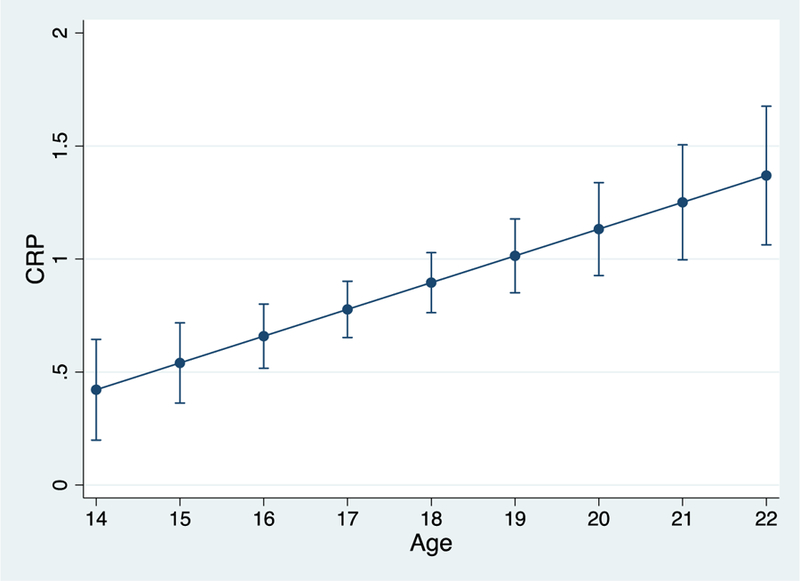
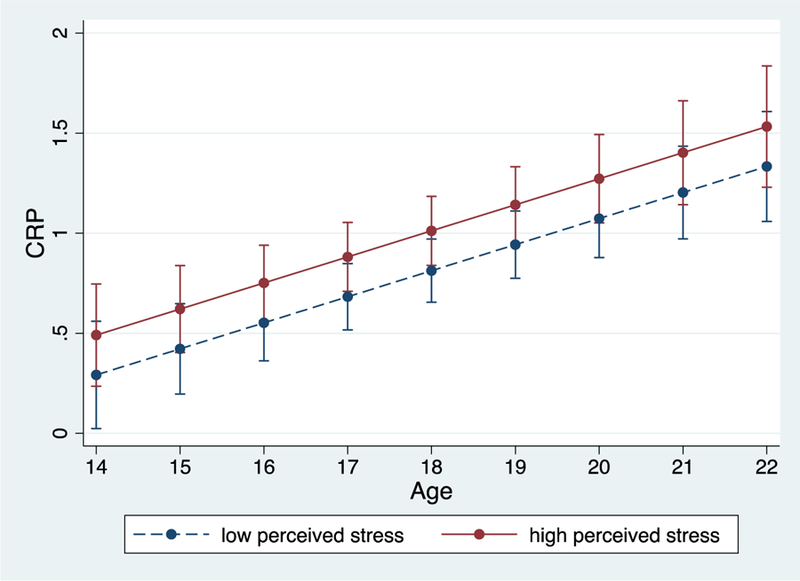
Results: Multilevel modeling indicated that CRP increased with age, and within-person increases in perceived stress, but not life events or daily stress, were associated with higher CRP. Between-person differences in average levels of stress from mid-adolescence into young adulthood were not associated with changes in CRP.
Conclusion: These findings suggest that the link between stress and systemic inflammation between mid-adolescence and young adulthood may be most affected by contemporaneous experiences of perceived stress. There was little evidence to suggest that CRP trajectories varied by between-person differences in overall average levels of perceived stress, life events, and daily stress. (PsycINFO Database Record (c) 2019 APA, all rights reserved).
Conflict of interest statement
Figures
References
-
- Agostinis-Sobrinho C, Ruiz JR, Moreira C, Abreu S, Lopes L, Oliveira-Santos J, … Santos R (2018). Ability of nontraditional risk factors and inflammatory biomarkers for cardiovascular disease to identify high cardiometabolic risk in adolescents: results from the LabMed Physical Activity Study. Journal of Adolescent Health 62(3), 320–326. - PubMed
-
- American Psychological Association. (2014). Stress in America: Are teens adopting adults’ stress habits. Stress in America Surveys (http://www.apa.org/news/press/releases/stress/2013/stress-report.pdf).
-
- Berenson GS, Srinivasan SR, Bao W, Newman WP, Tracy RE, & Wattigney WA (1998). Association between multiple cardiovascular risk factors and atherosclerosis in children and young adults. New England Journal of Medicine 338(23), 1650–1656. - PubMed
-
- Blakemore SJ, & Mills KL (2014). Is adolescence a sensitive period for sociocultural processing? Annual Review of Psychology 65, 187–207. - PubMed
MeSH terms
Substances
Grants and funding
LinkOut - more resources
Full Text Sources
Medical
Research Materials
Miscellaneous
