


Silica-Based Infiltrations for Enhanced Zirconia-Resin Interface Toughness
- PMID: 30763138
- PMCID: PMC6429668
- DOI: 10.1177/0022034518819477
Silica-Based Infiltrations for Enhanced Zirconia-Resin Interface Toughness
Abstract
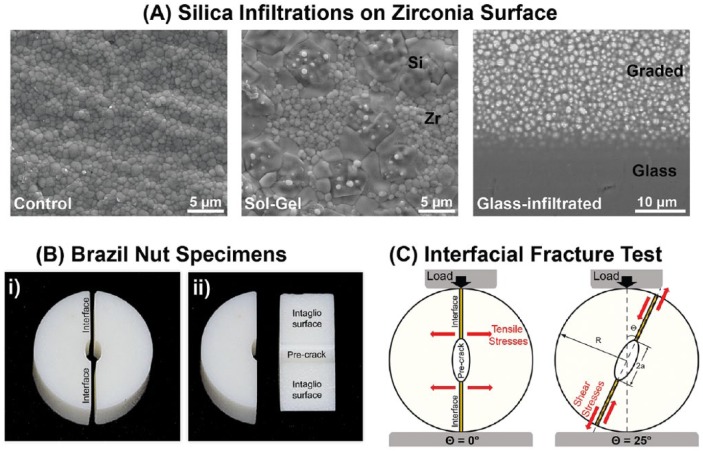
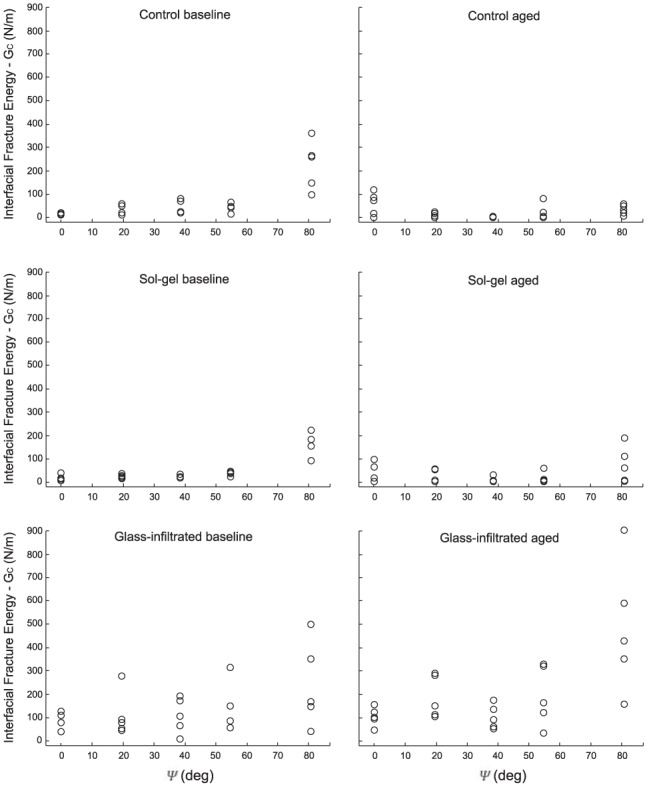
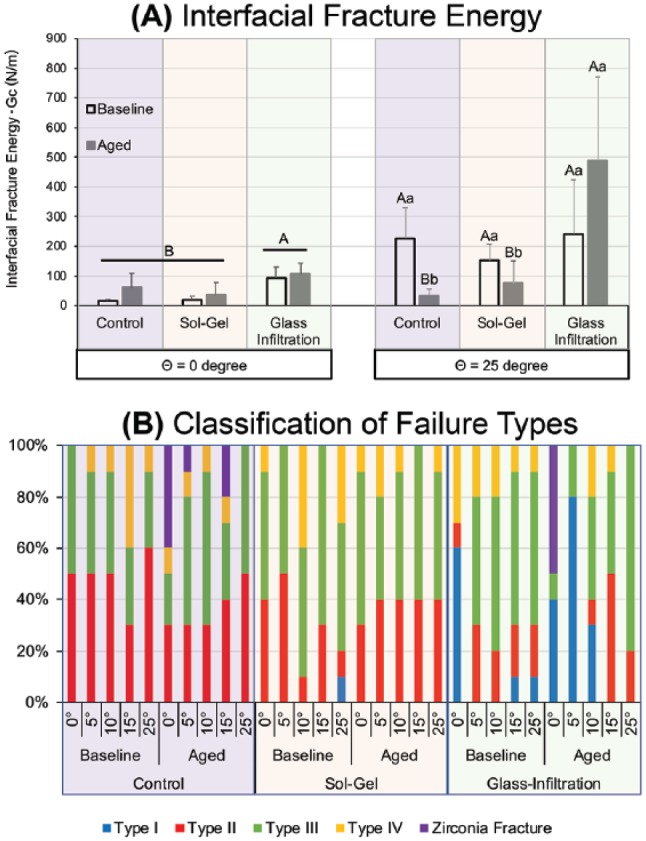
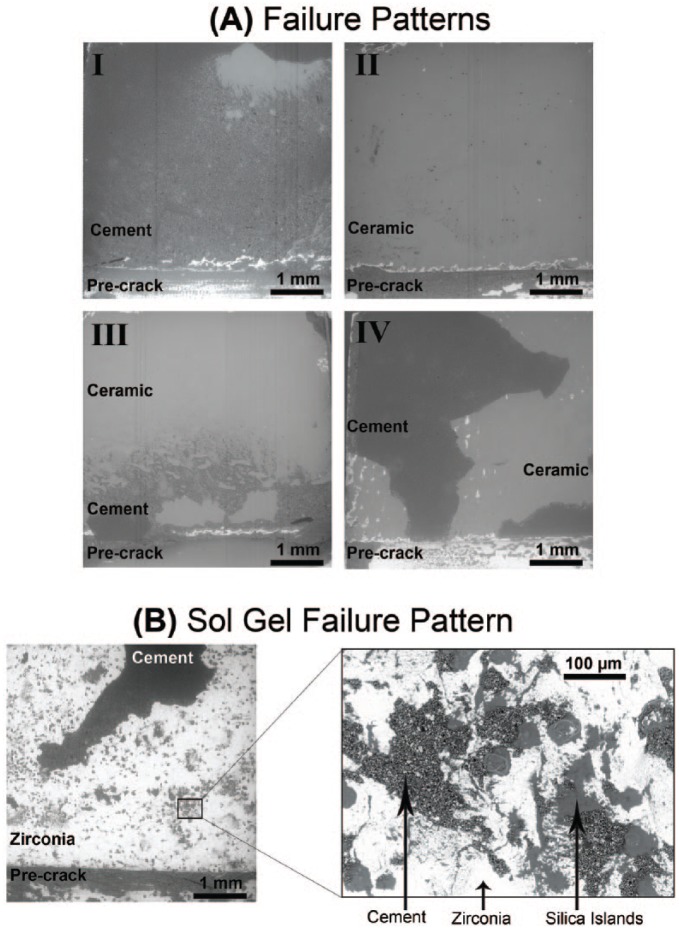
Novel silica-based infiltrations on the surface of zirconia have the potential to improve their bondability, allowing for the etching/silane adhesive bonding technique. Nonetheless, adhesively bonded joints are subject to mixed tensile and shear stresses when the restoration is in occlusal service. Thus, we aimed to investigate the effect of 2 novel silica-based infiltrations on the interfacial toughness of adhesively bonded zirconia using the Brazil nut method, which allows for controlled types of stresses to be applied at the interfaces. In total, 150 3Y-TZP (In-Ceram YZ; Vita) Brazil nuts were machined and randomly assigned to 3 groups: C, control (air abraded); SG, sol-gel silica infiltration; and GI, glass infiltration. SG specimens were immersed twice in silicic acid for 20 min and dried (100°C, 1 h). GI specimens were presintered (1,400°C, 1 h) before a glass powder slurry was applied to the intaglio surface. All specimens were then sintered (1,530°C, 2 h). Following adhesive bonding (Panavia F 2.0, Kuraray) and water storage (37°C) for 10 d, the Brazil nuts were subdivided into groups baseline and aged (40,000 thermal cycles between 5°C and 55°C, with a dwell time of 30 s). The Brazil nuts were subjected to axial-loading tests using various inclinations (precrack angle with load direction): Θ = 0°, 5°, 10°, 15°, or 25°, which define the stress type at the interface, from pure tension (0°) to increasing levels of shear. Under pure tension (0°), GI yielded superior interfacial fracture energy, SG and C were similar, and aging had no effect. Under predominantly shear stresses (25°), aging significantly decreased interfacial fracture energy of C and SG, while GI remained stable and was superior. The glass infiltration of the zirconia intaglio surface increases its adhesive bonding interfacial toughness. The sol-gel silica infiltration method requires improvement to obtain a homogeneous surface infiltration and an enhanced bond strength.
Keywords: bonding force; ceramics; fracture strength; resin cements; shear strength; tensile strength.
Conflict of interest statement
The authors declare no potential conflicts of interest with respect to the authorship and/or publication of this article.
Figures
References
-
- Atkinson C, Smelser RE, Sanchez J. 1982. Combined mode fracture via the cracked Brazilian disc test. Int J Fract. 18(4):279–291.
-
- Brinker CJ. 1988. Hydrolysis and condensation of silicates: effects on structure. J Non-Cryst Solids. 100(1–3):31–50.
-
- Campos TM, Ramos NC, Machado JP, Bottino MA, Souza RO, Melo RM. 2016. A new silica-infiltrated Y-TZP obtained by the sol-gel method. J Dent. 48:55–61. - PubMed
-
- Chevalier J, Gremillard L, Virkar AV, Clarke DR. 2009. The tetragonal-monoclinic transformation in zirconia: lessons learned and future trends. J Am Ceram Soc. 92(9):1901–1920.
Publication types
MeSH terms
Substances
Grants and funding
LinkOut - more resources
Full Text Sources
