


Insomnia symptoms and short sleep predict anxiety and worry in response to stress exposure: a prospective cohort study of medical interns
- PMID: 30763868
- PMCID: PMC7045299
- DOI: 10.1016/j.sleep.2018.12.001
Insomnia symptoms and short sleep predict anxiety and worry in response to stress exposure: a prospective cohort study of medical interns
Abstract
Study objectives: While anxiety rates are alarmingly high in short sleeping insomniacs, the relationship between insomnia and anxiety symptoms has not been extensively studied, especially in comparison to the relationship between insomnia and depressive symptoms. Using residency training as a naturalistic stress exposure, we prospectively assessed the role of sleep disturbance and duration on anxiety-risk in response to stress.
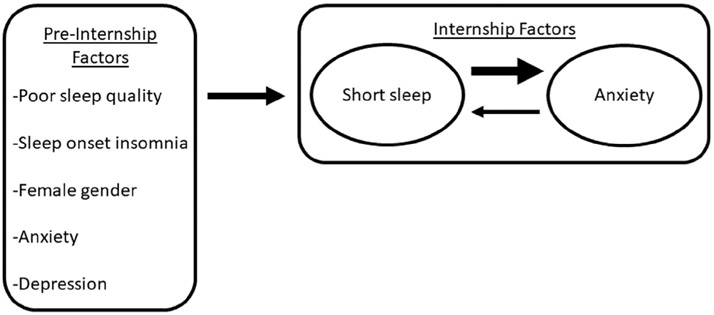
Methods: Web-based survey data from 1336 first-year training physicians (interns) prior to and then quarterly across medical internship. Using mixed effects modeling, we examined how pre-internship sleep disturbance and internship sleep duration predicted symptoms of anxiety, using an established tool for quantifying symptom severity in generalized anxiety disorder (GAD).
Results: Pre-internship poor sleepers are at more than twice the odds of having short sleep (≤6 h) during internship as good sleepers (OR = 2.38, 95% CI = 1.61, 3.57). Poor sleepers were also at twice the odds for screening positive for probable GAD diagnosis (OR = 2.08, 95% CI = 1.26, 3.45). Notably, sleep onset insomnia strongly predicted anxiety development under stress (OR = 3.55, 95% CI = 1.49, 8.45). During internship, short sleep associated with concurrent anxiety symptoms (b = -0.26, 95% CI = -0.38, -0.14) and predicted future anxiety symptoms even more strongly (b = -0.39, 95% CI = -0.76, -0.03).
Conclusions: Poor sleepers, particularly those with sleep onset insomnia symptoms, are vulnerable to short sleep and GAD anxiety and worry during chronic stress.
Keywords: Anxiety; Insomnia; Physicians; Residents; Stress; Worry.
Copyright © 2018. Published by Elsevier B.V.
Conflict of interest statement
Conflict of interest
The ICMJE Uniform Disclosure Form for Potential Conflicts of Interest associated with this article can be viewed by clicking on the following link:
Figures
References
-
- Kessler RC, Berglund P, Demler O, et al. Lifetime prevalence and age-of-onset distributions of DSM-IV disorders in the National comorbidity survey replication. Arch Gen Psychiatr 2005;62(6):593–602. - PubMed
-
- Hoffman DL, Dukes EM, Wittchen HU. Human and economic burden of generalized anxiety disorder. Depress Anxiety 2008;25(1):72–90. - PubMed
-
- Wittchen HU. Generalized anxiety disorder: prevalence, burden, and cost to society. Depress Anxiety 2002;16(4):162–71. - PubMed
-
- Baglioni C, Battagliese G, Feige B, et al. Insomnia as a predictor of depression: a meta-analytic evaluation of longitudinal epidemiological studies. J Affect Disord 2011;135(1):10–9. - PubMed
