


Assessing Gait in Parkinson's Disease Using Wearable Motion Sensors: A Systematic Review
- PMID: 30764502
- PMCID: PMC6473911
- DOI: 10.3390/diseases7010018
Assessing Gait in Parkinson's Disease Using Wearable Motion Sensors: A Systematic Review
Abstract
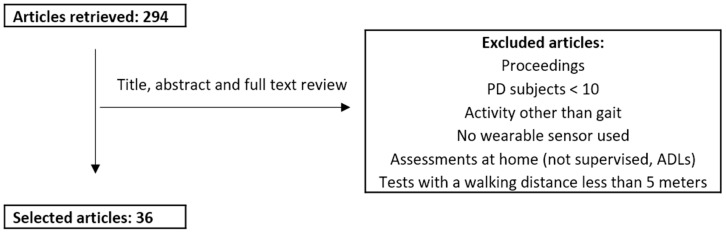
: Parkinson's disease (PD) is a progressive neurodegenerative disorder. Gait impairments are common among people with PD. Wearable sensor systems can be used for gait analysis by providing spatio-temporal parameters useful to investigate the progression of gait problems in Parkinson disease. However, various methods and tools with very high variability have been developed. The aim of this study is to review published articles of the last 10 years (from 2008 to 2018) concerning the application of wearable sensors to assess spatio-temporal parameters of gait in patients with PD. We focus on inertial sensors used for gait analysis in the clinical environment (i.e., we do not cover the use of inertial sensors to monitor walking or general activities at home, in unsupervised environments). Materials and Methods: Relevant articles were searched in the Medline database using Pubmed. Results and Discussion: Two hundred ninety-four articles were initially identified while searching the scientific literature regarding this topic. Thirty-six articles were selected and included in this review. Conclusion: Wearable motion sensors are useful, non-invasive, low-cost, and objective tools that are being extensively used to perform gait analysis on PD patients. Being able to diagnose and monitor the progression of PD patients makes wearable sensors very useful to evaluate clinical efficacy before and after therapeutic interventions. However, there is no uniformity in the use of wearable sensors in terms of: number of sensors, positioning, chosen parameters, and other characteristics. Future research should focus on standardizing the measurement setup and selecting which spatio-temporal parameters are the most informative to analyze gait in PD. These parameters should be provided as standard assessments in all studies to increase replicability and comparability of results.
Keywords: Parkinson’s disease; accelerometry; gait; inertial sensor; wearable device; wearable sensor.
Conflict of interest statement
All other authors declare no competing interests.
Figures
References
-
- Zampieri C., Salarian A., Carlson-Kuhta P., Aminian K., Nutt J.G., Horak F.B. The instrumented timed up and go test: potential outcome measure for disease modifying therapies in Parkinson’s disease. J. Neurol. Neurosurg. Psychiatry. 2010;81:171–176. doi: 10.1136/jnnp.2009.173740. - DOI - PMC - PubMed
Publication types
LinkOut - more resources
Full Text Sources
Other Literature Sources
