Review
. 2019 Feb 5;8(2):35.
doi: 10.3390/antiox8020035.

Potential Role of Flavonoids in Treating Chronic Inflammatory Diseases with a Special Focus on the Anti-Inflammatory Activity of Apigenin

Affiliations
Review

Potential Role of Flavonoids in Treating Chronic Inflammatory Diseases with a Special Focus on the Anti-Inflammatory Activity of Apigenin

Rashida Ginwala et al. Antioxidants (Basel). .

Abstract

Inflammation has been reported to be intimately linked to the development or worsening of several non-infectious diseases. A number of chronic conditions such as cancer, diabetes, cardiovascular disorders, autoimmune diseases, and neurodegenerative disorders emerge as a result of tissue injury and genomic changes induced by constant low-grade inflammation in and around the affected tissue or organ. The existing therapies for most of these chronic conditions sometimes leave more debilitating effects than the disease itself, warranting the advent of safer, less toxic, and more cost-effective therapeutic alternatives for the patients. For centuries, flavonoids and their preparations have been used to treat various human illnesses, and their continual use has persevered throughout the ages. This review focuses on the anti-inflammatory actions of flavonoids against chronic illnesses such as cancer, diabetes, cardiovascular diseases, and neuroinflammation with a special focus on apigenin, a relatively less toxic and non-mutagenic flavonoid with remarkable pharmacodynamics. Additionally, inflammation in the central nervous system (CNS) due to diseases such as multiple sclerosis (MS) gives ready access to circulating lymphocytes, monocytes/macrophages, and dendritic cells (DCs), causing edema, further inflammation, and demyelination. As the dearth of safe anti-inflammatory therapies is dire in the case of CNS-related disorders, we reviewed the neuroprotective actions of apigenin and other flavonoids. Existing epidemiological and pre-clinical studies present considerable evidence in favor of developing apigenin as a natural alternative therapy against chronic inflammatory conditions.

Keywords: apigenin; chronic inflammation; dendritic cells; flavonoids; natural products; neuroinflammation.


Conflict of interest statement

The authors report no financial or other conflict of interest.

Figures
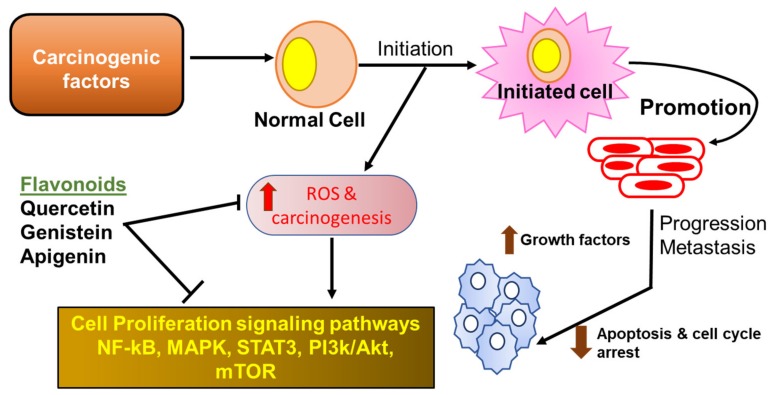
Figure 1
Figure 1
Flavonoids in cancer. Flavonoids exert their anti-inflammatory activities by reducing the production of reactive oxygen species (ROS) and the down-regulation of several inflammatory mediators through key inhibition of signaling pathways. NF-κB—nuclear factor-kappa B; MAPK—mitogen-activated protein kinase; STAT—signal transducers and activators of transcription.
Figure 2
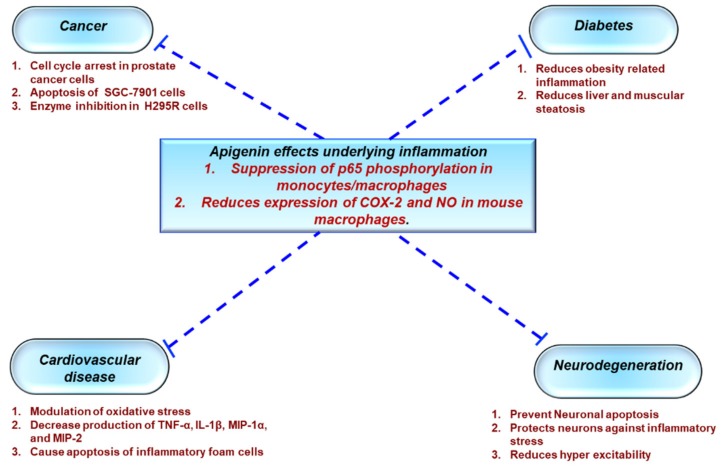
Figure 2
Role of apigenin in chronic inflammatory diseases. Apigenin as an anti-inflammatory compound acts as a protective agent in several disorders via inhibition of key inflammatory mediators, signaling pathways, and molecules. COX-2—cyclooxygenase-2; IL—interleukin; TNF—tumor necrosis factor; NO—nitric oxide.
Figure 3
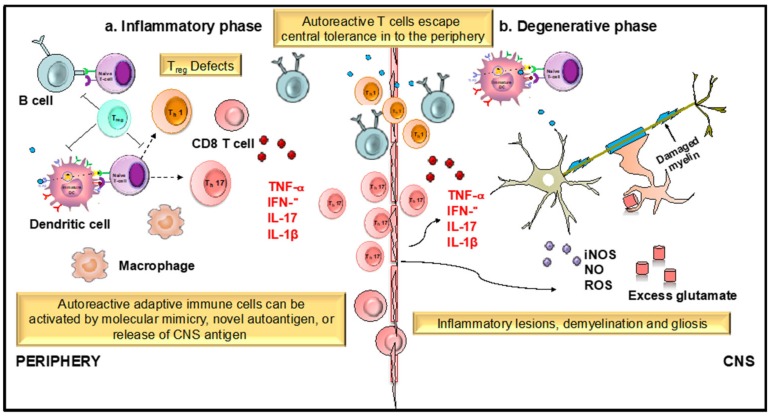
Figure 3
Role of dendritic cells (DCs) and T cells in the development and progression of multiple sclerosis (MS). MS is an immune mediated disease characterized by an initial inflammatory event consisting of presentation of as yet unknown antigens to CD8 T cells, their entry across the blood–brain barrier (BBB) into the central nervous system (CNS), and their subsequent reactivation by CNS resident DCs and microglial cells. This results in an inflammatory cascade involving secretion of several proinflammatory mediators such as cytokines IL-1β, IL-17, and TNF- α. The release of these cytokines initiates the degenerative phase that is characterized by increase in iNOS, NO, glutamate, and ROS, which brings about formation of inflammatory lesions, gliosis, and demyelination, which are the hallmarks of MS.
Figure 4
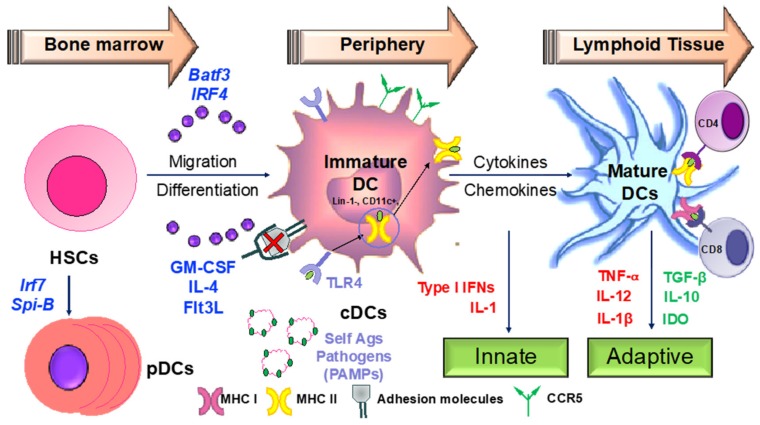
Figure 4
Dendritic cells as sentinels of the immune system. DCs orchestrate the immune response initiating both the innate and adaptive branches of the immune system. Any dysregulation in their activity is the key to development of chronic inflammatory and autoimmune conditions. IFN—interferon; GM-CSF—granulocyte macrophage colony-stimulating factor; HSC—hematopoietic stem cell(s); MHC—major histocompatibility complex; TLR—toll-like receptor.

References

    1. Hunter P. The inflammation theory of disease. The growing realization that chronic inflammation is crucial in many diseases opens new avenues for treatment. EMBO Rep. 2012;13:968–970. doi: 10.1038/embor.2012.142. - DOI - PMC - PubMed
    1. Netea M.G., Balkwill F., Chonchol M., Cominelli F., Donath M.Y., Giamarellos-Bourboulis E.J., Golenbock D., Gresnigt M.S., Heneka M.T., Hoffman H.M., et al. A guiding map for inflammation. Nat. Immunol. 2017;18:826–831. doi: 10.1038/ni.3790. - DOI - PMC - PubMed
    1. Ma K.C., Schenck E.J., Pabon M.A., Choi A.M.K. The Role of Danger Signals in the Pathogenesis and Perpetuation of Critical Illness. Am. J. Respir. Crit. Care Med. 2018;197:300–309. doi: 10.1164/rccm.201612-2460PP. - DOI - PMC - PubMed
    1. Pahwa R., Jialal I. Chronic Inflammation. StatPearls; Treasure Island, FL, USA: 2018.
    1. Herwald H., Egesten A. On PAMPs and DAMPs. J. Innate Immun. 2016;8:427–428. doi: 10.1159/000448437. - DOI - PMC - PubMed