


Perceived Impact of Taiwan's National Health Insurance Allocation Strategy: Health Professionals' Perspective
- PMID: 30764553
- PMCID: PMC6388230
- DOI: 10.3390/ijerph16030467
Perceived Impact of Taiwan's National Health Insurance Allocation Strategy: Health Professionals' Perspective
Abstract
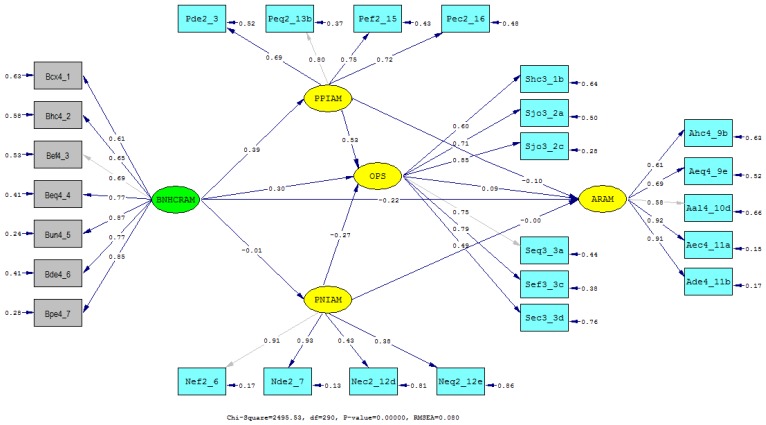
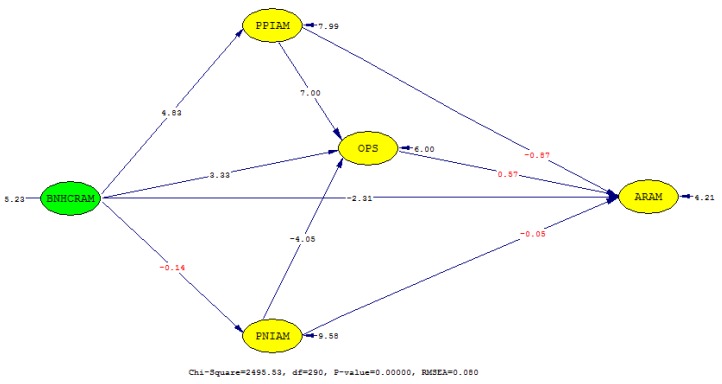
Studies on health care demand have indicated high levels of public satisfaction with Taiwan's National Health Insurance (NHI). However, the global budget allocation mechanism (GBAM) used by NHI has led to various adjustments in the providers' way of practice, quality of care, utilization of care, and health expenditure. Studies focusing on the satisfaction of providers with health care supply, however, remain limited. We therefore explored the provider's perceived impact of the NHI allocation plan. A cross-sectional data of 299 health professionals was collected at Taipei Medical University Hospitals in April 2012. Perceptions and attitudes were assessed using a validated 5-point Likert-type questionnaire before using a structural equation modeling technique to explore the complex interrelationships of the NHI's perceived impact. The causal path relationships between the latent variables 'characteristics of NHI's allocation plan' and 'perceived positive effect' (β = 0.39), 'perceived positive effect' and 'satisfaction of health professionals' (β = 0.53), and between 'characteristics of NHI's allocation plan' and 'satisfaction of health professionals' (β = 0.30) were positively associated; while the path relationships between the latent variables 'perceived negative effect' and 'satisfaction of health professionals' (β = -0.27) and 'characteristics of NHI's allocation plan' and 'attitude toward allocation criteria' (β = -0.22) were negatively associated. These results indicate that providers perceived a positive impact of the NHI allocation strategy. The NHI allocation plan is an important decision-making tool among policy makers since it helps optimize outcomes. Research based on its impact at both horizontal and vertical levels on the supply side may be useful towards understanding Taiwan's GBAM. Policy-makers should therefore consider understanding the impact of GBAM at both the demand and supply side in adjusting allocation criteria.
Keywords: global budget; health insurance; health professionals; perceptions and attitudes; resource allocation; structural equation modeling.
Conflict of interest statement
The authors declare no conflict of interest.
Figures
References
-
- White-Means S.I., Osmani A.R. Affordable Care Act and Disparities in Health Services Utilization among Ethnic Minority Breast Cancer Survivors: Evidence from Longitudinal Medical Expenditure Panel Surveys 2008(-)2015. Int. J. Environ. Res. Public Health. 2018;15:1860. doi: 10.3390/ijerph15091860. - DOI - PMC - PubMed
Publication types
MeSH terms
LinkOut - more resources
Full Text Sources
Miscellaneous
