


Assessment of Vitamin Status in Patients with Nontuberculous Mycobacterial Pulmonary Disease: Potential Role of Vitamin A as a Risk Factor
- PMID: 30764587
- PMCID: PMC6412884
- DOI: 10.3390/nu11020343
Assessment of Vitamin Status in Patients with Nontuberculous Mycobacterial Pulmonary Disease: Potential Role of Vitamin A as a Risk Factor
Abstract
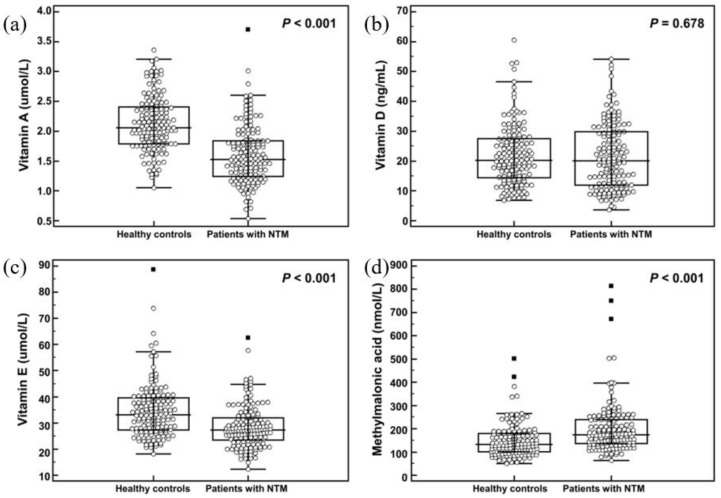
As microbiological diagnostic techniques improve and the frequency of nontuberculous mycobacterial pulmonary disease (NTM-PD) infection increases worldwide, NTM-PD is becoming increasingly important to clinicians and researchers. Vitamin activity has been associated with the host immune response in tuberculosis; however, such information is very limited in NTM-PD. We performed a case-control study in 150 patients with NTM-PD and 150 healthy controls to investigate serum vitamin status. We measured concentrations of vitamins A, D, and E along with homocysteine and methylmalonic acid (MMA) as indicators of vitamin B12 deficiency, using high-performance liquid chromatography (HPLC) or HPLC-tandem mass spectrometry. The serum concentrations of vitamins A and E were significantly lower in patients with NTM-PD than in healthy controls (1.5 vs. 2.1 µmol/L, p < 0.01 for vitamin A; and 27.3 vs. 33.1 µmol/L, p < 0.01 for vitamin E). In contrast, the serum concentrations of vitamin D and homocysteine were not significantly different between the two groups. Vitamin A deficiency (< 1.05 µmol/L) was significantly more prevalent in patients with NTM-PD than in healthy controls (p < 0.01) and was associated with an 11-fold increase in risk of NTM-PD. Multiple vitamin deficiencies were only observed in patients with NTM-PD (7.3% of all NTM-PD patients). Positive correlations were observed among vitamins (vitamins A and D; r = 0.200, p < 0.05; vitamins D and E, r = 0.238, p < 0.05; vitamins A and E, r = 0.352, p < 0.05). Serum vitamin status, demographic variables, and biochemical indicators were not associated with treatment outcomes. Vitamin A deficiency was strongly associated with patients with NTM-PD. Our study suggests that altered vitamin status is associated with mycobacterial disease. Future well-designed prospective studies with large patient cohorts addressing these issues are needed to clarify the significance of vitamins in NTM-PD.
Keywords: nontuberculous mycobacteria; nutrition; vitamin.
Conflict of interest statement
The authors declare no conflicts of interest.
Figures
Comment in
-
Letter to the Editor Re: Oh J., et al. Nutrients 2019, 11, 343.Nutrients. 2019 Mar 20;11(3):667. doi: 10.3390/nu11030667. Nutrients. 2019. PMID: 30897689 Free PMC article.
References
-
- Ko R.E., Moon S.M., Ahn S., Jhun B.W., Jeon K., Kwon O.J., Huh H.J., Ki C.S., Lee N.Y., Koh W.J. Changing epidemiology of nontuberculous mycobacterial lung diseases in a tertiary referral hospital in Korea between 2001 and 2015. J. Korean Med. Sci. 2018;33:e65. doi: 10.3346/jkms.2018.33.e65. - DOI - PMC - PubMed
MeSH terms
Substances
Grants and funding
LinkOut - more resources
Full Text Sources
Medical
Research Materials
