


Developing and Testing a Personalized, Evidence-Based, Shared Decision-Making Tool for Stent Selection in Percutaneous Coronary Intervention Using a Pre-Post Study Design
- PMID: 30764654
- PMCID: PMC6383794
- DOI: 10.1161/CIRCOUTCOMES.118.005139
Developing and Testing a Personalized, Evidence-Based, Shared Decision-Making Tool for Stent Selection in Percutaneous Coronary Intervention Using a Pre-Post Study Design
Abstract
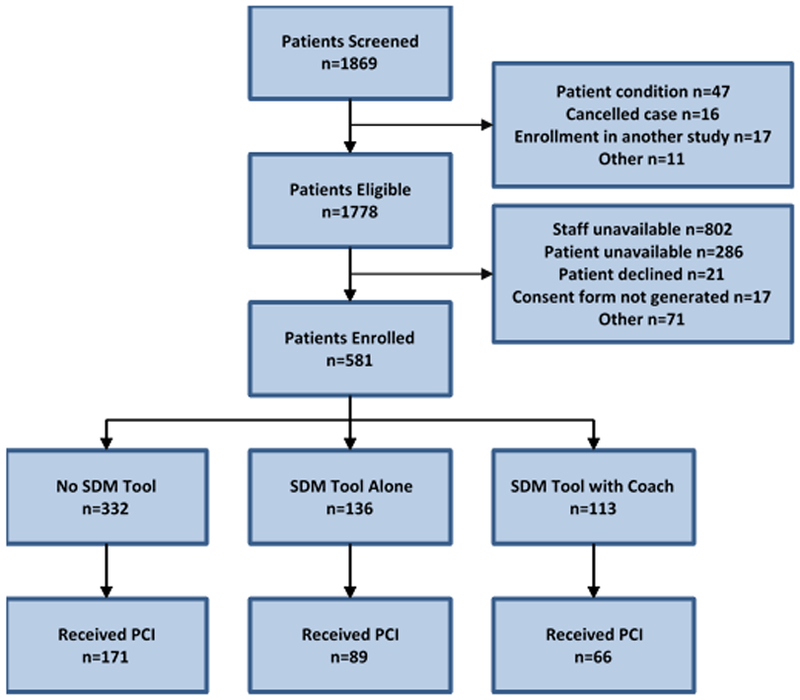
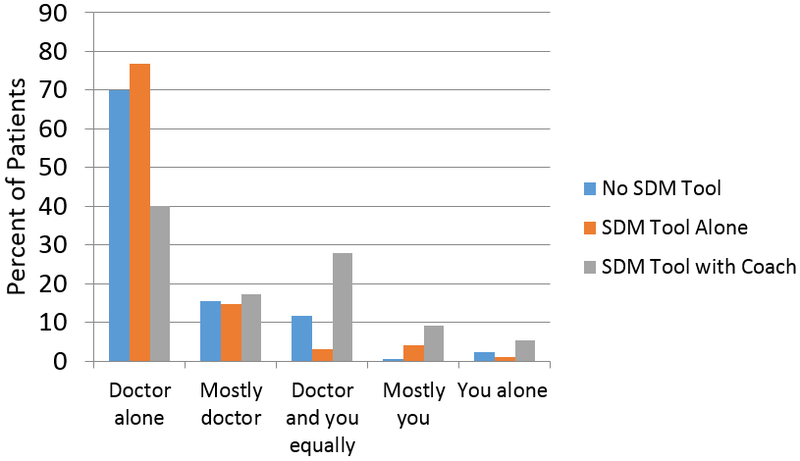
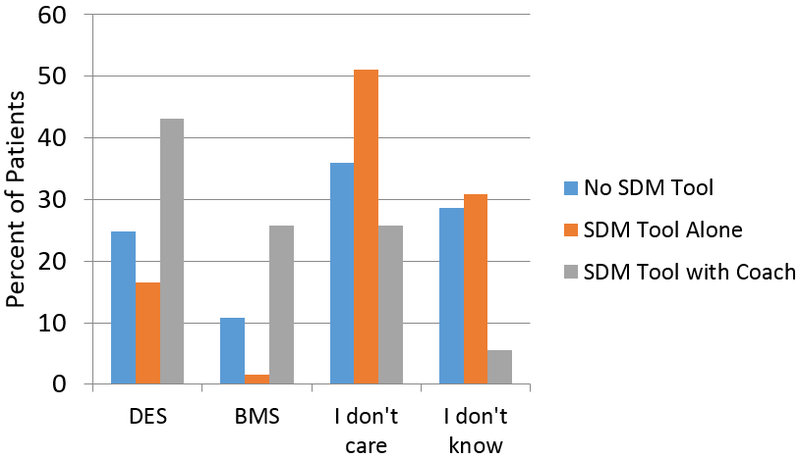
Background Drug-eluting stents reduce the risk of restenosis in patients undergoing percutaneous coronary intervention, but their use necessitates prolonged dual antiplatelet therapy, which increases costs and bleeding risk, and which may delay elective surgeries. While >80% of patients in the United States receive drug-eluting stents, less than a third report that their physicians discussed options with them. Methods and Results An individualized shared decision-making (SDM) tool for stent selection was designed and implemented at 2 US hospitals. In the postimplementation phase, all patients received the SDM tool before their procedure, with or without decision coaching from a trained nurse. All patients were interviewed with respect to their knowledge of stents, their participation in SDM, and their stent preference. Between May 2014 and December 2016, 332 patients not receiving the SDM tool, 113 receiving the SDM tool with coaching, and 136 receiving the tool without coaching were interviewed. Patients receiving the SDM tool + coaching, as compared with usual care, demonstrated higher knowledge scores (mean difference +1.8; P<0.001), reported more frequent participation in SDM (odds ratio=2.96; P<0.001), and were more likely to state a stent preference (odds ratio=2.00; P<0.001). No significant differences were observed between the use of the SDM tool without coaching and usual care. For patients who voiced a stent preference, concordance between stent desired and stent received was 98% for patients who preferred a drug-eluting stent and 50% for patients who preferred a bare metal stent. The SDM tool (with or without coaching) had no impact on stent selection or concordance. Conclusions An SDM tool for stent selection was associated with improvements in patient knowledge and SDM only when accompanied by decision coaching. However, the SDM tool (with or without coaching) had no impact on stent selection or concordance between patients' stent preference and stent received, suggesting that physician-level barriers to SDM may exist. Clinical Trial Information URL: https://www.clinicaltrials.gov . Unique Identifier: NCT02046902.
Keywords: coronary artery disease; drug-eluting stent; percutaneous coronary intervention; stents.
Figures
Comment in
-
Shared Decision-Making in Revascularization Decisions.Circ Cardiovasc Qual Outcomes. 2019 Feb;12(2):e005446. doi: 10.1161/CIRCOUTCOMES.119.005446. Circ Cardiovasc Qual Outcomes. 2019. PMID: 30764653 No abstract available.
References
-
- Roger VL, Go AS, Lloyd-Jones DM, Benjamin EJ, Berry JD, Borden WB, Bravata DM, Dai S, Ford ES, Fox CS, Fullerton HJ, Gillespie C, Hailpern SM, Heit JA, Howard VJ, Kissela BM, Kittner SJ, Lackland DT, Lichtman JH, Lisabeth LD, Makuc DM, Marcus GM, Marelli A, Matchar DB, Moy CS, Mozaffarian D, Mussolino ME, Nichol G, Paynter NP, Soliman EZ, Sorlie PD, Sotoodehnia N, Turan TN, Virani SS, Wong ND, Woo D and Turner MB. Heart disease and stroke statistics−−2012 update: a report from the American Heart Association. Circulation. 2012;125:e2–e220. - PMC - PubMed
-
- Moses JW, Leon MB, Popma JJ, Fitzgerald PJ, Holmes DR, O’Shaughnessy C, Caputo RP, Kereiakes DJ, Williams DO, Teirstein PS, Jaeger JL and Kuntz RE. Sirolimus-eluting stents versus standard stents in patients with stenosis in a native coronary artery. N Engl J Med. 2003;349:1315–23. - PubMed
-
- Stone GW, Ellis SG, Cox DA, Hermiller J, O’Shaughnessy C, Mann JT, Turco M, Caputo R, Bergin P, Greenberg J, Popma JJ and Russell ME. A polymer-based, paclitaxel-eluting stent in patients with coronary artery disease. N Engl J Med. 2004;350:221–31. - PubMed
-
- Bonaa KH, Mannsverk J, Wiseth R, Aaberge L, Myreng Y, Nygard O, Nilsen DW, Klow NE, Uchto M, Trovik T, Bendz B, Stavnes S, Bjornerheim R, Larsen AI, Slette M, Steigen T, Jakobsen OJ, Bleie O, Fossum E, Hanssen TA, Dahl-Eriksen O, Njolstad I, Rasmussen K, Wilsgaard T and Nordrehaug JE. Drug-Eluting or Bare-Metal Stents for Coronary Artery Disease. N Engl J Med. 2016;375:1242–52. - PubMed
-
- Chhatriwalla AK, Venkitachalam L, Kennedy KF, Stolker JM, Jones PG, Cohen DJ and Spertus JA. Relationship between stent type and quality of life after percutaneous coronary intervention for acute myocardial infarction. Am Heart J. 2015;170:796–804 e3. - PubMed
Publication types
MeSH terms
Associated data
LinkOut - more resources
Full Text Sources
Medical
