


Self-report occupational-related contact dermatitis: prevalence and risk factors among healthcare workers in Gondar town, Northwest Ethiopia, 2018-a cross-sectional study
- PMID: 30764759
- PMCID: PMC6376784
- DOI: 10.1186/s12199-019-0765-0
Self-report occupational-related contact dermatitis: prevalence and risk factors among healthcare workers in Gondar town, Northwest Ethiopia, 2018-a cross-sectional study
Abstract
Background: Occupational skin diseases are the second most common occupational diseases and are responsible for an estimated 25% of all lost work days. Occupational contact dermatitis (OCD) comprises 70-90% of all occupational skin diseases. In Ethiopia, information about the prevalence and factors which determine developments of contact dermatitis is not recognized. The objective of this study was to investigate prevalence and factors influencing the occurrences of occupational-related contact dermatitis among healthcare workers in Gondar town, Northwest Ethiopia.
Methods: We employed a healthcare-based cross-sectional study from March to April 2018. A stratified sampling method followed by simple random sampling method was used to select 422 participants. The standardized Nordic Occupational Skin Questionnaire was pretested and interviewer-administered for data collection. We used SPSS version 20 to conduct a binary logistic regression analysis. We set ≤ 0.05 p value to ascertain significance and 95% CI with odds ratios to evaluate the strength of associations.
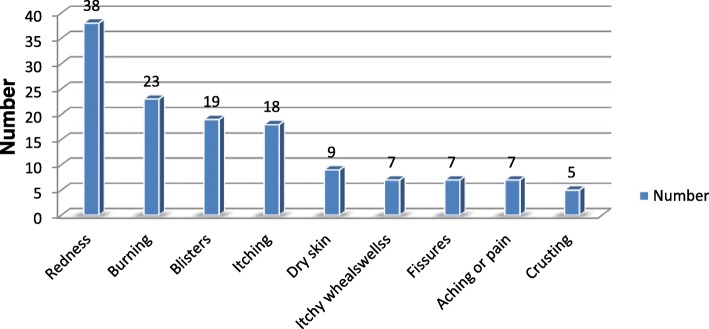
Results: Response rate was 100%. The majority, 52.4% (N = 221), were males. The mean age was 22.6 (SD ± 6.3) years. The overall prevalence of self-report occupational contact dermatitis in the previous 12 months was 31.5% (N = 133) [95% CI (27, 36.2)]. The highest symptoms indicated was redness, 28.5% (n = 38), followed by burning, 17.3% (n = 23). The hand is the most commonly affected body sites, 22% (N = 93). Hand washing frequency [AOR 1.80, 95% CI (1.10, 3.20)], pairs of hand gloves used per day [AOR 3.22, 95% CI (2.05, 5.87)], personal history of allergy [AOR 2.37, 95% CI (1.32, 4.61)], and lack of health and safety training [AOR 2.12, 95% CI (1.12, 2.25)] were factors considerably associated with contact dermatitis.
Conclusions: The prevalence of occupational-induced contact dermatitis is common among healthcare workers in Ethiopia. Therefore, our finding indicates that intervention aiming at workers' health and safety training demands urgent public health responses to tackle the ailment. The result also demonstrates that healthcare workers should be aware of when and how hands should be washed. The number of pairs of gloves used per day should also be taken into consideration while devising prevention strategies.
Keywords: Ethiopia; Healthcare workers; Occupational-related contact dermatitis; Self-report.
Conflict of interest statement
Ethics approval and consent to participate
We obtained ethical clearance from the University of Gondar, Institute of Public Health, Department of Environmental and Occupational Health and Safety (Reference No.EOHS 463/10). We submitted letters to the two hospitals. Informed consent was obtained from the participants. Involvement in the study was based on the full consent of the participants. The confidentiality of the collected data was ensured and maintained. Only aggregate data were used for interpretation of the results.
Consent for publication
Not applicable.
Competing interests
The authors declare that they have no competing interests.
Publisher’s Note
Springer Nature remains neutral with regard to jurisdictional claims in published maps and institutional affiliations.
Figures
References
-
- Ngajilo D. Occupational contact dermatitis among nurses: a report of two cases: allergies in the workplace. Curr Allergy Clin Immunol. 2014;27(1):42–46.
-
- Ozgur E, Demıral Y, Cımrın A. Occupational contact dermatitis. Occup Environ Med. 2018;75(Suppl 2):A1–A650.
-
- Union of Shop, Distributive and Allied Workers: Work-related Skin Disease. July 2010. Available athttps://www.usdaw.org.uk/USDAW/media/Documents/Health%20and%20Safety/Health%20an.... Accessed 23 July 2018.
-
- Public Health Ontario: Occupational dermatitis in health care settings. 27 Septembe 2017. Availableat:https://neo.ipaccanada.org/photos/custom/Presentations/Occupational%20De.... Accessed 23 July 2018.
-
- Peate W. Occupational skin disease. Am Fam Physician. 2002;66(6):1025–1032. - PubMed
MeSH terms
LinkOut - more resources
Full Text Sources
Miscellaneous