


Revisiting racial differences in ESRD due to ADPKD in the United States
- PMID: 30764782
- PMCID: PMC6376748
- DOI: 10.1186/s12882-019-1241-1
Revisiting racial differences in ESRD due to ADPKD in the United States
Abstract
Introduction: Autosomal dominant polycystic kidney disease (ADPKD) affects all races. Whether the progression of ADPKD varies by race remains unclear.
Methods: In this retrospective cohort study from 2004 to 2013 non-Hispanic blacks and non-Hispanic whites of all ages classified in the US Renal Data System (USRDS) with incident ESRD from ADPKD (n = 23,647), hypertension/large vessel disease (n = 296,352), or diabetes mellitus (n = 451,760) were stratified into five-year age categories ranging from < 40 to > 75 (e.g., < 40, 40-44, 45-49, …, 75+). The Cochran-Mantel-Haenszel test was used to determine the association of race and incidence of ESRD from ADPKD, diabetes, or hypertension. The difference in the proportions of ESRD in non-Hispanic black and non-Hispanic white patients at each age categorical bin was compared by two-sample proportion test. The age of ESRD onset between non-Hispanic black and non-Hispanic white patients at each year was compared using two-sample t-test with unequal variance.
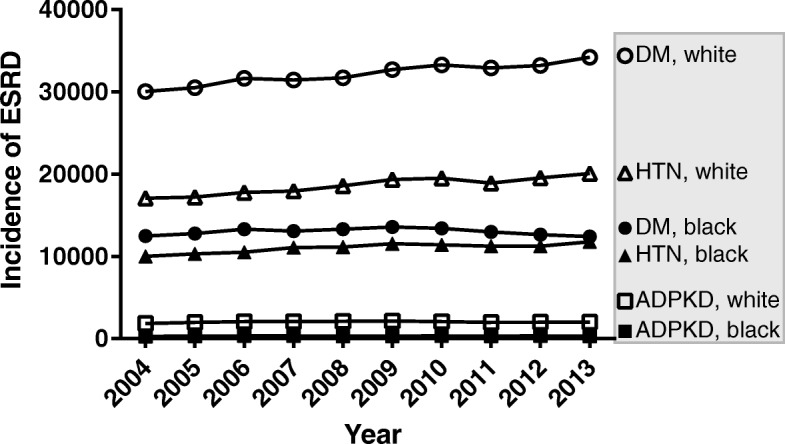
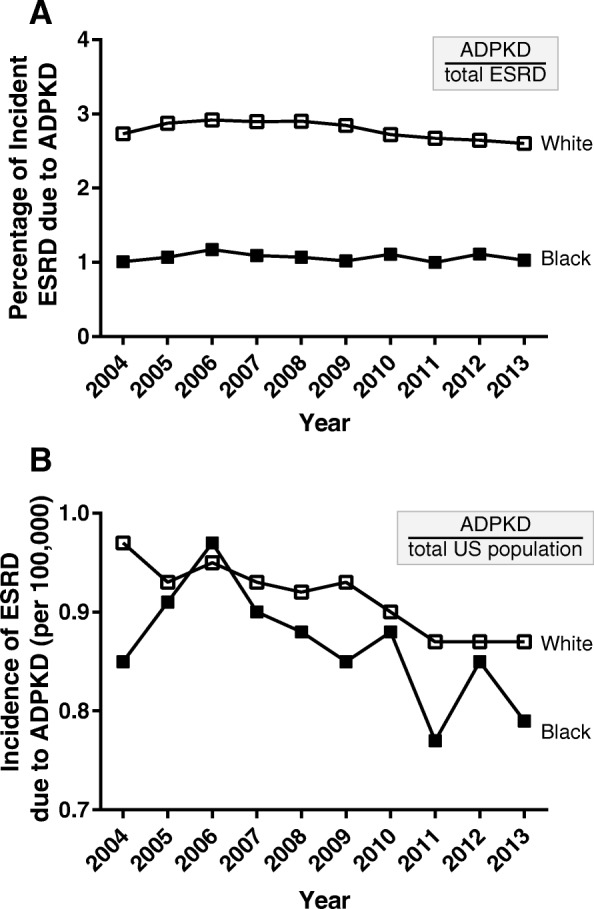
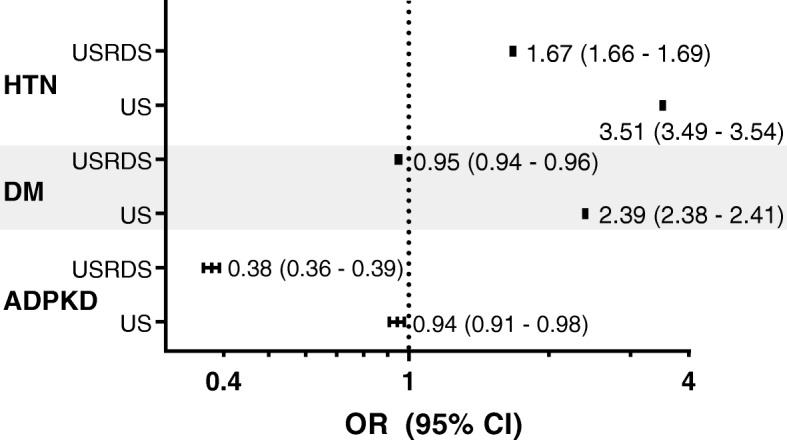
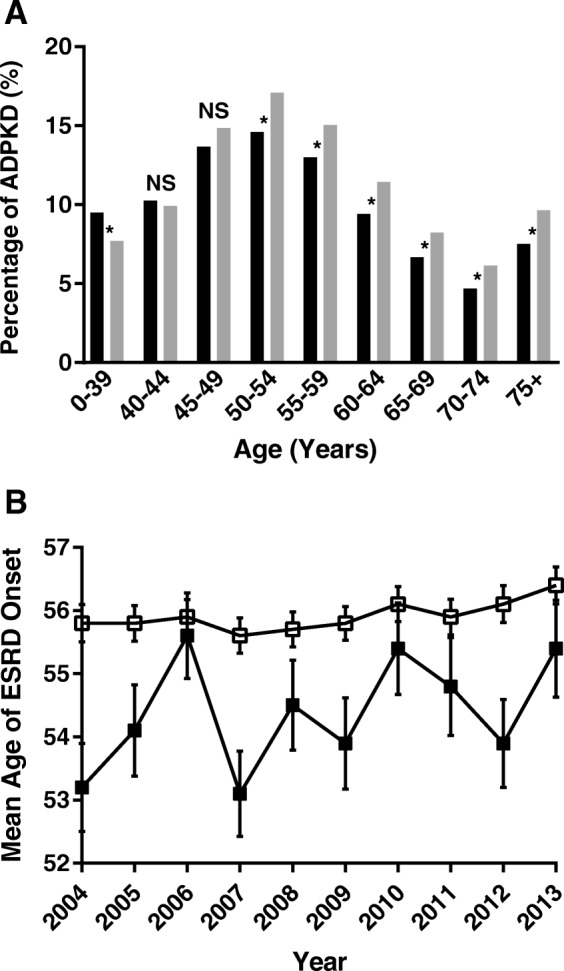
Results: 1.068% of non-Hispanic blacks and 2.778% of non-Hispanic whites had ESRD attributed to ADPKD. Non-Hispanic blacks were less likely than non-Hispanic whites to have ESRD attributed to ADPKD (odds ratio (OR) (95% CI) = 0.38 (0.36-0.39), p < 0.0001). Using US Census data as the denominator to adjust for population differences non-Hispanic blacks were still slightly under-represented (OR (95% CI) 0.94 (0.91-0.96), p = 0.004). However, non-Hispanic blacks with ADPKD had a younger age of ESRD (54.4 years ±13) than non-Hispanic whites (55.9 years ±12.8) (p < 0.0001). For those < 40 years old, more non-Hispanic blacks had incident ESRD from ADPKD than non-Hispanic whites (9.49% vs. 7.68%, difference (95% CI) = 1.81% (0.87-2.84%), p < 0.001) for the combined years examined.
Conclusions: As previously shown, we find the incidence of ESRD from ADPKD in non-Hispanic blacks is lower than in non-Hispanic whites. Among the younger ADPKD population (age < 40), however, more non-Hispanic blacks initiated dialysis than non-Hispanic whites. Non-Hispanic blacks with ADPKD initiated dialysis younger than non-Hispanic whites. A potential implication of these findings may be that black race should be considered an additional risk factor for progression in ADPKD.
Keywords: Autosomal dominant polycystic kidney disease (ADPKD); End-stage renal disease (ESRD); Incidence; United States renal data system (USRDS).
Conflict of interest statement
Ethics approval and consent to participate
Our data analysis was on aggregate, publicly available population-level data from the USRDS dataset. This type of analysis is exempt from consent as outlined in 45 CFR 46 and in guidance from the Yale Human Research Protection Policy.
Consent for publication
N/A
Competing interests
The authors declare that they have no competing interests.
Publisher’s Note
Springer Nature remains neutral with regard to jurisdictional claims in published maps and institutional affiliations.
Figures
References
-
- Chapman AB, Guay-Woodford LM, Grantham JJ, et al. Renal structure in early autosomal-dominant polycystic kidney disease (ADPKD): the consortium for radiologic imaging studies of polycystic kidney disease (CRISP) cohort. Kidney Int. 2003;64(3):1035–1045. doi: 10.1046/j.1523-1755.2003.00185.x. - DOI - PubMed
Publication types
MeSH terms
LinkOut - more resources
Full Text Sources
Medical
Research Materials
