. 2019 May;369(2):182-187.
doi: 10.1124/jpet.118.253583. Epub 2019 Feb 14.

Acetylcholine Inhibits Platelet Activation

Affiliations

Acetylcholine Inhibits Platelet Activation

John A Bennett et al. J Pharmacol Exp Ther. 2019 May.

Abstract

Platelets are key mediators of thrombosis. Many agonists of platelet activation are known, but fewer endogenous inhibitors of platelets, such as prostacyclin and nitric oxide (NO), have been identified. Acetylcholinesterase inhibitors, such as donepezil, can cause bleeding in patients, but the underlying mechanisms are not well understood. We hypothesized that acetylcholine is an endogenous inhibitor of platelets. We measured the effect of acetylcholine or analogs of acetylcholine on human platelet activation ex vivo. Acetylcholine and analogs of acetylcholine inhibited platelet activation, as measured by P-selectin translocation and glycoprotein IIb IIIa conformational changes. Conversely, we found that antagonists of the acetylcholine receptor, such as pancuronium, enhance platelet activation. Furthermore, drugs inhibiting acetylcholinesterase, such as donepezil, also inhibit platelet activation, suggesting that platelets release acetylcholine. We found that NO mediates acetylcholine inhibition of platelets. Our data suggest that acetylcholine is an endogenous inhibitor of platelet activation. The cholinergic system may be a novel target for antithrombotic therapies.


Figures

Fig. 1.
Fig. 1.
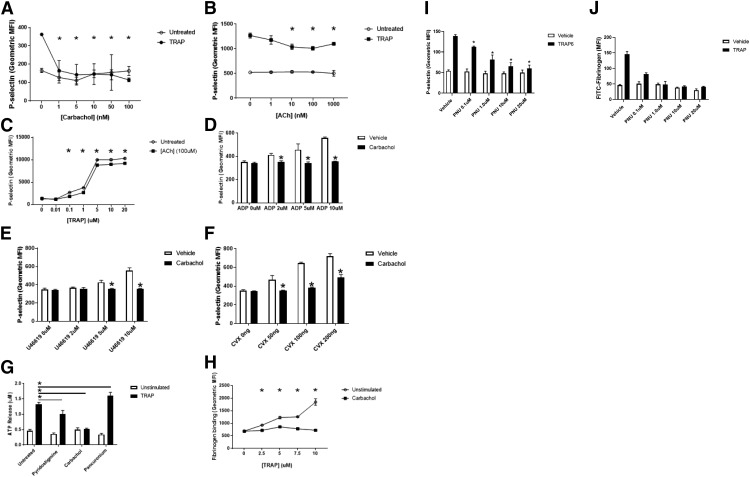
Acetylcholine receptors regulate platelet activation. (A) Carbachol inhibits platelet activation. Human platelets were isolated and treated with phosphate-buffered saline or carbachol, stimulated with PBS or 10 μM TRAP, and analyzed for surface expression of P-selectin using flow cytometry. (n = 4 ± S.D., *P < 0.05 for TRAP vs. TRAP + carbachol). (B) Acetylcholine inhibits platelet activation. Human platelets were treated with PBS or ACh, stimulated with PBS or 10 μM TRAP, and analyzed as already described. (n = 4 ± S.D., *P < 0.05 for TRAP vs. TRAP + ACh). (C) Carbachol inhibits platelet activation over a range of TRAP doses. Platelets were stimulated with varying concentrations of TRAP and analyzed for surface expression of P-selectin as desccribed (n = 4 ± S.D., *P < 0.05 for the indicated concentration of TRAP vs. TRAP + carbachol). (D) Carbachol inhibits platelet activation by ADP. (E) Carbachol inhibits platelet activation by U46619. (F) Carbachol inhibits platelet activation by convulxin. For (D–G), isolated human platelets were treated with PBS or 10 nM carbachol, then stimulated with various agonists, and analyzed via flow cytometry (n = 4 ± S.D., *P < 0.05 for agonist vs. agonist + carbachol). (G) Carbachol inhibits platelet-dense granule release. Platelets were isolated and treated with 10 nM carbachol, 100 μM pyridostigmine bromide or 100 nM pancuronium bromide, and then stimulated with PBS or TRAP and analyzed for surface expression of P-selectin (n = 4 ± S.D. *P < 0.05 for TRAP vs. TRAP and indicated compound). (H) Carbachol inhibits GPIIbIIIa activation as measured by FITC-fibrinogen binding to platelets. Platelets were isolated and treated with 10 nM carbachol and then stimulated with the indicated concentrations of TRAP and analyzed for surface expression of P-selectin (n = 4 ± S.D., *P < 0.05 for TRAP vs. TRAP + carbachol). (I) Treatment with the nAChRα7-selective agonist PNU-282987 inhibits P-selectin exposure. Platelets were treated with PNU-282987 at the indicated concentrations, then stimulated with TRAP6, and analyzed for surface expression of p-selectin (*P < 0.05 for TRAP6 + vehicle vs. TRAP6 + indicated concentration of PNU). (J) PNU inhibits GPIIbIIIa activation. Platelets were treated with PNU-282987 at the indicated concentrations, then stimulated with TRAP6, and analyzed for activation of GPIIbIIIa as described (*P < 0.05 for TRAP6 + vehicle vs. TRAP6 + indicated concentration of PNU).
Fig. 2.
Fig. 2.
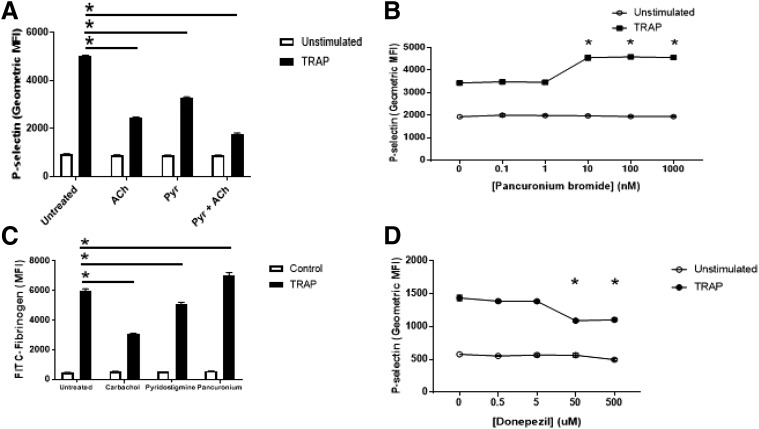
Endogenous acetylcholine inhibits platelet activation. (A) Pyridostigmine inhibition of AChE permits endogenous acetylcholine inhibition of activation of human platelets. Isolated human platelets were treated with 100 μM pyridostigmine or 100 μM pyridostigmine and 100 μM ACh, stimulated with 10 μM TRAP, and then analyzed for P-selectin using flow cytometry (n = 4 ± S.D., *P < 0.05 for TRAP vs. TRAP + pyridostigmine/ACh). (B) Pancuronium antagonism of acetylcholine receptor blocks endogenous acetylcholine inhibition of human platelets. Isolated human platelets were treated with pancuronium and then stimulated with 10 μM TRAP and analyzed for P-selectin using flow cytometry (n = 4 ± S.D., *P < 0.05 for TRAP vs. TRAP + pancuronium). (C) Endogenous ACh inhibits GPIIbIIIa conformational changes. Platelets were isolated and treated with 10 nM carbachol, 100 μM pyridostigmine, or 100 nM pancuronium bromide and analyzed for FITC-fibrinogen binding to measure GPIIbIIIa activation (n = 4 ± S.D., *P < 0.05 for TRAP vs. TRAP + indicated compound). (D) Donepezil inhibition of AChE permits endogenous acetylcholine inhibition of activation of human platelets. Isolated human platelets were treated with donepezil hydrochloride and then stimulated with 10 μM TRAP and analyzed for P-selectin using flow cytometry (n = 4 ± S.D. *P < 0.05 for TRAP vs. TRAP + donepezil).
Fig. 3.
Fig. 3.
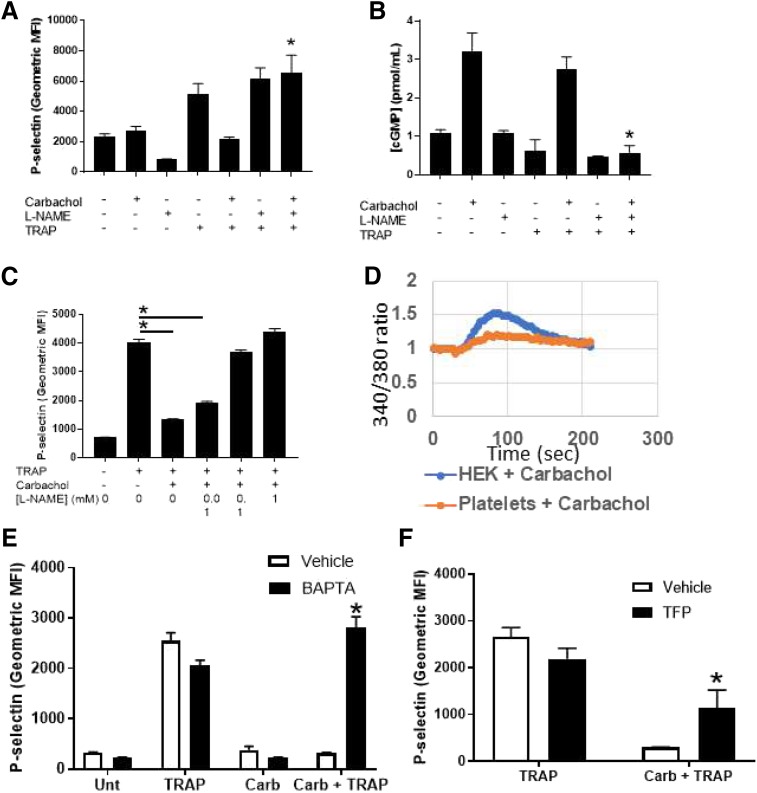
Nitric oxide mediates Ach inhibition of platelet activation. (A) NOS mediates carbachol inhibition of platelet activation. Isolated human platelets were treated with PBS, carbachol, l-NAME, or l-NAME + carbachol, stimulated with 10 μM TRAP, and then analyzed for P-selectin using flow cytometry (n = 4 ± S.D., *P < 0.05 for TRAP + carbachol vs. TRAP + carbachol + l-NAME). (B) NOS mediates carbachol-induced production of cGMP. Isolated human platelets were treated as described, and cGMP content was measured using a commercial kit (n = 4 ± S.D., *P < 0.05 for TRAP-6 + carbachol vs. TRAP + carbachol + l-NAME). (C) l-NAME reversal of carbachol-mediated platelet inhibition is dose-dependent. Platelets were isolated as above and treated with 10 nM carbachol; 1, 0.1, or 0.01 mM l-NAME, and then stimulated with TRAP and analyzed for surface expression of P-selectin. (n = 4 ± S.D., *P < 0.05 for TRAP + carbachol vs. TRAP + carbachol + indicated concentration of l-NAME). (D) Carbachol elevates intracellular calcium. Platelets or HEK293 cells were loaded with Fura-2 AM, treated with carbachol, and analyzed for calcium flux. (E) Calcium mediates the inhibitory effect of carbachol. Isolated human platelets were treated with BAPTA and then carbachol and then stimulated with TRAP and analyzed for surface expression of p-selectin (n = 4, *P < 0.05 for carbachol + TRAP vs. carbachol + TRAP + BAPTA). (F) Calmodulin activity is required for the inhibitory effect of carbachol. Platelets were treated with trifluoperazine (TFP) and then carbachol and then stimulated with TRAP and analyzed for surface expression of P-selectin (*P < 0.05 for TRAP + carbachol vs. TRAP + carbachol + TFP).

References

    1. Beker F, Weber M, Fink RH, Adams DJ. (2003) Muscarinic and nicotinic ACh receptor activation differentially mobilize Ca2+ in rat intracardiac ganglion neurons. J Neurophysiol 90:1956–1964. - PubMed
    1. Birks J. (2006) Cholinesterase inhibitors for Alzheimer’s disease. Cochrane Database Syst Rev (1):CD005593. - PMC - PubMed
    1. Boeynaems JM, Communi D, Gonzalez NS, Robaye B. (2005) Overview of the P2 receptors. Semin Thromb Hemost 31:139–149. - PubMed
    1. Cameron SJ, Ture SK, Mickelsen D, Chakrabarti E, Modjeski KL, McNitt S, Seaberry M, Field DJ, Le NT, Abe J, et al. (2015) Platelet extracellular regulated protein kinase 5 is a redox switch and triggers maladaptive platelet responses and myocardial infarct expansion. Circulation 132:47–58. - PMC - PubMed
    1. Cholongitas E, Pipili C, Dasenaki M. (2006) Recurrence of upper gastrointestinal bleeding after donepezil administration. Alzheimer Dis Assoc Disord 20:326. - PubMed

Publication types

MeSH terms

LinkOut - more resources