Urinary Potassium Excretion and Progression of CKD
- PMID: 30765533
- PMCID: PMC6419276
- DOI: 10.2215/CJN.07820618
Urinary Potassium Excretion and Progression of CKD
Abstract
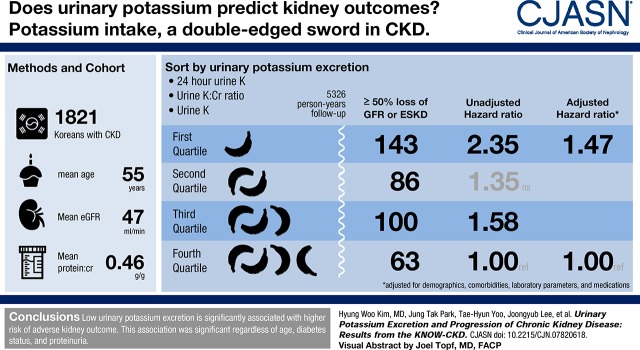
Background and objectives: Data on whether low or high urinary potassium excretion is associated with poor kidney outcome have been conflicting. The aim of this study was to clarify the association between urinary potassium excretion and CKD progression.
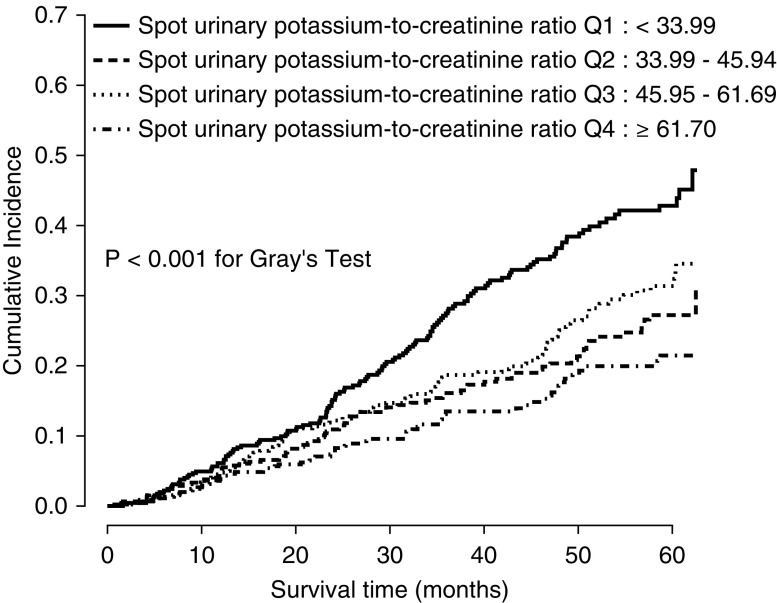
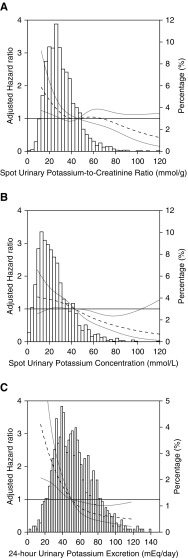
Design, setting, participants, & measurements: We investigated the relationship between lower urinary potassium excretion and CKD progression and compared three urinary potassium indices among 1821 patients from the Korean Cohort Study for Outcome in Patients with CKD. Urinary potassium excretion was determined using spot urinary potassium-to-creatinine ratio, spot urinary potassium concentration, and 24-hour urinary potassium excretion. Patients were categorized into four groups according to quartiles of each urinary potassium excretion metric. The study end point was a composite of a ≥50% decrease in eGFR from baseline values and ESKD.
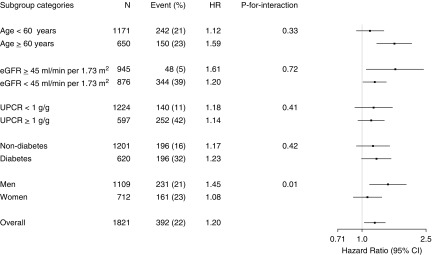
Results: During 5326 person-years of follow-up, the primary outcome occurred in 392 (22%) patients. In a multivariable cause-specific hazard model, lower urinary potassium-to-creatinine ratio was associated with higher risk of CKD progression (adjusted hazard ratio, 1.47; 95% confidence interval, 1.01 to 2.12) comparing the lowest quartile with the highest quartile. Sensitivity analyses with other potassium metrics also showed consistent results in 855 patients who completed 24-hour urinary collections: adjusted hazard ratios comparing the lowest quartile with the highest quartile were 3.05 (95% confidence interval, 1.54 to 6.04) for 24-hour urinary potassium excretion, 1.95 (95% confidence interval, 1.05 to 3.62) for spot urinary potassium-to-creatinine ratio, and 3.79 (95% confidence interval, 1.51 to 9.51) for spot urinary potassium concentration.
Conclusions: Low urinary potassium excretion is associated with progression of CKD.
Keywords: Confidence Intervals; Disease Progression; Follow-Up Studies; Kidney Failure, Chronic; Potassium; Proportional Hazards Models; Renal Insufficiency, Chronic; Urinary potassium excretion; chronic kidney disease; creatinine; glomerular filtration rate; kidney.
Copyright © 2019 by the American Society of Nephrology.
Figures
Comment in
-
Inadequate Dietary Potassium and Progression of CKD.Clin J Am Soc Nephrol. 2019 Mar 7;14(3):319-320. doi: 10.2215/CJN.01020119. Epub 2019 Feb 14. Clin J Am Soc Nephrol. 2019. PMID: 30765535 Free PMC article. No abstract available.
References
-
- Holbrook JT, Patterson KY, Bodner JE, Douglas LW, Veillon C, Kelsay JL, Mertz W, Smith JC Jr.: Sodium and potassium intake and balance in adults consuming self-selected diets. Am J Clin Nutr 40: 786–793, 1984 - PubMed
-
- Mente A, O’Donnell MJ, Rangarajan S, McQueen MJ, Poirier P, Wielgosz A, Morrison H, Li W, Wang X, Di C, Mony P, Devanath A, Rosengren A, Oguz A, Zatonska K, Yusufali AH, Lopez-Jaramillo P, Avezum A, Ismail N, Lanas F, Puoane T, Diaz R, Kelishadi R, Iqbal R, Yusuf R, Chifamba J, Khatib R, Teo K, Yusuf S; PURE Investigators : Association of urinary sodium and potassium excretion with blood pressure. N Engl J Med 371: 601–611, 2014 - PubMed
-
- O’Donnell M, Mente A, Rangarajan S, McQueen MJ, Wang X, Liu L, Yan H, Lee SF, Mony P, Devanath A, Rosengren A, Lopez-Jaramillo P, Diaz R, Avezum A, Lanas F, Yusoff K, Iqbal R, Ilow R, Mohammadifard N, Gulec S, Yusufali AH, Kruger L, Yusuf R, Chifamba J, Kabali C, Dagenais G, Lear SA, Teo K, Yusuf S; PURE Investigators : Urinary sodium and potassium excretion, mortality, and cardiovascular events. N Engl J Med 371: 612–623, 2014 - PubMed
-
- O’Donnell MJ, Yusuf S, Mente A, Gao P, Mann JF, Teo K, McQueen M, Sleight P, Sharma AM, Dans A, Probstfield J, Schmieder RE: Urinary sodium and potassium excretion and risk of cardiovascular events. JAMA 306: 2229–2238, 2011 - PubMed
-
- Dunkler D, Dehghan M, Teo KK, Heinze G, Gao P, Kohl M, Clase CM, Mann JF, Yusuf S, Oberbauer R; ONTARGET Investigators : Diet and kidney disease in high-risk individuals with type 2 diabetes mellitus. JAMA Intern Med 173: 1682–1692, 2013 - PubMed
Publication types
MeSH terms
Substances
LinkOut - more resources
Full Text Sources
Medical
Research Materials
Miscellaneous