. 2019 Feb 15;363(6428):eaar7785.
doi: 10.1126/science.aar7785.

The human gut bacterial genotoxin colibactin alkylates DNA

Affiliations

The human gut bacterial genotoxin colibactin alkylates DNA

Matthew R Wilson et al. Science. .

Abstract

Certain Escherichia coli strains residing in the human gut produce colibactin, a small-molecule genotoxin implicated in colorectal cancer pathogenesis. However, colibactin's chemical structure and the molecular mechanism underlying its genotoxic effects have remained unknown for more than a decade. Here we combine an untargeted DNA adductomics approach with chemical synthesis to identify and characterize a covalent DNA modification from human cell lines treated with colibactin-producing E. coli Our data establish that colibactin alkylates DNA with an unusual electrophilic cyclopropane. We show that this metabolite is formed in mice colonized by colibactin-producing E. coli and is likely derived from an initially formed, unstable colibactin-DNA adduct. Our findings reveal a potential biomarker for colibactin exposure and provide mechanistic insights into how a gut microbe may contribute to colorectal carcinogenesis.


Figures

Fig. 1.
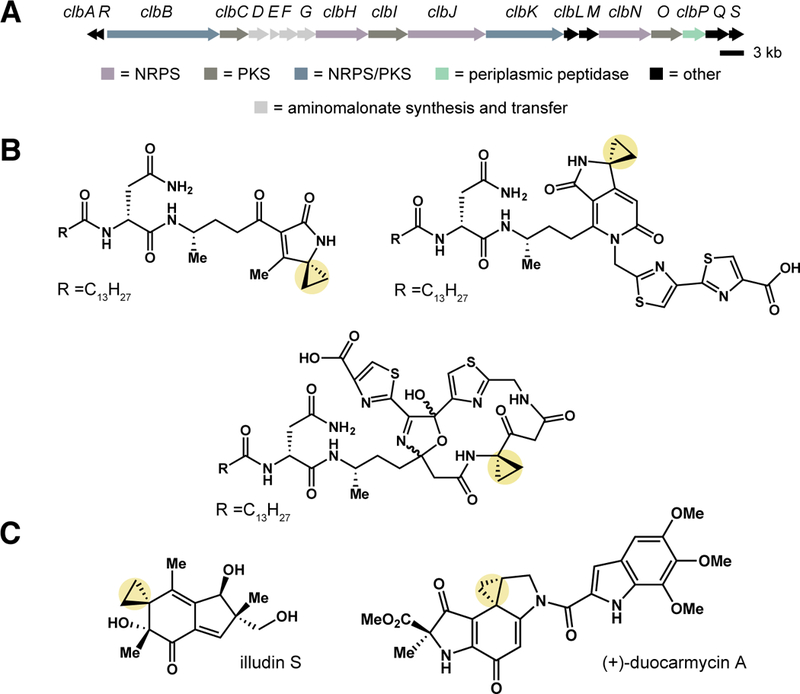
Fig. 1.. pks+ E. coli synthesize cyclopropane-containing metabolites that may alkylate DNA.
(A) pks genomic island. Open reading frames encoding nonribosomal peptide synthetase (NRPS) (purple), polyketide synthase (PKS) (brown), hybrid NRPS/PKS (blue), peptidase (ClbP) (green), aminomalonate synthesis and transfer (grey), and other (black) enzymes are highlighted. (B) Selected cyclopropane-containing candidate precolibactins isolated and structurally characterized from pks+ ΔclbP E. coli, including lactam, pyridone, and macrocyclic scaffolds. (C) Illudin S and (+)-duocarmycin A are DNA alkylating metabolites that contain a cyclopropane ring.
Fig. 2.
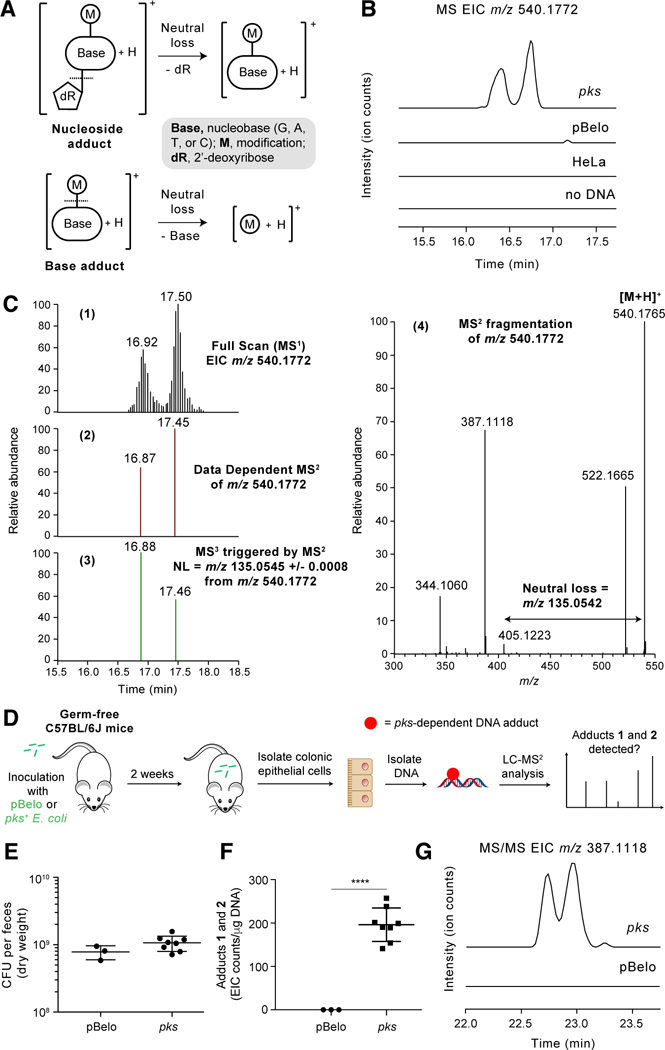
Fig. 2.. High-resolution accurate mass (HRAM) LC-MS3 DNA adductomic analysis identifies DNA adducts in HeLa cells and mice exposed to pks+ E. coli.
(A) Structural features of DNA adducts and detection by neutral loss monitoring. (B) Full scan extracted ion chromatogram (EIC) of DNA adducts 1 and 2 (m/z 540.1772) in HeLa cells exposed to colibactin-producing E. coli and negative controls (HeLa cells exposed to non-colibactin producing pBeloBAC E. coli, HeLa cells alone, or when no DNA was present). (C) 1. Full scan EIC of DNA adducts 1 and 2 (m/z 540.1772). 2. Signal corresponding to the data dependent MS2 events (RT = 16.87 and 17.45 min). RT = retention time. 3. Signal corresponding to MS3 events (RT = 16.88 and 17.46 min) triggered by the neutral loss of adenine. 4. MS2 mass spectrum resulting from fragmentation of m/z 540.1772 which triggered the MS3 event. (D) Flowchart of experiment detecting DNA adducts 1 and 2 in mouse colonic epithelial cells. (E) Bacterial load in the feces of mice colonized with pBelo (n = 3) or pks+ E. coli (n = 8) for 2 weeks. (F) EIC counts of DNA adducts 1 and 2 per μg of DNA in colonic epithelial cells isolated from mice colonized with pBelo (n = 3) or pks+ E. coli (n = 8) for 2 weeks. EIC counts were determined by area under the curve integrations of the most abundant MS2 fragmentation ion (m/z 387.1118 ± 0.0008) of the adducts 1 and 2 precursor ion (m/z 540.1772). (G) Representative MS/MS EIC of DNA adducts 1 and 2 (m/z 387.1118 [M+H-Ade-H2O]+), the most abundant fragment ion of m/z 540.1772. Each symbol in (E) and (G) represents an individual mouse; error bars represent mean +/− the standard error of the mean (SEM); **** P < 0.0001 (unpaired t test).
Fig. 3.
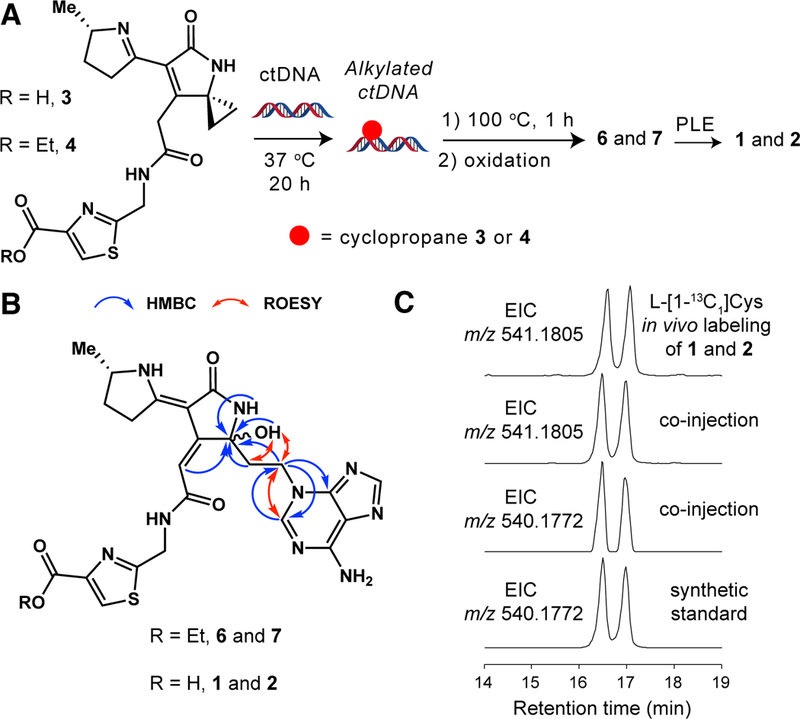
Fig. 3.. Comparing DNA adducts generated in vivo with a synthetic standard confirms their chemical structures.
(A) In vitro DNA alkylation reaction used to generate a synthetic standard of adducts 1 and 2. ctDNA = calf-thymus DNA; PLE = pig liver esterase. (B) Chemical structures of diastereomeric DNA adducts 6 and 7 showing key 2D-NMR correlations that support the hemiaminal and N3-adenine assignments. (C) EICs of the L-[1-13C]Cys-labeled in vivo adducts 1 and 2 (m/z 541.1805), co-injection of synthetic standard (m/z 540.1772) with in vivo adducts 1 and 2 (m/z 541.1805 and residual unlabeled m/z 540.1772), and synthetic standard (m/z 540.1772).
Fig. 4.
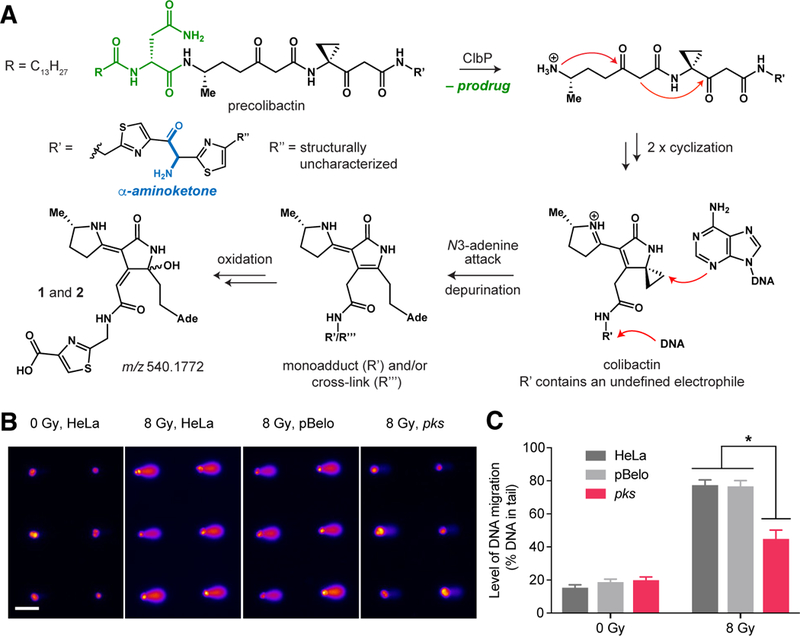
Fig. 4.. The characterized DNA adducts may derive from a colibactin-DNA interstrand cross-link.
(A) Proposed model for colibactin DNA alkylation and formation of DNA adducts 1 and 2 (DNA = deoxyribonucleic acid; Ade = adenine). (B) Arrayed microwell comets from untreated HeLa cells and HeLa cells treated with pBelo or pks+ E. coli for 1 h at 37 °C [multiplicity of infection (MOI) = 1,000]. Scale bar indicates 100 μm. (C) Quantification of % DNA in tail from untreated HeLa cells and HeLa cells treated with pBelo or pks+ E. coli for 1 h at 37 °C (MOI = 1,000). Data points and error bars represent mean +/− SEM, respectively, of three independent experiments. Student’s t-test was performed to compare each treated dose to the corresponding negative controls (* P < 0.05).

Comment in

  • Revealing a microbial carcinogen.
    Bleich RM, Arthur JC. Bleich RM, et al. Science. 2019 Feb 15;363(6428):689-690. doi: 10.1126/science.aaw5475. Science. 2019. PMID: 30765550 No abstract available.

References

    1. Lynch SV, Pedersen O, The human intestinal microbiome in health and disease. N. Engl. J. Med. 375, 2369–2379 (2016). - PubMed
    1. Nougayrède J-P, Homburg S, Taieb F, Boury M, Brzuszkiewicz E, Gottschalk G, Buchrieser C, Hacker J, Dobrindt U, Oswald E, Escherichia coli induces DNA double-strand breaks in eukaryotic cells. Science 313, 848–851 (2006). - PubMed
    1. Cuevas-Ramos G, Petit CR, Marcq I, Boury M, Oswald E, Nougayrède J-P, Escherichia coli induces DNA damage in vivo and triggers genomic instability in mammalian cells. Proc. Natl. Acad. Sci. U.S.A. 107, 11537–11542 (2010). - PMC - PubMed
    1. Arthur JC, Peréz-Chanona E, Mühlbauer M, Tomkovich S, Uronis JM, Fan TJ, Campbell BJ, Abujamel T, Dogan B, Rogers AB, Rhodes JM, Stintzi A, Simpson KW, Hansen JJ, Keku TO, Fodor AA, Jobin C, Intestinal inflammation targets cancer-inducing activity of the microbiota. Science 338, 120–123 (2012). - PMC - PubMed
    1. Buc E, Dubois D, Sauvanet P, Raisch J, Delmas J, Darfeuille-Michaud A, Pezet D, Bonnet R, High prevalence of mucosa-associated E. coli producing cyclomodulin and genotoxin in colon cancer. PLoS ONE 8, e56964 (2013). - PMC - PubMed

Publication types

MeSH terms