. 2019 Feb 14;9(1):2145.
doi: 10.1038/s41598-019-38599-3.

Female resistance and harmonic convergence influence male mating success in Aedes aegypti

Affiliations

Female resistance and harmonic convergence influence male mating success in Aedes aegypti

Andrew Aldersley et al. Sci Rep. .

Abstract

Despite the importance of mosquito mating biology to reproductive control strategies, a mechanistic understanding of individual mating interactions is currently lacking. Using synchronised high-speed video and audio recordings, we quantified behavioural and acoustic features of mating attempts between tethered female and free-flying male Aedes aegypti. In most couplings, males were actively displaced by female kicks in the early phases of the interaction, while flight cessation prior to adoption of the pre-copulatory mating pose also inhibited copulation. Successful males were kicked at a reduced rate and sustained paired contact-flight for longer than those that were rejected. We identified two distinct phases of acoustic interaction. Rapid frequency modulation of flight tones was observed in all interactions up to acceptance of the male. Harmonic convergence (wingbeat frequency matching) was detected more often in successful attempts, coinciding with the transition to stabilised paired flight and subsequent genital contact. Our findings provide a clearer understanding of the relationship between acoustic interactions and mating performance in mosquitoes, offering insights which may be used to target improvements in laboratory reared lines.


Conflict of interest statement

The authors declare no competing interests.

Figures
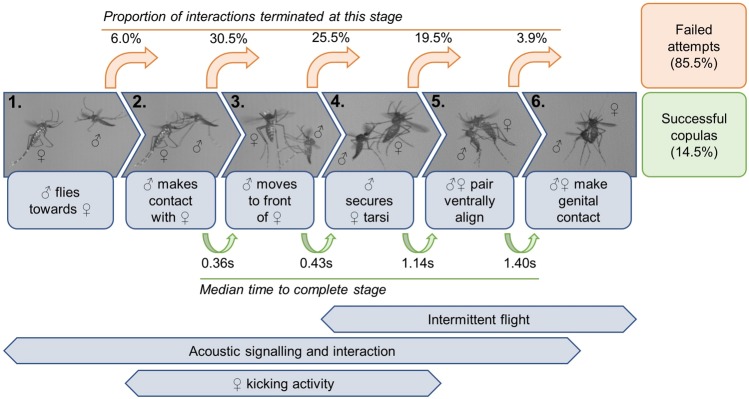
Figure 1
Figure 1
Flow diagram of the steps observed in mating interactions between free-flying male and tethered female Ae. aegypti mosquitoes (further detailed in Table 1). To make genital contact the pair must sequentially pass through each stage. Rejections (unsuccessful mating attempts)—which can be “active” or “passive” (Table 1)—may occur at any point post-contact and pre-genital engagement. Proportions above each “termination” arrow indicate the percentage of total mating attempts that failed at this stage (a full breakdown for each rejection type is given in Table 3). Green arrows give the median time taken to complete each stage, across all interactions that did so. Acoustic signalling, female kicking activity, and individual flight cessation feature across the span of the interaction.
Figure 2
Figure 2
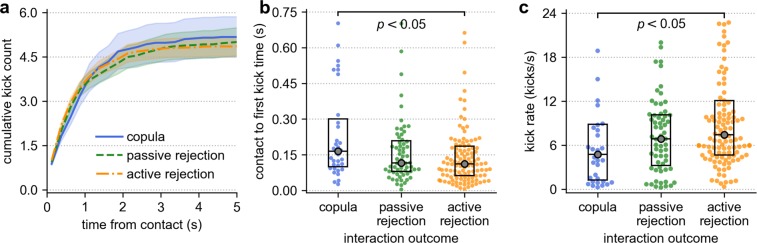
Kicking activity in different interaction outcome types. (a) Mean (±standard error) cumulative kick count plotted as a function of time from male-female contact. Most kicks take place within the first seconds of interaction, and at a similar rate across outcome types. (b) The distribution times at which the female first kicked the male, relative to contact, for each outcome type. (c) The kick rate (number of kicks divided by the kick period, Table 1) for different outcomes, only including interactions that involved more than one kick (kick period > 0). Boxes represent the median and interquartile range for each measure. In comparison to attempts that resulted in active rejection of the male, kicks began significantly later in copulas (Table 3, Dunn’s post-hoc test with Bonferonni correction; χ2 = 2.64, p = 1.26 × 10−2) and were delivered at a lower rate (Table 3, Dunn’s post-hoc test with Bonferroni correction; χ2 = −2.72, p = 9.68 × 10−3).
Figure 3
Figure 3
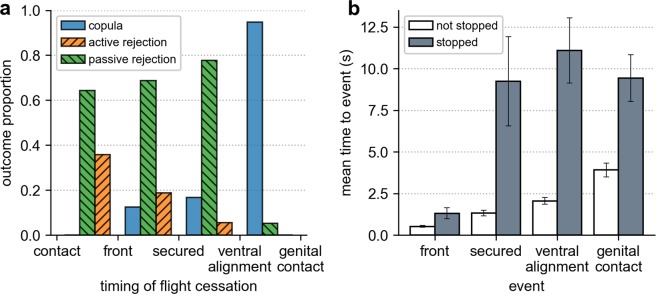
The effect of flight cessation on interaction outcome and progression speed. (a) The relative proportion of outcomes realised for interactions in which flight cessation took place between the labelled pre-copulatory behavioural events. Stoppage of flight overwhelmingly results in passive rejection, unless it occurs after the pair is ventrally aligned. Each interaction is only counted once. (b) The mean time from contact to event completion in all interactions where flight cessation did or did not occur at some point prior to the event. Vertical lines show the standard error. Note that “genital contact” data only considers those interactions that resulted in successful copula formation.
Figure 4
Figure 4
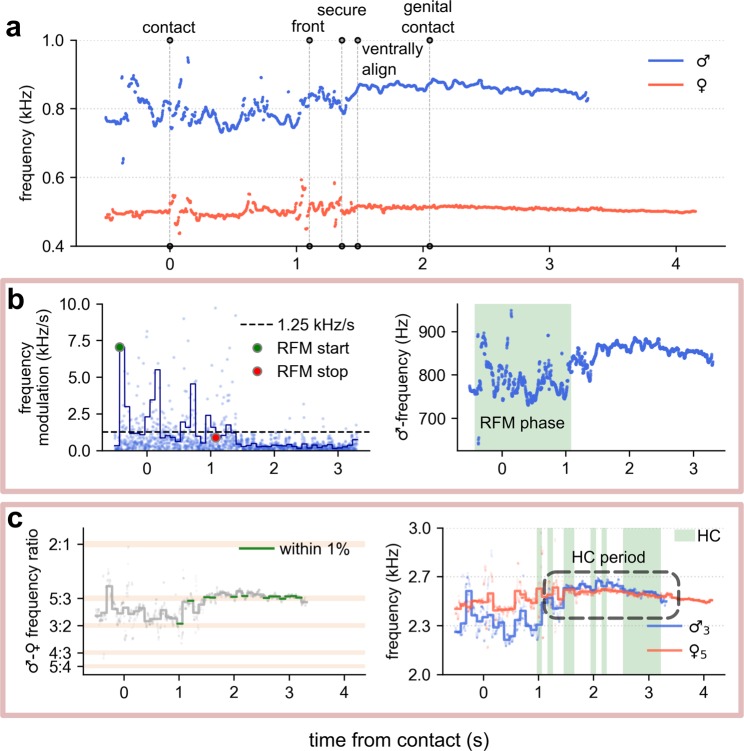
Wingbeat frequency measures of acoustic interactions for a mating attempt (in this instance one that resulted in copulation). (a) Male and female fundamental wingbeat frequencies extracted using the reassigned spectrogram method. Vertical dashed lines denote behavioural features of the interaction. (b) Detection of RFM, in male flight tones. Left panel: point-to-point fundamental frequency modulation, overlaid with a smoothed average (blue line) equivalent to 0.08 s per segment. The dashed line shows the RFM threshold of 1250 Hz/s, with initiation and termination of the RFM phase given respectively by the green and red markers. Right panel: the male fundamental wingbeat frequency with identified RFM phase highlighted. (c) Automated detection of harmonic convergence events. Left panel: smoothed male-female fundamental wingbeat frequency ratio spectra with convergent segments—characterised as being less than 1% deviation from a given harmonic combination—highlighted in green. Right panel: male and female harmonic frequencies with the automatically quantified convergent periods highlighted in green. In this case, convergence was identified at the male 3rd, female 5th harmonic overtone. Most harmonic convergence takes place when the wingbeat frequencies of both individuals are stabilised.
Figure 5
Figure 5
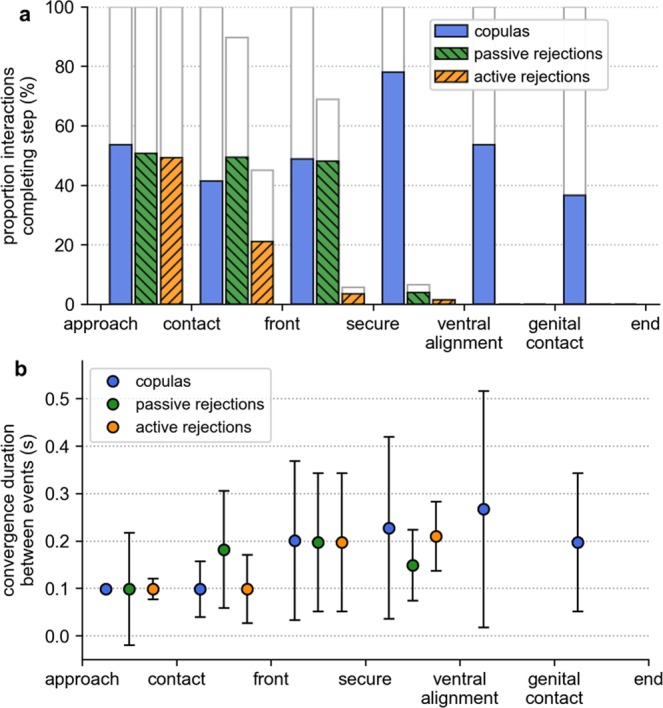
Harmonic convergence prevalence and duration at different pre-copulatory behavioural stages of interactions for different outcome types. (a) The proportion of all attempts completing each step. Coloured bars indicate the total proportion in which harmonic convergence was detected. (b) Median (±median absolute deviation) harmonic convergence durations between each behavioural step for all interactions, including those that did not complete the given stage. For interactions that ended during the period, convergence times were calculated over the interval beginning at the first event up to the point of termination.

References

    1. Alphey L, et al. Sterile-Insect Methods for Control of Mosquito-Borne Diseases: An Analysis. Vector-Borne Zoonotic Dis. 2010;10:295–311. doi: 10.1089/vbz.2009.0014. - DOI - PMC - PubMed
    1. Benelli G. Research in mosquito control: current challenges for a brighter future. Parasitol. Res. 2015;114:2801–2805. doi: 10.1007/s00436-015-4586-9. - DOI - PubMed
    1. Lees RS, Gilles JR, Hendrichs J, Vreysen MJ, Bourtzis K. Back to the future: the sterile insect technique against mosquito disease vectors. Curr. Opin. Insect Sci. 2015;10:156–162. doi: 10.1016/j.cois.2015.05.011. - DOI - PubMed
    1. Yakob L, Walker T. Zika virus outbreak in the Americas: the need for novel mosquito control methods. Lancet Glob. Heal. 2016;4:e148–e149. doi: 10.1016/S2214-109X(16)00048-6. - DOI - PubMed
    1. Lees RS, et al. Review: Improving our knowledge of male mosquito biology in relation to genetic control programmes. Acta Trop. 2014;132:S2–S11. doi: 10.1016/j.actatropica.2013.11.005. - DOI - PubMed

Publication types