. 2019 Feb 14;9(1):2097.
doi: 10.1038/s41598-019-38702-8.

Comparative Physiological and Metabolic Analysis Reveals a Complex Mechanism Involved in Drought Tolerance in Chickpea (Cicer arietinum L.) Induced by PGPR and PGRs

Affiliations

Comparative Physiological and Metabolic Analysis Reveals a Complex Mechanism Involved in Drought Tolerance in Chickpea (Cicer arietinum L.) Induced by PGPR and PGRs

Naeem Khan et al. Sci Rep. .

Abstract

The plant growth promoting rhizobacteria (PGPR) and plant growth regulators (PGRs) can be applied to improve the growth and productivity of plants, with potential to be used for genetic improvement of drought tolerance. However, for genetic improvement to be achieved, a solid understanding of the physiological and biochemical changes in plants induced by PGPR and PGR is required. The present study was carried out to investigate the role of PGPR and PGRs on the physiology and biochemical changes in chickpea grown under drought stress conditions and their association with drought tolerance. The PGPR, isolated from the rhizosphere of chickpea, were characterized on the basis of colony morphology and biochemical characters. They were also screened for the production of indole-3-acetic acid (IAA), hydrogen cyanide (HCN), ammonia (NH3), and exopolysaccharides (EPS) production. The isolated PGPR strains, named P1, P2, and P3, were identified by 16S-rRNA gene sequencing as Bacillus subtilis, Bacillus thuringiensis, and Bacillus megaterium, respectively. The seeds of two chickpea varieties, Punjab Noor-2009 (drought sensitive) and 93127 (drought tolerant) were soaked for 2-3 h prior to sowing in 24 h old cultures of isolates. The salicylic acid (SA) and putrescine (Put) were sprayed (150 mg/L) on 25 day old chickpea seedlings. The results showed that chickpea plants treated with a consortium of PGPR and PGRs significantly enhanced the chlorophyll, protein, and sugar contents compared to irrigated and drought conditions. Leaf proline content, lipid peroxidation, and activities of antioxidant enzymes (CAT, APOX, POD, and SOD) all increased in response to drought stress but decreased due to the PGPR and PGRs treatment. An ultrahigh performance liquid chromatography-high resolution mass spectrometry (UPLC-HRMS) analysis was carried out for metabolic profiling of chickpea leaves planted under controlled (well-irrigated), drought, and consortium (drought plus PGPR and PGRs) conditions. Proline, L-arginine, L-histidine, L-isoleucine, and tryptophan were accumulated in the leaves of chickpea exposed to drought stress. Consortium of PGPR and PGRs induced significant accumulation of riboflavin, L-asparagine, aspartate, glycerol, nicotinamide, and 3-hydroxy-3-methyglutarate in the leaves of chickpea. The drought sensitive chickpea variety showed significant accumulation of nicotinamide and 4-hydroxy-methylglycine in PGPR and PGR treated plants at both time points (44 and 60 days) as compared to non-inoculated drought plants. Additionally, arginine accumulation was also enhanced in the leaves of the sensitive variety under drought conditions. Metabolic changes as a result of drought and consortium conditions highlighted pools of metabolites that affect the metabolic and physiological adjustments in chickpea that reduce drought impacts.


Conflict of interest statement

The authors declare no competing interests.

Figures
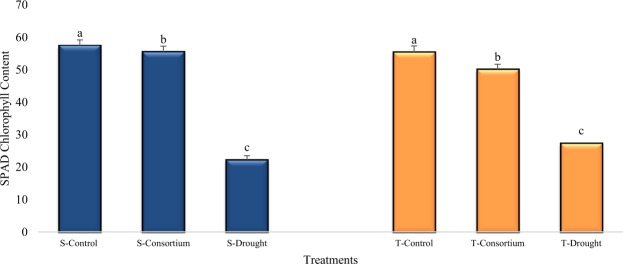
Figure 1
Figure 1
Mean chlorophyll content (±SE) in the leaves of drought sensitive (S) and tolerant variety (T) varieties under irrigated, drought, and consortium treatments across 14 and 25 days after water treatment imposition. Data are means of six replicates along with standard error bars. Different letters are indicating significant differences (P < 0.05) among treatments (control vs consortium vs drought) for a variety.
Figure 2
Figure 2
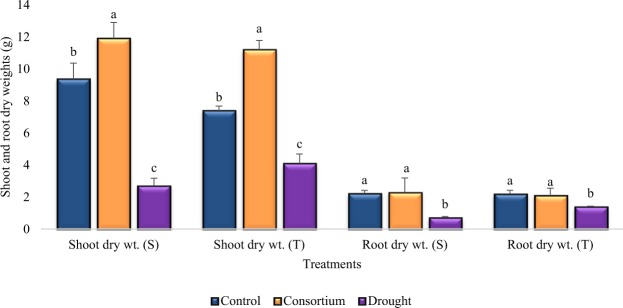
Mean shoot and root dry weights (±SE) of chickpea under control, drought, and consortium treatments after 25 days of drought stress imposition. S-drought sensitive variety (Punjab Noor-2009), T-drought tolerant variety (93127). Error bars represent standard errors of the mean (n = 6). Different letters are indicating significant differences (P < 0.05) among treatments (control vs drought vs consortium) for a variety.
Figure 3
Figure 3
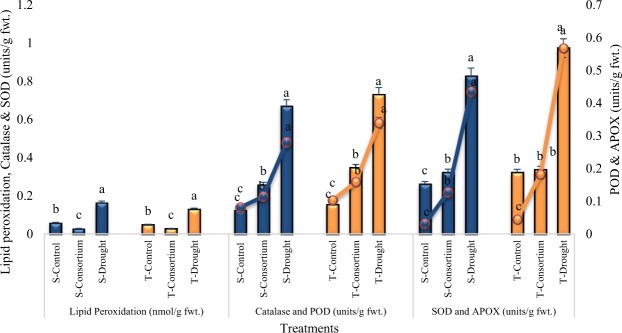
Mean lipid peroxidation (nmol/g fwt.) and antioxidant enzyme activities (±SE) in the leaves of drought sensitive (S) and tolerant variety (T) varieties under irrigated, drought, and consortium treatments. Data are means of six replicates along with standard error bars. Different letters are indicating significant differences (P < 0.05) among treatments (control vs consortium vs drought) for a variety.
Figure 4
Figure 4
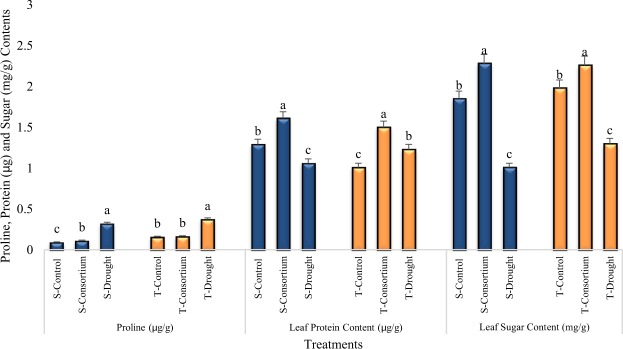
Mean leaf proline, protein and sugar contents (±SE) in the leaves of drought sensitive (S) and tolerant (T) varieties under irrigated, drought, and consortium treatments. Data are average of six replicates along with standard error bars. Different letters are indicating significant differences (P < 0.05) among treatments (control vs consortium vs drought) for a variety.
Figure 5
Figure 5
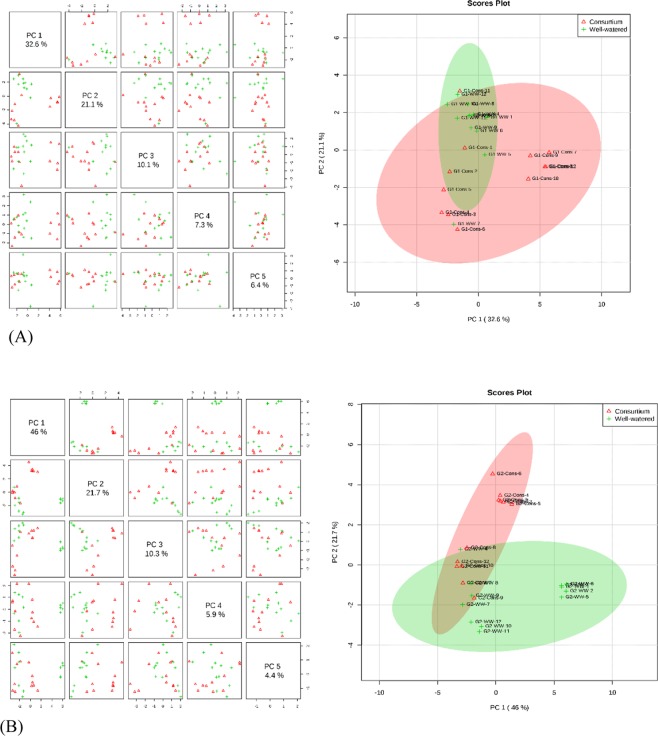
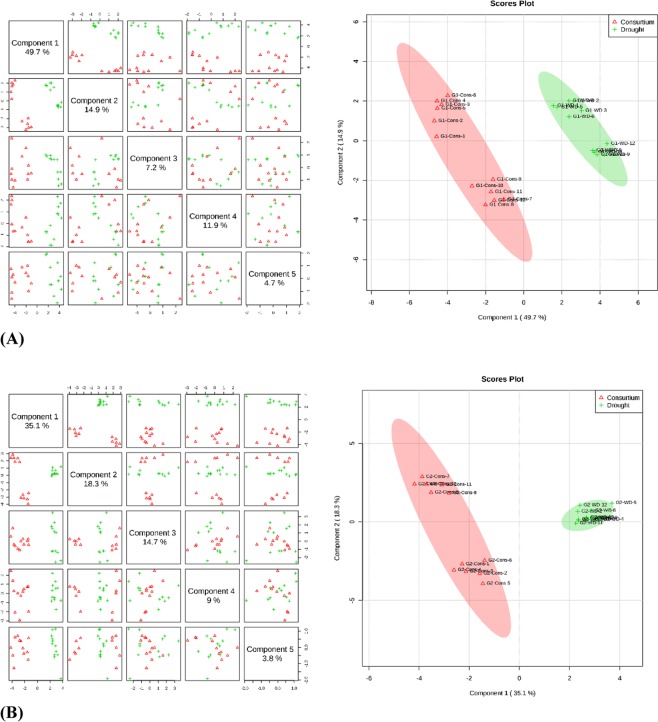
Partial least square discriminant analysis (PLS-DA) and 2D Scores loading plot for the drought sensitive variety Punjab Noor-2009 (A) and drought tolerant variety 93127 (B) at 2 time points under control (well-watered) and consortium treatments (A). Metabolites at two treatments overlapped with each other indicating an unchanged state of metabolite levels in the chickpea leaves.
Figure 6
Figure 6
Partial least square discriminant analysis (PLS-DA) and 2 Scores loading plot for the drought sensitive variety Punjab Noor-2009 (A) and drought tolerant variety 93127 (B) at 2 time points under consortium and drought treatments. Metabolites at consortium and drought treatments did not overlap indicating an altered state of metabolite levels in the chickpea leaves.
Figure 7
Figure 7
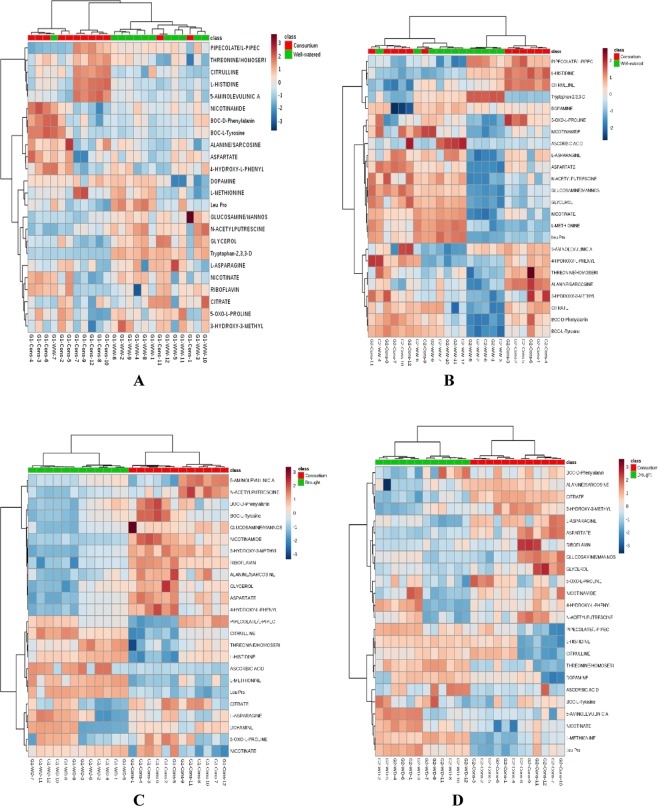
Heat maps, (A) (consortium vs well-watered for drought sensitive variety Punjab Noor-2009), (B) (consortium vs well-watered for drought tolerant variety 93127), (C) (consortium vs drought for drought sensitive variety Punjab Noor-2009), and (D) (consortium vs drought for drought tolerant variety 93127), are illustrating top metabolites at two time points. The heat maps were generated based on using Pearson and Ward for distance measure and clustering algorithm, respectively. Metabolite feature areas were normalized and range-scaled across all experimental samples at two different time points.

References

    1. Mor A, et al. Singlet oxygen signatures are detected independent of light or chloroplasts in response to multiple stresses. Plant Physiol. 2014;165(1):249–261. doi: 10.1104/pp.114.236380. - DOI - PMC - PubMed
    1. Obata, T. et al. Metabolite profiles of maize leaves in drought, heat and combined stress field trials reveal the relationship between metabolism and grain yield. Plant Physiol. 01164 (2015). - PMC - PubMed
    1. Xu GY, et al. A novel rice calmodulin-like gene, OsMSR2, enhances drought and salt tolerance and increases ABA sensitivity in Arabidopsis. Planta. 2011;234(1):47–59. doi: 10.1007/s00425-011-1386-z. - DOI - PubMed
    1. Xu X, et al. Sex‐specific responses of Populus cathayana to drought and elevated temperatures. Plant. Cell. Environ. 2008;31(6):850–860. doi: 10.1111/j.1365-3040.2008.01799.x. - DOI - PubMed
    1. Zhao Y, et al. Systematic analysis of sequences and expression patterns of drought-responsive members of the HD-Zip gene family in maize. PloS One. 2011;6(12):e28488. doi: 10.1371/journal.pone.0028488. - DOI - PMC - PubMed

Publication types