. 2019 Mar;120(6):601-611.
doi: 10.1038/s41416-018-0375-4. Epub 2019 Feb 15.

Brivanib in combination with Notch3 silencing shows potent activity in tumour models

Affiliations

Brivanib in combination with Notch3 silencing shows potent activity in tumour models

Catia Giovannini et al. Br J Cancer. 2019 Mar.

Abstract

Background: Sorafenib is the first targeted agent proven to improve survival of patients with advanced hepatocellular carcinoma (HCC) and it has been used in first line treatments with heterogeneous response across patients. Most of the promising agents evaluated in first-line or second-line phase III trials for HCC failed to improve patient survival. The absence of molecular characterisation, including the identification of pathways driving resistance might be responsible for these disappointing results.

Methods: 2D DIGE and MS analyses were used to reveal proteomic signatures resulting from Notch3 inhibition in HepG2 cells, combined with brivanib treatment. The therapeutic potential of Notch3 inhibition combined with brivanib treatment was also demonstrated in a rat model of HCC and in cell lines derived from different human cancers.

Results: Using a proteomic approach, we have shown that Notch3 is strongly involved in brivanib resistance through a p53-dependent regulation of enzymes of the tricarboxylic acid (TCA), both in vitro and in vivo.

Conclusion: We have demonstrated that regulation of the TCA cycle is a common mechanism in different human cancers, suggesting that Notch3 inhibitors combined with brivanib treatment may represent a strong formulation for the treatment of HCC as well as Notch3-driven cancers.


Conflict of interest statement

The authors declare no competing interests.

Figures
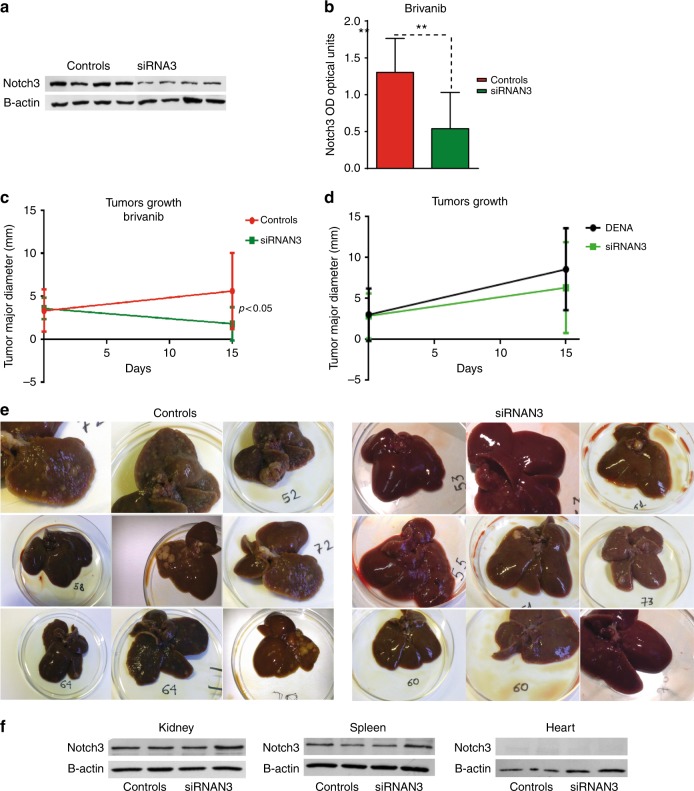
Fig. 1
Fig. 1
In vivo evidence of the role of Notch3 in brivanib resistance. a Representative Notch3 expression in rat HCC nodules detected by western blotting. Higher Notch3 expression was observed in controls, compared to Notch3-silenced rats (siRNAN3). All rats were treated with brivanib for 15 days. b Notch3 levels detected by western blotting were quantified and expressed as ratio with respect to housekeeping β-actin. **p < 0.01 (by two tailed Student’s t-test). c A difference in tumour growth was evident between controls vs. siRNAN3 after 15 days of brivanib treatment. p < 0.05 by two-tailed Student’s t-test. d Tumours growth analysis in DENA treated rats and in Notch3-depleted animals. e Macroscopic examination showing the upper and lower surfaces of representative cases of controls and siRNAN3 livers treated with brivanib for 15 days. Livers from rats treated by brivanib associated with siRNAN3 displayed a lower nodularity, as well as a lower number of tumours. f siRNAN3 does not affect Notch3 expression in Kidney, spleen and heart as evaluated by western blot
Fig. 2
Fig. 2
Effects of Notch3 silencing on brivanib response in vitro. a Efficacy of Notch3 silencing (shN3) was measured by western blotting in HepG2, Huh7 and Hep3B cells. b Cell cycle distribution of control (GL2) and Notch3-depleted (shN3) cells in response to 60 μM brivanib were quantified by FACS analysis after 48 h of treatment. Results are the mean of three independent experiments (±S.E.). *p < 0.05; **p < 0.01 values by two-tailed Student’s t-test. c After treatment with 60 μM brivanib for 72 h, HepG2, Huh7 and Hep3B cells were labelled with annexin V-FITC and propidium iodide. The distribution pattern of live and apoptotic cells was determined by FACS analysis. x-axis represents propidium staining (PE) and y-axis represents FITC staining. Data are representative of at least three independent experiments
Fig. 3
Fig. 3
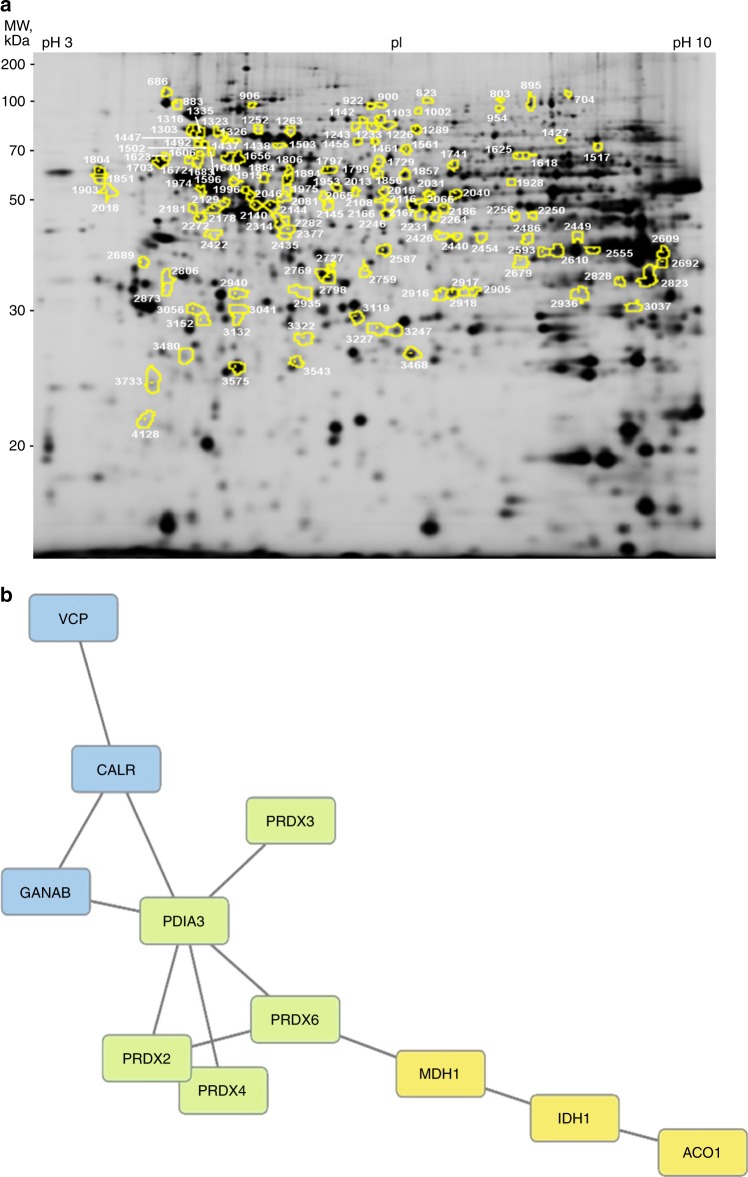
Proteomic analysis of HepG2-GL2 and HepG2-shN3 preventively treated with brivanib. a Analytical two-dimensional gel electrophoresis of HepG2 proteins. The figure reports the Cy2-labelled proteins on the scanned master gel. Preparative and analytical assays were performed as reported in the experimental section. Differentially represented spots are numbered in the gel image; they were picked automatically from a preparative gel for protein identification and analysed for their tryptic digests by nLC-ESI-LIT-MS/MS. Protein identification results are reported in Supplementary Table 1. b STRING analysis of differentially represented proteins identified by combined 2D-DIGE/nLC-ESI-LIT-MS/MS analysis. Protein acronyms are reported in capital letters
Fig. 4
Fig. 4
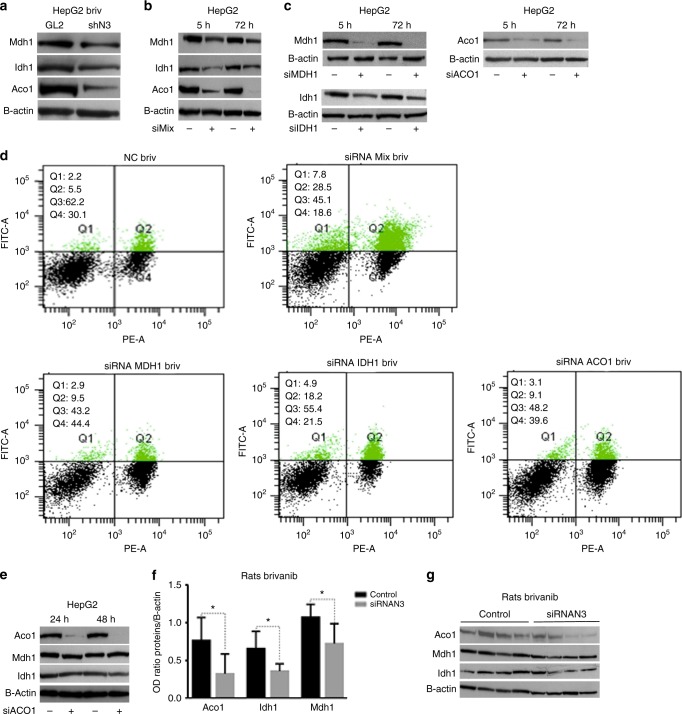
Enzymes of the TCA cycle are involved in brivanib resistance. a Western blotting analysis confirms a down-representation of Mdh1, Idh1 and Aco1 proteins in Notch3-depleted HepG2 cells compared to GL2 control cells, when both were exposed to 60 μM brivanib for 72 h. b–d HepG2 were transiently transfected with a pool of siRNAs (siMix) directed against Mdh1, Idh1, Aco1 or negative control (NC) for 5 and 72 h. Single gene silencing was also performed as showed in panel c. Five hours post-transfection, cells were treated with 60 μM brivanib for 72 h, and apoptosis was assessed by annexin V-FITC and propidium iodide. Data are representative of at least three independent experiments. e Aco1 silencing, the first enzyme involved in the TCA cycle, does not affect the representation of Mdh1 and Idh1, as evaluated by western blotting. f Aco1, Idh1 and Mdh1 protein representation was detected by western blotting in rat HCCs exposed to brivanib for 15 days; it is expressed as ratio with respect to β-actin housekeeping. *p < 0.05 (by two-tailed Student’s t-test). g Representative western blot analyses of Aco1, Mdh1 and Idh1 protein representation in rat HCCs treated either by brivanib alone or in combination with Notch3 inhibitors
Fig. 5
Fig. 5
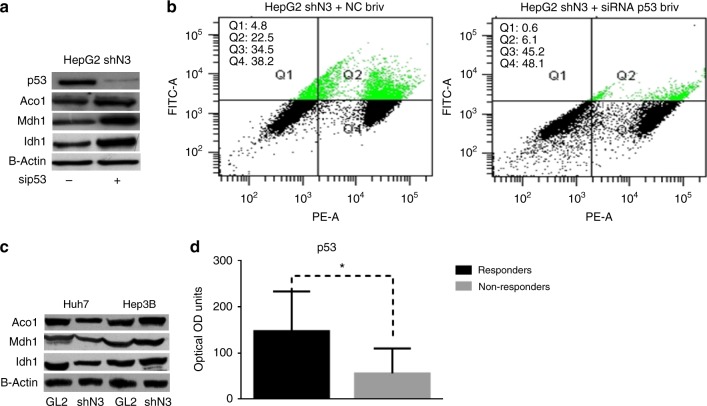
P53 is required to enhance the cytotoxicity of brivanib. a and b Endogenous p53 expression was ablated by transient siRNA transfection in Notch3-depleted HepG2 cells, and p53, Aco1, Mdh1 and Idh1 protein levels were evaluated by western blotting 5 h post-transfection. Cells were treated with 60 μM brivanib for 72 h, and apoptosis was assessed by annexin V-FITC and propidium iodide. Data are representative of three independent experiments. c Aco1, Mdh1 and Idh1 protein representation evaluated in Huh7 and Hep3B control cells (GL2) and in Notch3KD cells (shN3) by western blotting. d p53 protein representation evaluated by ELISA in HCC tissue of 20 rats treated with brivanib for 15 days and grouped accordingly to response to treatment
Fig. 6
Fig. 6
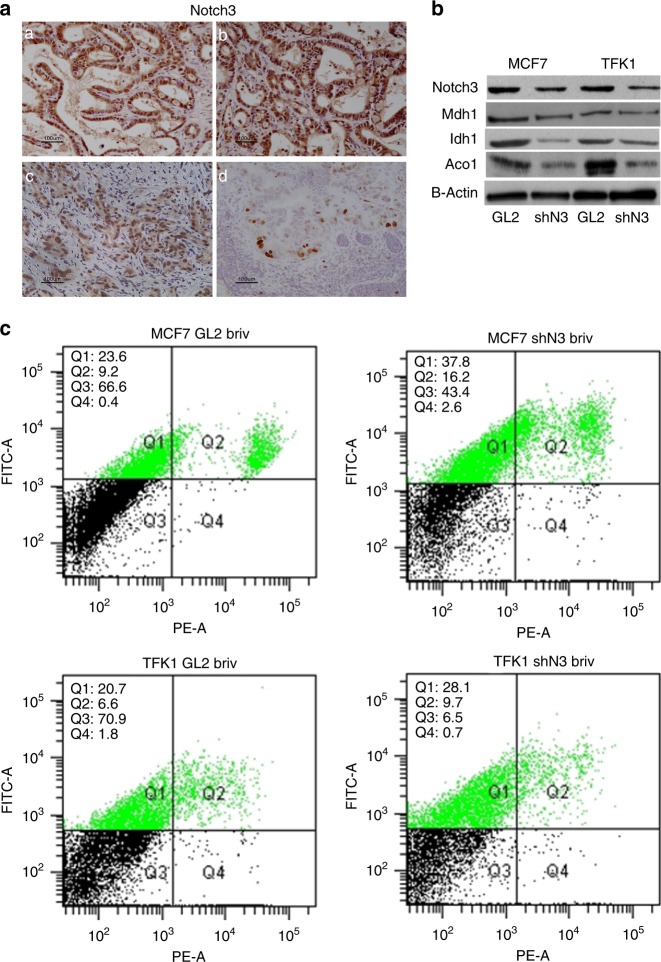
Notch3 confers resistance to brivanib in different tumour models. a Immunohistochemistry of Notch3 in four representative cases of CCA (a–d). Notch3 accumulation was evident in the nucleus. Scale bars = 100 μm. b Mdh1, Idh1 and Aco1 protein representation evaluated by western blotting in MCF7 and TFK1 negative control (GL2) and Notch3-silenced cells (shN3). c After treatment with 60 μM brivanib for 72 h, MCF7 and TFK1 cells were labelled with annexin V-FITC and propidium iodide. The distribution pattern of live and apoptotic cells was determined by FACS analysis

References

    1. Ferlay J, et al. Cancer incidence and mortality worldwide: sources, methods and major patterns in GLOBOCAN 2012. Int. J. Cancer. 2015;136:E359–E386. doi: 10.1002/ijc.29210. - DOI - PubMed
    1. Ziogas IA, Tsoulfas G. Evolving role of Sorafenib in the management of hepatocellular carcinoma. World J. Clin. Oncol. 2017;8:203–213. doi: 10.5306/wjco.v8.i3.203. - DOI - PMC - PubMed
    1. Bhide RS, et al. The antiangiogenic activity in xenograft models of brivanib, a dual inhibitor of vascular endothelial growth factor receptor-2 and fibroblast growth factor receptor-1 kinases. Mol. Cancer Ther. 2010;9:369–378. doi: 10.1158/1535-7163.MCT-09-0472. - DOI - PubMed
    1. Park JW, et al. Phase II, open-label study of brivanib as first-line therapy in patients with advanced hepatocellular carcinoma. Clin. Cancer Res. 2011;17:1973–1983. doi: 10.1158/1078-0432.CCR-10-2011. - DOI - PubMed
    1. Johnson PJ, et al. Brivanib versus sorafenib as first-line therapy in patients with unresectable, advanced hepatocellular carcinoma: results from the randomized phase III BRISK-FL study. J. Clin. Oncol. 2013;31:3517–3524. doi: 10.1200/JCO.2012.48.4410. - DOI - PubMed

Publication types

MeSH terms