


Compensatory Relearning Following Stroke: Cellular and Plasticity Mechanisms in Rodents
- PMID: 30766468
- PMCID: PMC6365459
- DOI: 10.3389/fnins.2018.01023
Compensatory Relearning Following Stroke: Cellular and Plasticity Mechanisms in Rodents
Abstract
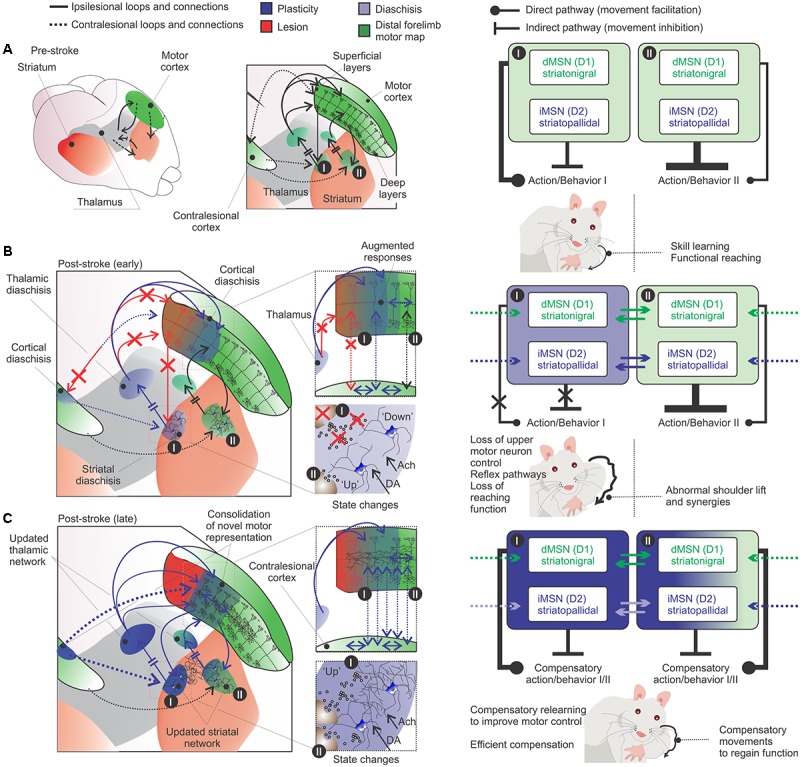
von Monakow's theory of diaschisis states the functional 'standstill' of intact brain regions that are remote from a damaged area, often implied in recovery of function. Accordingly, neural plasticity and activity patterns related to recovery are also occurring at the same regions. Recovery relies on plasticity in the periinfarct and homotopic contralesional regions and involves relearning to perform movements. Seeking evidence for a relearning mechanism following stroke, we found that rodents display many features that resemble classical learning and memory mechanisms. Compensatory relearning is likely to be accompanied by gradual shaping of these regions and pathways, with participating neurons progressively adapting cortico-striato-thalamic activity and synaptic strengths at different cortico-thalamic loops - adapting function relayed by the striatum. Motor cortex functional maps are progressively reinforced and shaped by these loops as the striatum searches for different functional actions. Several cortical and striatal cellular mechanisms that influence motor learning may also influence post-stroke compensatory relearning. Future research should focus on how different neuromodulatory systems could act before, during or after rehabilitation to improve stroke recovery.
Keywords: motor learning; pharmacotherapy; plasticity; rehabilitation; stroke.
Figures
References
-
- Akita H., Ogata M., Jitsuki S., Ogura T., Oh-Nishi A., Hoka S., et al. (2006). Nigral injection of antisense oligonucleotides to synaptotagmin I using HVJ-liposome vectors causes disruption of dopamine release in the striatum and impaired skill learning. Brain Res. 1095 178–189. 10.1016/j.brainres.2006.04.039 - DOI - PubMed
-
- Amitai Y., Connors B. W. (1995). “Intrinsic physiology and morphology of single neurons in neocortex,” in The Barrel Cortex of Rodents, eds Jones E. G., Diamond I. (New York, NY: Plenum Press; ), 299–331.
Publication types
LinkOut - more resources
Full Text Sources
