


Macrophage Activation-Like Syndrome: A Distinct Entity Leading to Early Death in Sepsis
- PMID: 30766533
- PMCID: PMC6365431
- DOI: 10.3389/fimmu.2019.00055
Macrophage Activation-Like Syndrome: A Distinct Entity Leading to Early Death in Sepsis
Abstract
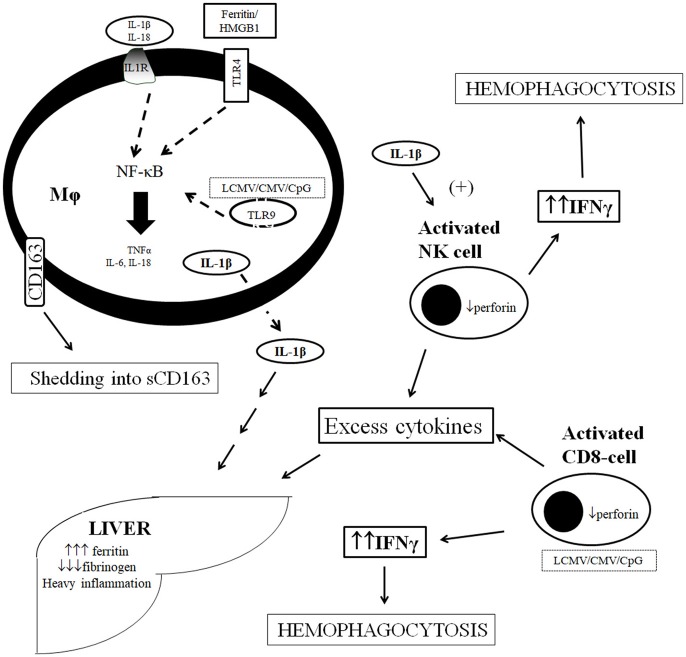
Hemophagocytic lymphohistocytosis (HLH) is characterized by fulminant cytokine storm leading to multiple organ dysfunction and high mortality. HLH is classified into familial (fHLH) and into secondary (sHLH). fHLH is rare and it is due to mutations of genes encoding for perforin or excretory granules of natural killer (NK) cells of CD8-lymphocytes. sHLH is also known as macrophage activation syndrome (MAS). Macrophage activation syndrome (MAS) in adults is poorly studied. Main features are fever, hepatosplenomegaly, hepatobiliary dysfunction (HBD), coagulopathy, cytopenia of two to three cell lineages, increased triglycerides and hemophagocytosis in the bone marrow. sHLH/MAS complicates hematologic malignancies, autoimmune disorders and infections mainly of viral origin. Pathogenesis is poorly understood and it is associated with increased activation of macrophages and NK cells. An autocrine loop of interleukin (IL)-1β over-secretion leads to cytokine storm of IL-6, IL-18, ferritin, and interferon-gamma; soluble CD163 is highly increased from macrophages. The true incidence of sHLH/MAS among patients with sepsis has only been studied in the cohort of the Hellenic Sepsis Study Group. Patients meeting the Sepsis-3 criteria and who had positive HSscore or co-presence of HBD and disseminated intravascular coagulation (DIC) were classified as patients with macrophage activation-like syndrome (MALS). The frequency of MALS ranged between 3 and 4% and it was an independent entity associated with early mortality after 10 days. Ferritin was proposed as a diagnostic and surrogate biomarker. Concentrations >4,420 ng/ml were associated with diagnosis of MALS with 97.1% specificity and 98% negative predictive value. Increased ferritin was also associated with increased IL-6, IL-18, IFNγ, and sCD163 and by decreased IL-10/TNFα ratio. A drop of ferritin by 15% the first 48 h was a surrogate finding of favorable outcome. There are 10 on-going trials in adults with sHLH; two for the development of biomarkers and eight for management. Only one of them is focusing in sepsis. The acronym of the trial is PROVIDE (ClinicalTrials.gov NCT03332225) and it is a double-blind randomized clinical trial aiming to deliver to patients with septic shock treatment targeting their precise immune state. Patients diagnosed with MALS are receiving randomized treatment with placebo or the IL-1β blocker anakinra.
Keywords: ferritin; hemophagocytic lymphohistocytosis; interferon-gamma; interleukins; macrophage activation syndrome; sepsis.
Figures
References
-
- Carcillo L, Carcillo JA. Secondary hemophagocytic lymphohistocytosis and severe sepsis/systemic inflammatory response/multiorgan dysfunction syndrome/macrophage activation syndrome share common intermediate phenotypes on a spectrum of inflammation. Pediatr Crit Care Med. (2009) 10:387–92. 10.1097/PCC.0b013e3181a1ae08 - DOI - PubMed
Publication types
MeSH terms
Substances
Associated data
LinkOut - more resources
Full Text Sources
Other Literature Sources
Medical
Research Materials
Miscellaneous
