


Women's attitude and reasons toward justifying domestic violence in Ethiopia: a systematic review and meta-analysis
- PMID: 30766592
- PMCID: PMC6354873
- DOI: 10.4314/ahs.v18i4.47
Women's attitude and reasons toward justifying domestic violence in Ethiopia: a systematic review and meta-analysis
Abstract
Background: Domestic violence (DV) is a global public problem that touches all levels of society and socio-economic status. Identifying women's attitudes towards domestic violence is an important first step in the prevention and control of its consequence. Thus, this systematic review and meta-analysis aimed: (i) to synthesize women's reasons for justifying domestic violence and (ii) to determine the pooled prevalence of women's attitude towards domestic violence in Ethiopia.
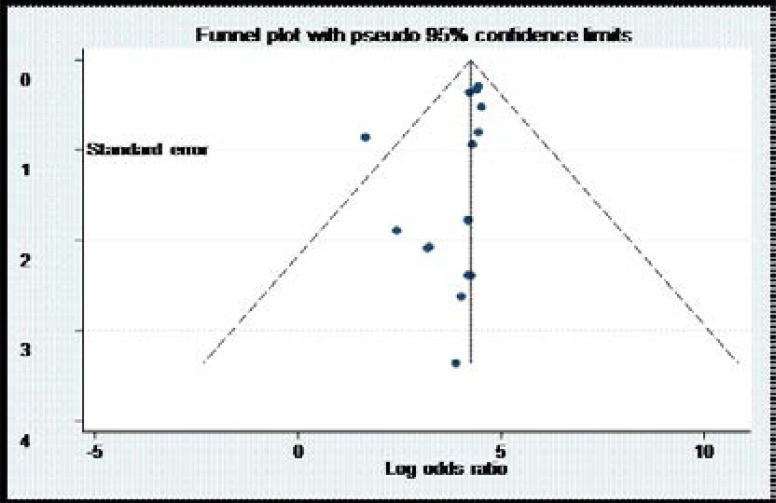
Methods: Pub-Med and google scholar data bases searched for quantitative cross-sectional studies. The study quality was assessed with the Newcastle-Ottawa quality assessment tool. Heterogeneity test and evidence of publication bias were assessed. Pooled prevalence of women's attitude was calculated with 95%CI using random effects model.
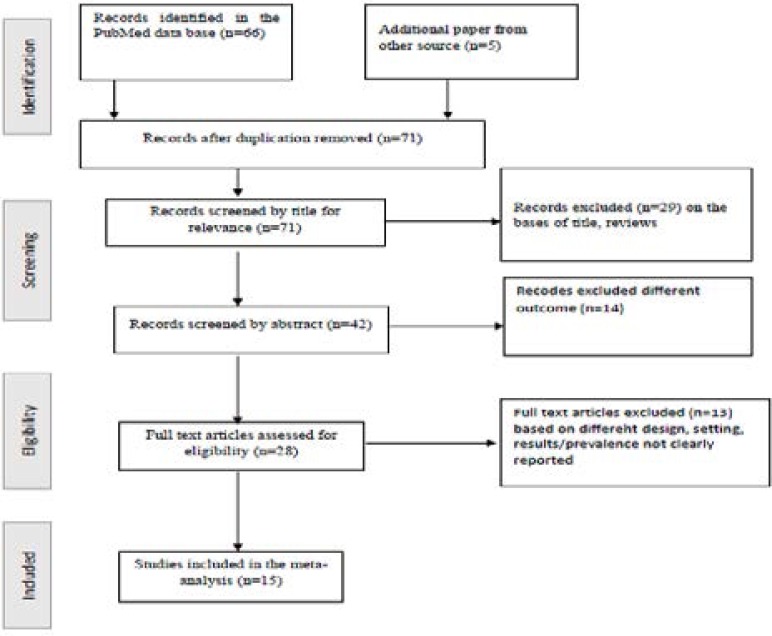
Results: A total of 15 articles were included in the study. The pooled prevalence of women's attitude towards justifying domestic violence was found to be 57% (95% CI; 47.0%-67.2%). Reasons for justifying were: burning food, argues with husband, goes out without telling, neglects children, refuses sex, unfaithful, disobeys and suspects infidelity.
Conclusion: More than half of women accept domestic violence. Authors' suggest strengthening of women's awareness toward norms that justify wife beating.
Keywords: Attitude; Ethiopia; domestic violence.
Figures

References
-
- Ellsberg M, Garcia-Moreno C, Heise L, Jansen H, Watts C. WHO Multi-country Study on Women's Health and Domestic Violence against Women. 2005. - PubMed
-
- WHO, author. Understanding and addressing violence against women intimate partner violence. 2012.
-
- Central Statistical Agency & ICF International, author. Ethiopia demographic and health survey 2011. Addis Ababa, Ethiopia and Calverton, MD, USA: Central Statistical Agency & ICF International; 2012.
-
- Nations. U, author. Consideration of reports submitted by States parties under article 18 of the Convention on the Elimination of All Forms of Discrimination against Women combined sixth and seventh periodic reports of States parties Ethiopia. 2010. pp. 1–46.
-
- World Health Organization, author. Global and regional estimates of violence against women: prevalence and health effects of intimate partner violence and non-partner sexual violence. Geneva: WHO; 2013.
Publication types
MeSH terms
LinkOut - more resources
Full Text Sources