


Proenkephalin and prognosis in heart failure with preserved ejection fraction: a GREAT network study
- PMID: 30767059
- PMCID: PMC6652170
- DOI: 10.1007/s00392-019-01424-y
Proenkephalin and prognosis in heart failure with preserved ejection fraction: a GREAT network study
Abstract
Background: Proenkephalin (PENK), a stable endogenous opioid biomarker related to renal function, has prognostic utility in acute and chronic heart failure. We investigated the prognostic utility of PENK in heart failure with preserved ejection fraction (HFpEF), and its relationship to renal function, Body Mass Index (BMI), and imaging measures of diastolic dysfunction.
Methods: In this multicentre study, PENK was measured in 522 HFpEF patients (ejection fraction > 50%, 253 male, mean age 76.13 ± 10.73 years) and compared to 47 age and sex-matched controls. The primary endpoint was 2-years composite of all-cause mortality and/or heart failure rehospitalisation (HF). A subset (n = 163) received detailed imaging studies.
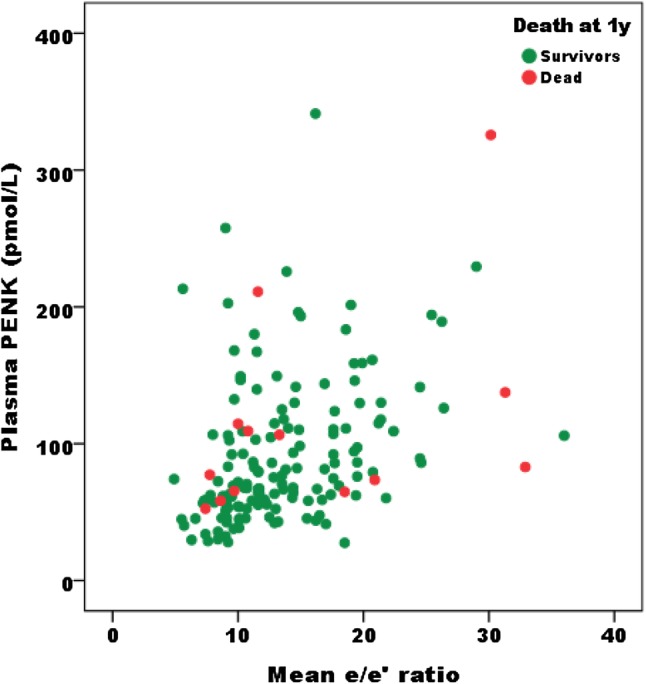
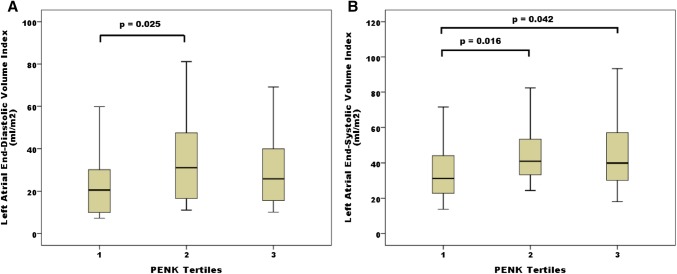
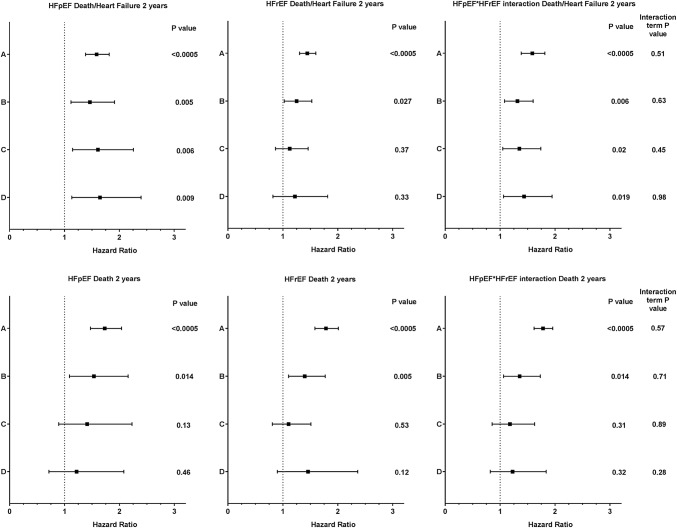
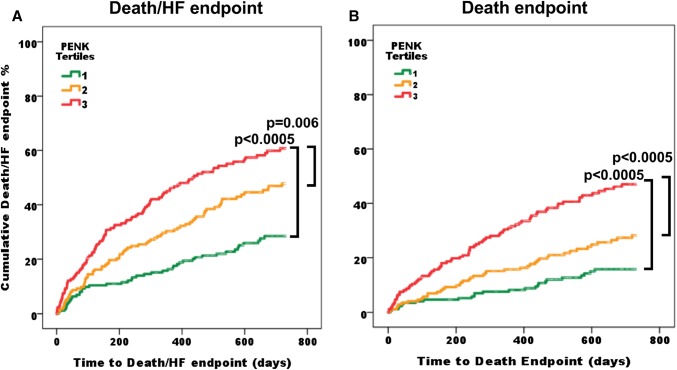
Results: PENK levels were raised in HFpEF (median [interquartile range] 88.9 [62.1-132.0]) compared to normal controls (56.3 [47.9-70.5]). PENK was correlated to urea, eGFR, Body Mass Index and E/e' (rs 0.635, - 0.741, - 0.275, 0.476, respectively, p < 0.0005). During 2 years follow-up 144 patients died and 220 had death/HF endpoints. Multivariable Cox regression models showed PENK independently predicted 2 year death/HF [hazard ratio (for 1 SD increment of log-transformed biomarker) HR 1.45 [95% CI 1.12-1.88, p = 0.005]], even after adjustment for troponin (HR 1.59 [1.14-2.20, p = 0.006]), and Body Mass Index (HR 1.63 [1.13-2.33, p = 0.009]). PENK showed no interaction with ejection fraction status for prediction of poor outcomes. Net reclassification analyses showed PENK significantly improved classification of death/HF outcomes for multivariable models containing natriuretic peptide, troponin and Body Mass Index (p < 0.05 for all).
Conclusions: In HFpEF, PENK levels are related to BMI, and measures of diastolic dysfunction and are prognostic for all-cause mortality and heart failure rehospitalisation.
Keywords: B-type natriuretic peptide; Heart failure; Opioids; Preserved ejection fraction; Proenkephalin; Renal function.
Conflict of interest statement
Dr. Bergmann holds ownership in Sphingotec GmbH which manufactures the PENK assay, and is a member of the board of directors of Sphingotec GmbH. Dr. Struck is an employee of Sphingotec GmbH which manufactures the PENK assay. Dr. Mueller has received research grants from the Swiss National Science Foundation, the Swiss Heart Foundation, the European Union, the Cardiovascular Research Foundation Basel, the University Hospital Basel, Abbott, Astra Zeneca, Beckman Coulter, BG medicine, Biomerieux, BRAHMS, Critical Diagnostics, Nanosphere, Roche, Siemens, Singulex, Sphingotec, 8sense as well as speaker/consulting honoraria from Abbott, Alere, Astra Zeneca, Biomerieux, BMS, Boehringer Ingelheim, BRAHMS, Cardiorentis, Eli Lilly, Novartis, Roche, Sanofi, Siemens, and Singulex. Dr Squire has received research grants from Novartis AG and Servier as well as speaker/consulting honoraria from Novartis. The authors declare that they have no conflict of interest.
Figures
References
-
- Anand IS, Rector TS, Cleland JG, et al. Prognostic value of baseline plasma amino-terminal pro-brain natriuretic peptide and its interactions with irbesartan treatment effects in patients with heart failure and preserved ejection fraction: findings from the I-PRESERVE trial. Circ Heart Fail. 2011;4(5):569–577. doi: 10.1161/CIRCHEARTFAILURE.111.962654. - DOI - PubMed
-
- Tschöpe C, Birner C, Böhm M, et al. Heart failure with preserved ejection fraction: current management and future strategies: expert opinion on the behalf of the nucleus of the “Heart Failure Working Group” of the German Society of Cardiology (DKG) Clin Res Cardiol. 2018;107:1–19. doi: 10.1007/s00392-017-1170-6. - DOI - PubMed
Publication types
MeSH terms
Substances
Grants and funding
LinkOut - more resources
Full Text Sources
Medical
Molecular Biology Databases
Research Materials
Miscellaneous
