. 2019 Jul;60(1):14-24.
doi: 10.1002/mus.26447. Epub 2019 Mar 8.

Long-term safety and efficacy of eculizumab in generalized myasthenia gravis

Collaborators, Affiliations

Long-term safety and efficacy of eculizumab in generalized myasthenia gravis

Srikanth Muppidi et al. Muscle Nerve. 2019 Jul.

Abstract

Introduction: Eculizumab is effective and well tolerated in patients with antiacetylcholine receptor antibody-positive refractory generalized myasthenia gravis (gMG; REGAIN; NCT01997229). We report an interim analysis of an open-label extension of REGAIN, evaluating eculizumab's long-term safety and efficacy.

Methods: Eculizumab (1,200 mg every 2 weeks for 22.7 months [median]) was administered to 117 patients.

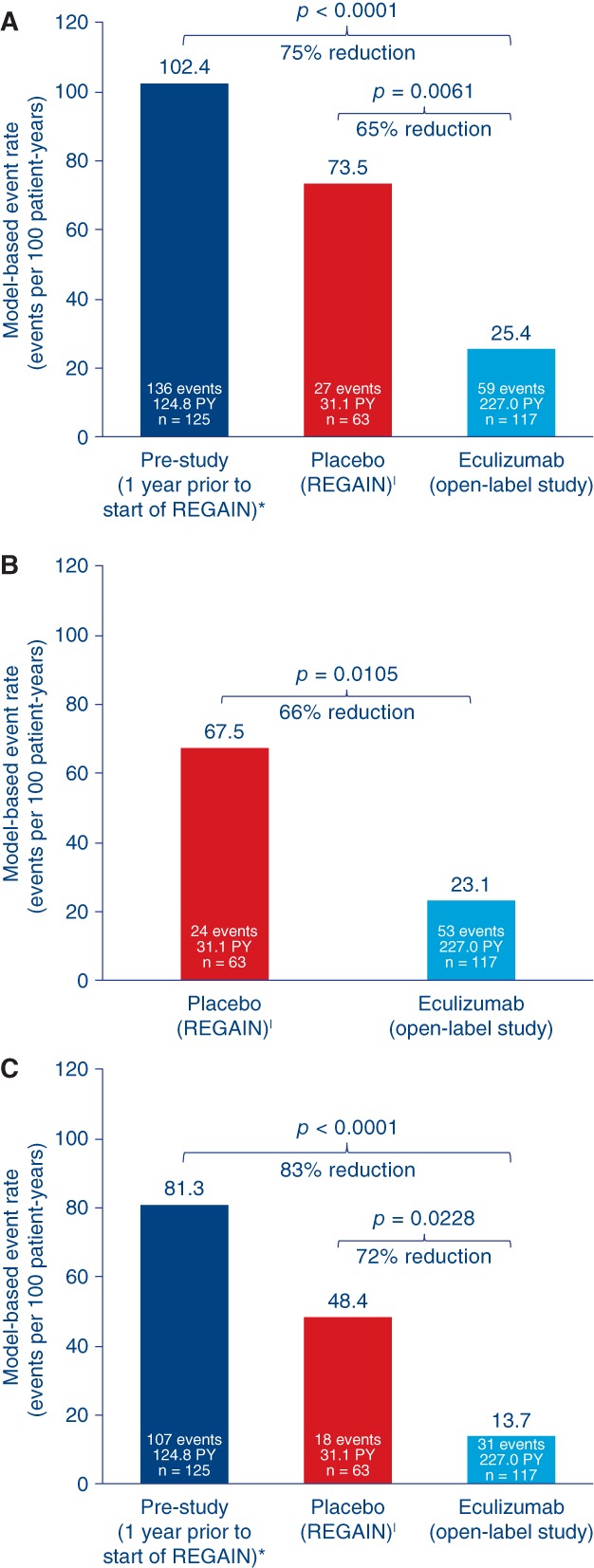
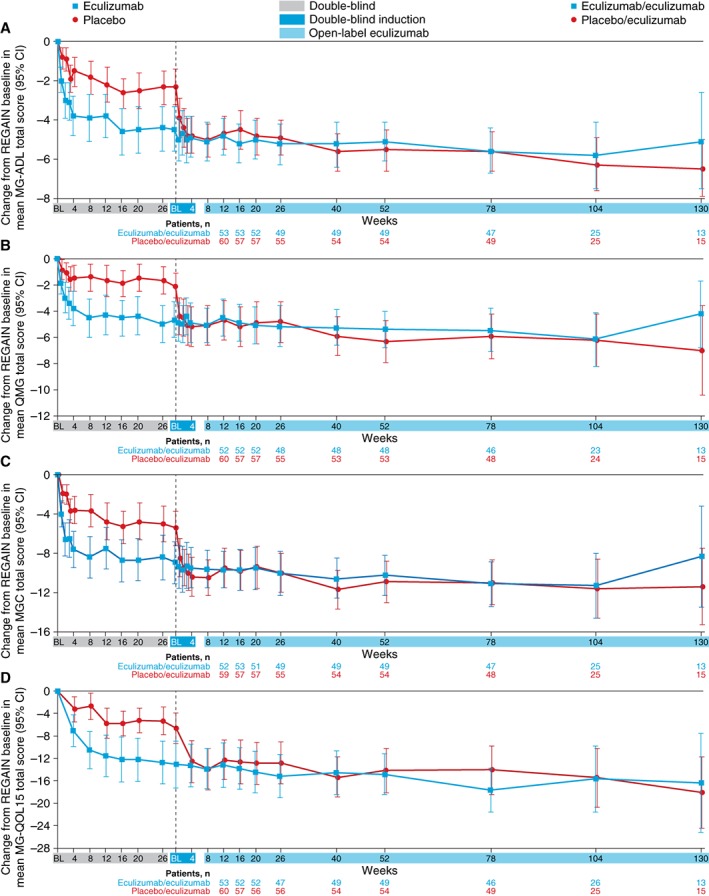
Results: The safety profile of eculizumab was consistent with REGAIN; no cases of meningococcal infection were reported during the interim analysis period. Myasthenia gravis exacerbation rate was reduced by 75% from the year before REGAIN (P < 0.0001). Improvements with eculizumab in activities of daily living, muscle strength, functional ability, and quality of life in REGAIN were maintained through 3 years; 56% of patients achieved minimal manifestations or pharmacological remission. Patients who had received placebo during REGAIN experienced rapid and sustained improvements during open-label eculizumab (P < 0.0001).

Discussion: These findings provide evidence for the long-term safety and sustained efficacy of eculizumab for refractory gMG. Muscle Nerve 2019.

Keywords: MG-ADL; MG-QOL15; MGC; QMG; eculizumab; myasthenia gravis.


Figures

Figure 1
Figure 1
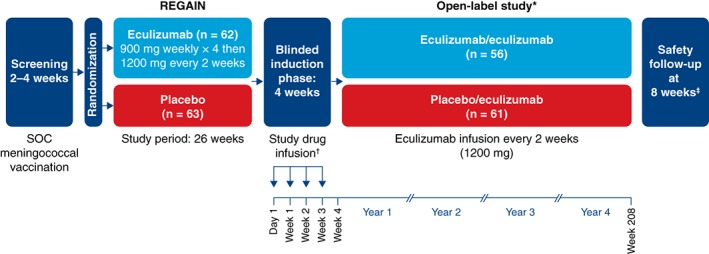
Study design. *Interim data are reported from the December 31, 2017 data cutoff point. During the blinded induction phase of the open‐label study, patients received eculizumab (1,200 mg; 4 vials) at day 1 and week 2 and received placebo (4 vials) at weeks 1 and 3 (eculizumab/eculizumab group) or placebo (1 vial) plus eculizumab (900 mg; 3 vials) each week (placebo/eculizumab group). Patients who withdrew or discontinued after receiving any amount of eculizumab were required to complete a safety follow‐up visit 8 weeks after their last eculizumab dose. SOC, standard of care.
Figure 2
Figure 2
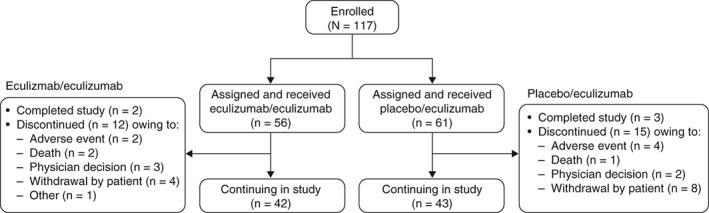
Patient disposition through December 31, 2017. In total, 117 patients enrolled in the open‐label study, of whom 56 had received eculizumab and 61 had received placebo during REGAIN. As of December 31, 2017, twenty‐seven patients had discontinued, 5 patients had completed the study, and 85 patients were continuing in the study.
Figure 3
Figure 3
Treatment effects on event rates for all reported exacerbations (A), rescue therapy administration (exacerbation events requiring rescue therapy (B), and MG‐related hospitalization (exacerbation events requiring rescue therapy (C). Model‐based event rate per 100 patient‐years is based on a generalized estimating equation Poisson regression repeated‐measures model with the number of events as the dependent variable, the logarithm of patient‐years as the offset variable, and the study phase indicator (prestudy, placebo, or eculizumab) as the factors assuming a compound symmetry correlation structure. *Patient‐year for prestudy accounted for a maximum of 365 days for each patient prior to screening. |Changes in event rates in this group reflect the response to placebo that was observed during REGAIN. PY, patient‐year.
Figure 4
Figure 4
Change from REGAIN baseline to week 130 in the open‐label extension study in MG‐ADL (A), QMG (B), MGC (C), and MG‐QOL15 (D) total scores (mean [95% CI]) by treatment arm over time (full analysis set). Patient numbers were not the same for each assessment. BL, baseline; CI, confidence interval; MG‐ADL, Myasthenia Gravis Activities of Daily Living; MGC, Myasthenia Gravis Composite scale; MG‐QOL15, Myasthenia Gravis Quality of Life 15; QMG, Quantitative Myasthenia Gravis scale.
Figure 5
Figure 5
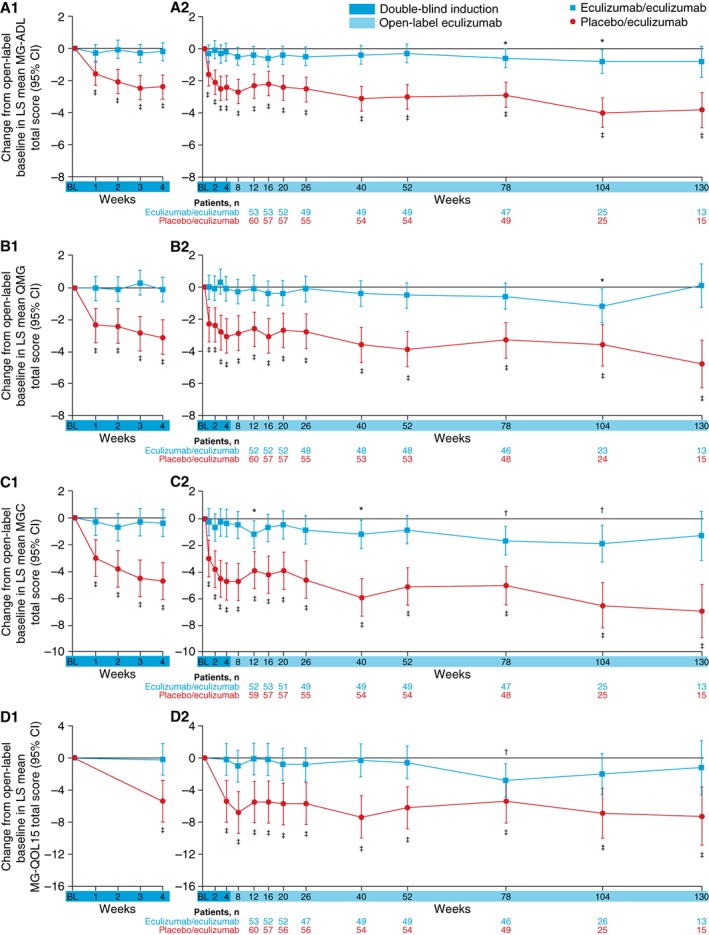
Change from open‐label baseline in MG‐ADL to week 4 (double‐blind induction phase only; A1), MG‐ADL to week 130 (A2), QMG to week 4 (B1), QMG to week 130 (B2), MGC to week 4 (C1), MGC to week 130 (C2), MG‐QOL15 to week 4 (D1), and MG‐QOL15 to week 130 (D2); total scores (LS mean [95% CI]) by treatment group over time (full analysis set). Patient numbers were not the same for each assessment. The stability of scores during the open‐label study in the eculizumab/eculizumab group is evidence of the maintenance of improvements achieved during eculizumab treatment in REGAIN in these patients. The rapid and significant improvements in the placebo/eculizumab group are evidence of these patients’ response to commencing eculizumab at the start of the open‐label study, including during the initial 4‐week blinded induction phase. *P ≤ 0.05, P ≤ 0.01, P ≤ 0.0001 compared with open‐label baseline, repeated‐measures analysis. BL, baseline; CI, confidence interval; LS, least‐squares; MG‐ADL, Myasthenia Gravis Activities of Daily Living; MGC, Myasthenia Gravis Composite scale; MG‐QOL15, Myasthenia Gravis Quality of Life 15; QMG, Quantitative Myasthenia Gravis scale.

Comment in

References

    1. Conti‐Fine BM, Milani M, Kaminski HJ. Myasthenia gravis: past, present, and future. J Clin Invest 2006;116:2843–2854. - PMC - PubMed
    1. Lindstrom JM, Seybold ME, Lennon VA, Whittingham S, Duane DD. Antibody to acetylcholine receptor in myasthenia gravis. Prevalence, clinical correlates, and diagnostic value. Neurology 1976;26:1054–1059. - PubMed
    1. Mantegazza R, Pareyson D, Baggi F, Romagnoli P, Peluchetti D, Sghirlanzoni A, et al Anti‐AChR antibody: relevance to diagnosis and clinical aspects of myasthenia gravis. Ital J Neurol Sci 1988;9:141–145. - PubMed
    1. Vincent A, McConville J, Farrugia ME, Bowen J, Plested P, Tang T, et al Antibodies in myasthenia gravis and related disorders. Ann N Y Acad Sci 2003;998:324–335. - PubMed
    1. Vincent A, Newsom‐Davis J. Acetylcholine receptor antibody as a diagnostic test for myasthenia gravis: results in 153 validated cases and 2967 diagnostic assays. J Neurol Neurosurg Psychiatry 1985;48:1246–1252. - PMC - PubMed

Publication types

MeSH terms

Substances