


Clinical developmental, neuropsychological, and social-emotional features of Turner syndrome
- PMID: 30767374
- PMCID: PMC6487305
- DOI: 10.1002/ajmg.c.31687
Clinical developmental, neuropsychological, and social-emotional features of Turner syndrome
Abstract
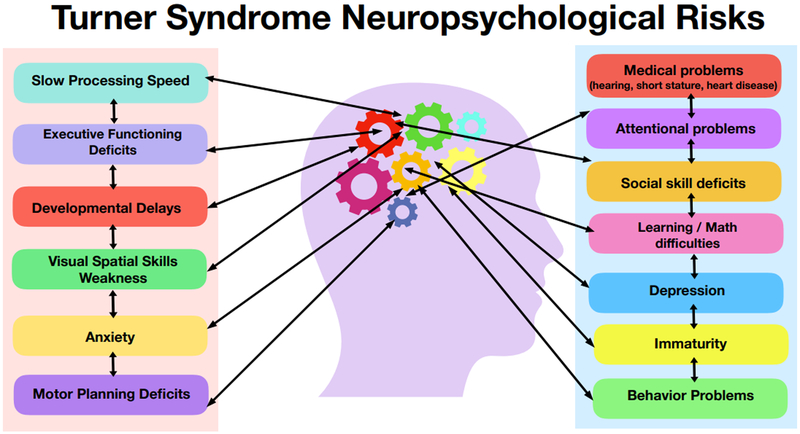
Individuals with Turner syndrome (TS) are at risk for a constellation of neurocognitive and psychosocial differences, although there is significant individual variability in these features. TS is associated with an increased risk for difficulties with visual-spatial reasoning, visual-spatial memory, attention, executive functioning, motor, and math skills. Additionally, increased rates of social difficulties, anxiety, and depression are observed. There can be significant interplay between all of these factors contributing to the behavioral phenotype. Neuropsychological features and previous research are reviewed. Clinical considerations and recommendations for evaluation and treatment of psychological and behavioral difficulties are provided, including consideration of medical features in TS, as well as therapies, educational supports, and medication treatment. Future research is needed to evaluate effectiveness of different treatments for neuropsychological and psychosocial features of TS, including modification and validation of existing evidence-based treatments and new approaches to care.
Keywords: ADHD; anxiety; autism spectrum disorder; executive function; learning disability; turner syndrome.
© 2019 Wiley Periodicals, Inc.
Figures
References
-
- American Academy of Pediatrics, Council on Children With Disabilities, Section on Developmental Behavioral Pediatrics, Bright Futures Steering Committee, Medical Home Initiatives for Children With Special Needs Project Advisory Committee (2006). Identifying infants and young children with developmental disorders in the medical home: an algorithm for developmental surveillance and screening. Pediatrics, 118(1), 405–420. doi: 10.1542/peds.2006-1231 - DOI - PubMed
-
- American Psychiatric Association, A. P. (2013). Diagnostic and statistical manual of mental disorders (5th ed.) (DSM-5). Arlington, VA: American Psychiatric Publishing.
-
- Baio J, Wiggins L, Christensen DL, Maenner MJ, Daniels J, Warren Z, … Dowling NF (2018). Prevalence of Autism Spectrum Disorder Among Children Aged 8 Years - Autism and Developmental Disabilities Monitoring Network, 11 Sites, United States, 2014. MMWR Surveill Summ, 67(6), 1–23. Retrieved from 10.15585/mmwr.ss6706a1. doi: 10.15585/mmwr.ss6706a1 - DOI - PMC - PubMed
-
- Beaton EA, Stoddard J, Lai S, Lackey J, Shi J, Ross JL, & Simon TJ (2010). Atypical functional brain activation during a multiple object tracking task in girls with Turner syndrome: neurocorrelates of reduced spatiotemporal resolution. Am J Intellect Dev Disabil, 115(2), 140–156. doi: 10.1352/1944-7558-115.2.140 - DOI - PMC - PubMed
-
- Bender B, Linden M, & Robinson A (1994). Neurocognitive and Psychosocial Phenotypes Associated with Turner Syndrome In Broman SH & Grafman J (Eds.), Atypical Cognitive Deficits in Developmental Disorders: Implications for Brain Function. Hillside, NJ: Lawrence Erlbaum Associates.
Publication types
MeSH terms
Grants and funding
LinkOut - more resources
Full Text Sources
Medical
