


Heat stress combined with lipopolysaccharide alter the activity and superficial molecules of peripheral monocytes
- PMID: 30767578
- PMCID: PMC6378461
- DOI: 10.1177/2058738419828891
Heat stress combined with lipopolysaccharide alter the activity and superficial molecules of peripheral monocytes
Abstract
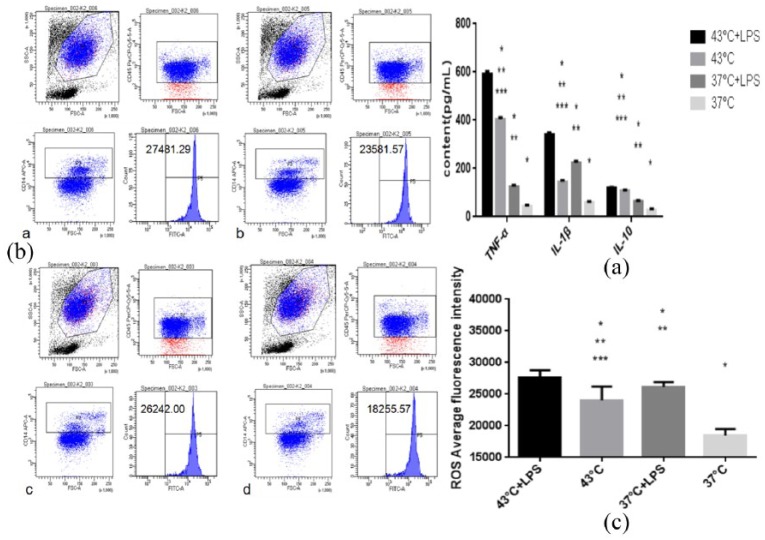
The purpose of this study was to focus on the underlying relationship between the hyperactivity for the peripheral monocytes and heat stroke by investigating the inflammatory oxidative activity of and the expression of superficial molecules. Peripheral blood samples were collected from 10 healthy adult volunteers. Human blood monocytes were isolated by density gradient centrifugation and sequent adherent culture. The objectives were divided into four groups: 43°C heat stress combined with lipopolysaccharide (LPS) group, 43°C heat stress group, LPS group, and control group. There were 10 cases in each group. An enzyme-linked immunosorbent assay (ELISA) test was used to measure the concentrations of supernatant inflammatory mediators (tumor necrosis factor alpha (TNF-α), interleukin-1β (IL-1β) and interleukin-10 (IL-10)). After loaded by 2,7-Dichlorodi-hydrofluorescein-diacetate (DCFHDA) fluorescent probe, intracellular reactive oxygen species (ROS) levels were determined by a flow cytometry. After fluorescent microspheres incubation, the phagocytosis of monocytes was observed under a fluorescent microscope. Respectively, the flow cytometry and Western blot were used to evaluate the level of triggering receptor expressed on myeloid cells-1 (TREM-1) and Toll-like receptor-4 (TLR-4) on the monocytes. Furthermore, the mRNA expression of TREM-1 and TLR-4 was detected by real-time polymerase chain reaction (RT-PCR). The heat stress combined with LPS stimulation promoted the peripheral monocytes to produce inflammatory mediators (TNF-α, IL-1β, and IL-10) and release ROS. Otherwise, such complex strike significantly suppressed the phagocytic activity of monocytes in peripheral blood. Moreover, the expression of TREM-1, TLR-4 and CD86 was measured by the flow cytometry on peripheral monocytes which were respectively promoted by the union of heat stress and LPS. The results of Western blot and RT-PCR demonstrated the similar kinetics on these superficial molecules (TREM-1, TLR-4, and CD86) stimulated by the combination of heat stress and LPS. The underlying mechanism of the dysfunction for the peripheral monocytes may be related to the abnormal expression of superficial molecules TREM-1, TLR-4, and CD86 on the monocytes induced by heat stress and LPS.
Keywords: CD86; TLR-4; TREM-1; heat stroke; monocytes.
Conflict of interest statement
Figures


References
-
- Bai L, Ding G, Gu S, et al. (2014) The effects of summer temperature and heat waves on heat-related illness in a coastal city of China, 2011-2013. Environmental Research 132: 212–219. - PubMed
-
- Chen CM, Hou CC, Cheng KC, et al. (2006) Activated protein C therapy in a rat heat stroke model. Critical Care Medicine 34: 1960–1966. - PubMed
-
- Wang Y, Braun OO, Zhang S, et al. (2015) Monocytes regulate systemic coagulation and inflammation in abdominal sepsis. American Journal of Physiology. Heart and Circulatory Physiology 308: H540–H547. - PubMed
MeSH terms
Substances
LinkOut - more resources
Full Text Sources
