


Goal-Directed and Habitual Control in Smokers
- PMID: 30768206
- PMCID: PMC7004226
- DOI: 10.1093/ntr/ntz001
Goal-Directed and Habitual Control in Smokers
Abstract
Introduction: Harmful behavior such as smoking may reflect a disturbance in the balance of goal-directed and habitual control. Animal models suggest that habitual control develops after prolonged substance use. In this study, we investigated whether smokers (N = 49) differ from controls (N = 46) in the regulation of goal-directed and habitual behavior. It was also investigated whether individual differences in nicotine dependence levels were associated with habitual responding.
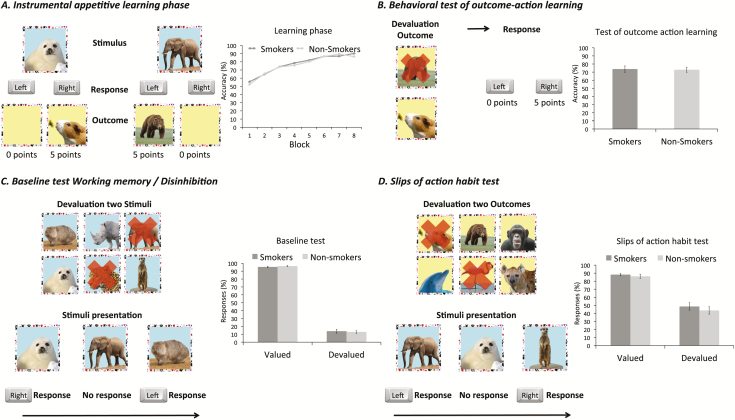
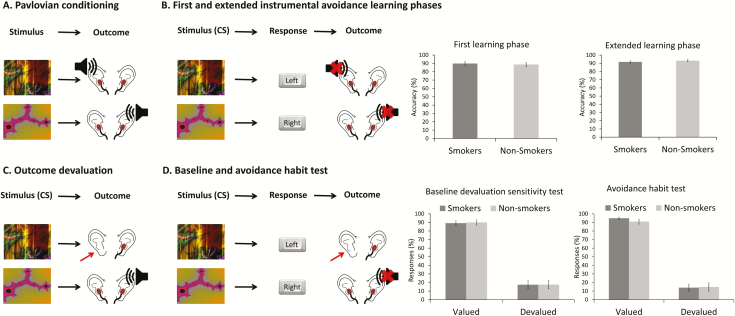
Methods: We used two different multistage instrumental learning tasks that consist of an instrumental learning phase, subsequent outcome devaluation, and a testing phase to measure the balance between goal-directed and habitual responding. The testing phases of these tasks occurred after either appetitive versus avoidance instrumental learning. The appetitive versus aversive instrumental learning stages in the two different tasks modeled positive versus negative reinforcement, respectively.
Results: Smokers and nonsmoking controls did not differ on habitual versus goal-directed control in either task. Individual differences in nicotine dependence within the group of smokers, however, were positively associated with habitual responding after appetitive instrumental learning. This effect seems to be due to impaired stimulus-outcome learning, thereby hampering goal-directed task performance and tipping the balance to habitual responding.
Conclusions: The current finding highlights the importance of individual differences within smokers. For future research, neuroimaging studies are suggested to further unravel the nature of the imbalance between goal-directed versus habitual control in severely dependent smokers by directly measuring activity in the corresponding brain systems.
Implications: Goal-directed versus habitual behavior in substance use and addiction is highly debated. This study investigated goal-directed versus habitual control in smokers. The findings suggest that smokers do not differ from controls in goal-directed versus habitual control. Individual differences in nicotine dependence within smokers, however, were positively associated with habitual responding after appetitive instrumental learning. This effect seems to be due to impaired stimulus-outcome learning, thereby hampering goal-directed task performance and tipping the balance to habitual responding. These findings add to the ongoing debate on habitual versus goal-directed control in addiction and emphasize the importance of individual differences within smokers.
© The Author(s) 2019. Published by Oxford University Press on behalf of the Society for Research on Nicotine and Tobacco.
Figures
References
-
- International Tobacco Control Policy Evaluation P. ITC Project: Netherlands National Report. The Hague, The Netherlands: STIVORO; 2011.
-
- Tiffany ST. A cognitive model of drug urges and drug-use behavior: role of automatic and nonautomatic processes. Psychol Rev. 1990;97(2):147–168. - PubMed
-
- Everitt BJ, Robbins TW. Drug addiction: updating actions to habits to compulsions ten years on. Annu Rev Psychol. 2016;67:23–50. - PubMed
Publication types
MeSH terms
LinkOut - more resources
Full Text Sources
Medical
