The impact of targeted malaria elimination with mass drug administrations on falciparum malaria in Southeast Asia: A cluster randomised trial
- PMID: 30768615
- PMCID: PMC6377128
- DOI: 10.1371/journal.pmed.1002745
The impact of targeted malaria elimination with mass drug administrations on falciparum malaria in Southeast Asia: A cluster randomised trial
Abstract
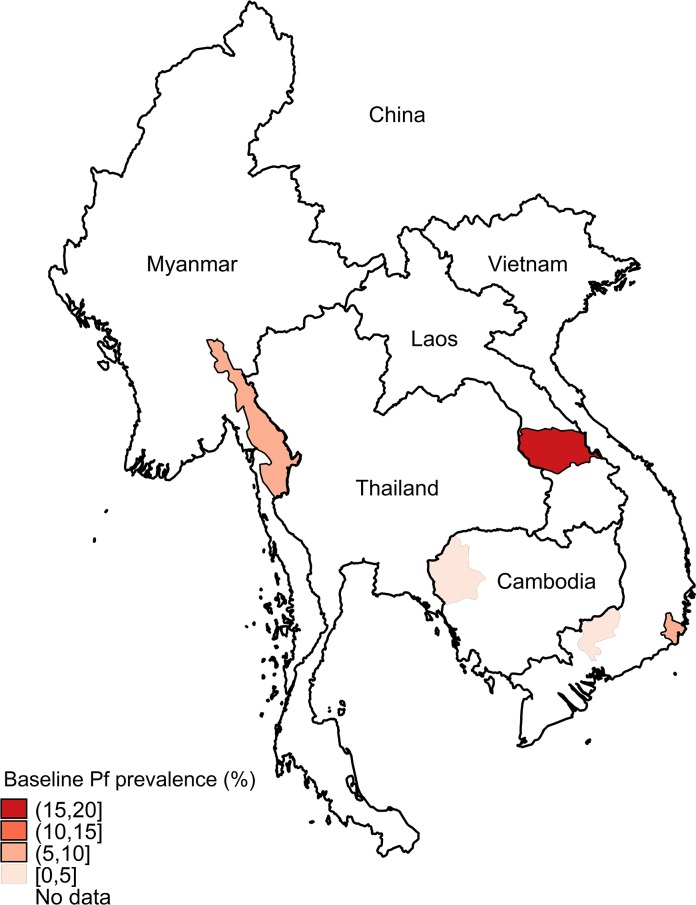
Background: The emergence and spread of multidrug-resistant Plasmodium falciparum in the Greater Mekong Subregion (GMS) threatens global malaria elimination efforts. Mass drug administration (MDA), the presumptive antimalarial treatment of an entire population to clear the subclinical parasite reservoir, is a strategy to accelerate malaria elimination. We report a cluster randomised trial to assess the effectiveness of dihydroartemisinin-piperaquine (DP) MDA in reducing falciparum malaria incidence and prevalence in 16 remote village populations in Myanmar, Vietnam, Cambodia, and the Lao People's Democratic Republic, where artemisinin resistance is prevalent.
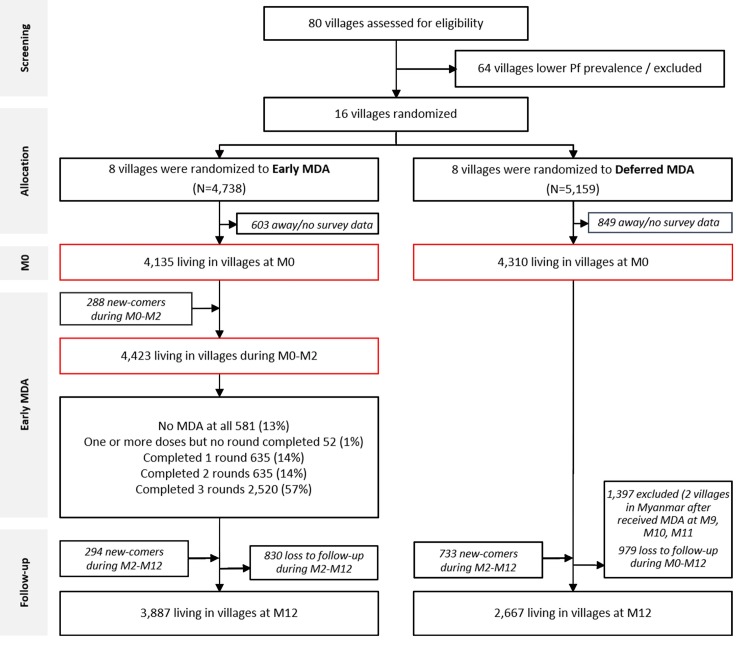
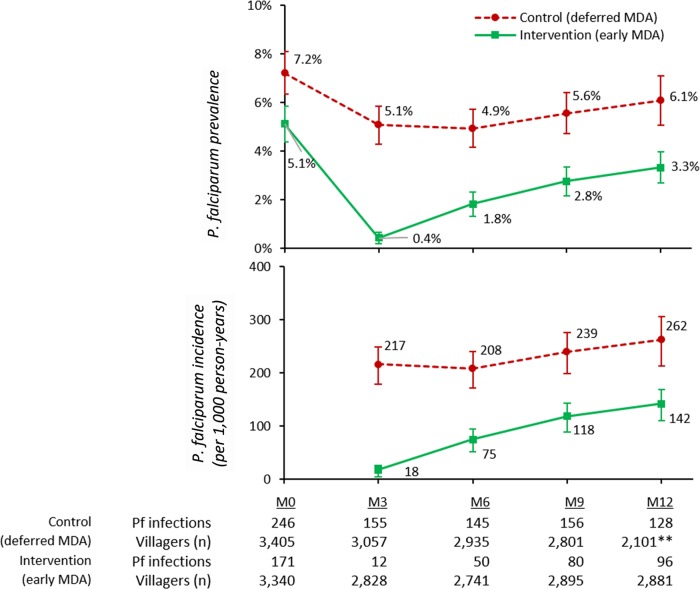
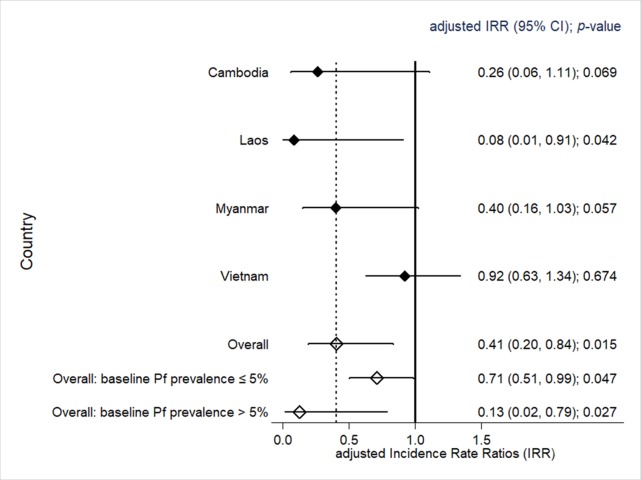
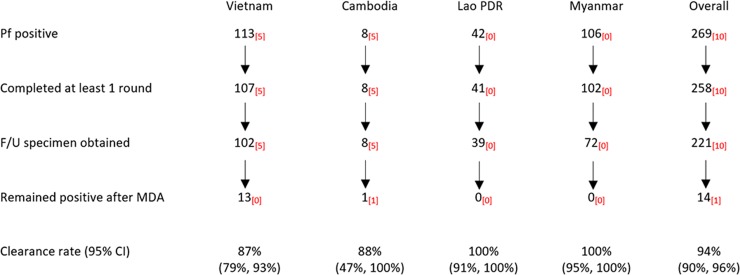
Methods and findings: After establishing vector control and community-based case management and following intensive community engagement, we used restricted randomisation within village pairs to select 8 villages to receive early DP MDA and 8 villages as controls for 12 months, after which the control villages received deferred DP MDA. The MDA comprised 3 monthly rounds of 3 daily doses of DP and, except in Cambodia, a single low dose of primaquine. We conducted exhaustive cross-sectional surveys of the entire population of each village at quarterly intervals using ultrasensitive quantitative PCR to detect Plasmodium infections. The study was conducted between May 2013 and July 2017. The investigators randomised 16 villages that had a total of 8,445 residents at the start of the study. Of these 8,445 residents, 4,135 (49%) residents living in 8 villages, plus an additional 288 newcomers to the villages, were randomised to receive early MDA; 3,790 out of the 4,423 (86%) participated in at least 1 MDA round, and 2,520 out of the 4,423 (57%) participated in all 3 rounds. The primary outcome, P. falciparum prevalence by month 3 (M3), fell by 92% (from 5.1% [171/3,340] to 0.4% [12/2,828]) in early MDA villages and by 29% (from 7.2% [246/3,405] to 5.1% [155/3,057]) in control villages. Over the following 9 months, the P. falciparum prevalence increased to 3.3% (96/2,881) in early MDA villages and to 6.1% (128/2,101) in control villages (adjusted incidence rate ratio 0.41 [95% CI 0.20 to 0.84]; p = 0.015). Individual protection was proportional to the number of completed MDA rounds. Of 221 participants with subclinical P. falciparum infections who participated in MDA and could be followed up, 207 (94%) cleared their infections, including 9 of 10 with artemisinin- and piperaquine-resistant infections. The DP MDAs were well tolerated; 6 severe adverse events were detected during the follow-up period, but none was attributable to the intervention.
Conclusions: Added to community-based basic malaria control measures, 3 monthly rounds of DP MDA reduced the incidence and prevalence of falciparum malaria over a 1-year period in areas affected by artemisinin resistance. P. falciparum infections returned during the follow-up period as the remaining infections spread and malaria was reintroduced from surrounding areas. Limitations of this study include a relatively small sample of villages, heterogeneity between villages, and mobility of villagers that may have limited the impact of the intervention. These results suggest that, if used as part of a comprehensive, well-organised, and well-resourced elimination programme, DP MDA can be a useful additional tool to accelerate malaria elimination.
Trial registration: ClinicalTrials.gov NCT01872702.
Conflict of interest statement
The authors have declared that no competing interests exist. LvS receives a stipend as a Specialty Consulting Editor for PLOS Medicine and serves on the journal's Editorial Board. NJW is a member of the Editorial Board of PLOS Medicine.
Figures
References
-
- Bulchis A, Larson E. Sri Lanka celebrates malaria-free certification after long history of malaria control. San Francisco: Malaria Elimination Initiative; 2016 Sep 6 [cited 2019 Jan 18]. Available: http://www.shrinkingthemalariamap.org/news-blog/blog/sri-lanka-celebrate....
-
- Duru V, Khim N, Leang R, Kim S, Domergue A, Kloeung N, et al. Plasmodium falciparum dihydroartemisinin-piperaquine failures in Cambodia are associated with mutant K13 parasites presenting high survival rates in novel piperaquine in vitro assays: retrospective and prospective investigations. BMC Med. 2015;13:305 10.1186/s12916-015-0539-5 - DOI - PMC - PubMed