. 2019 May 15:150:217-228.
doi: 10.1016/j.neuropharm.2019.02.010. Epub 2019 Feb 13.

MP1104, a mixed kappa-delta opioid receptor agonist has anti-cocaine properties with reduced side-effects in rats

Affiliations

MP1104, a mixed kappa-delta opioid receptor agonist has anti-cocaine properties with reduced side-effects in rats

Diana V Atigari et al. Neuropharmacology. .

Abstract

Kappa opioid receptor (KOPr) agonists have preclinical anti-cocaine and antinociceptive effects. However, adverse effects including dysphoria, aversion, sedation, anxiety and depression limit their clinical development. MP1104, an analogue of 3-iodobenzoyl naltrexamine, is a potent dual agonist at KOPr and delta opioid receptor (DOPr), with full agonist efficacy at both these receptors. In this study, we evaluate the ability of MP1104 to modulate cocaine-induced behaviors and side-effects preclinically. In male Sprague-Dawley rats trained to self-administer cocaine, MP1104 (0.3 and 1 mg/kg) reduced cocaine-primed reinstatement of drug-seeking behavior and caused significant downward shift of the dose-response curve in cocaine self-administration tests (0.3 and 0.6 mg/kg). The anti-cocaine effects exerted by MP1104 are in part due to increased dopamine (DA) uptake by the dopamine transporter (DAT) in the dorsal striatum (dStr) and nucleus accumbens (NAc). MP1104 (0.3 and 0.6 mg/kg) showed no significant anxiogenic effects in the elevated plus maze, pro-depressive effects in the forced swim test, or conditioned place aversion. Furthermore, pre-treatment with a DOPr antagonist, led to MP1104 producing aversive effects. This data suggests that the DOPr agonist actions of MP1104 attenuate the KOPr-mediated aversive effects of MP1104. The overall results from this study show that MP1104, modulates DA uptake in the dStr and NAc, and exerts potent anti-cocaine properties in self-administration tests with reduced side-effects compared to pure KOPr agonists. This data supports the therapeutic development of dual KOPr/DOPr agonists to reduce the side-effects of selective KOPr agonists. This article is part of the Special Issue entitled 'Opioid Neuropharmacology: Advances in treating pain and opioid addiction'.

Keywords: Behavioural pharmacology; Cocaine; Conditioned place aversion; Drug-seeking; Elevated plus maze; Self-administration.


Conflict of interest statement

Conflicts of interest

Both GWP and SM are co-founders of Sparian BioSciences. All authors report no other biomedical financial interests or potential conflicts of interests.

Figures
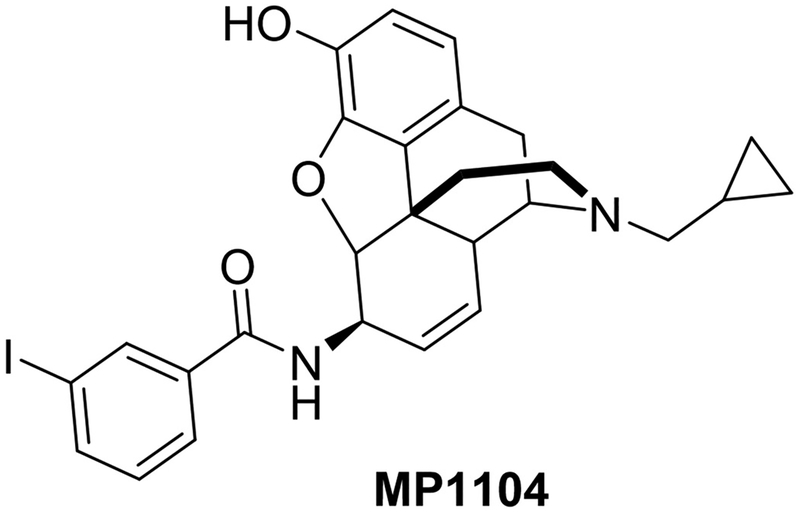
Fig. 1.
Fig. 1.
Structure of MP1104.
Fig. 2.
Fig. 2.
MP1104 attenuates cocaine prime-induced reinstatement of cocaine-seeking in rats and shifts cocaine dose-response self-administration curve downwards. (A) MP1104 (0.3 & 1 mg/kg, i.p.) dose-dependently attenuates cocaine-prime active lever responding compared to vehicle-treated controls which is inhibited by the pretreatment of nor-BNI (10 mg/kg, s.c.). NTI (15 mg/kg, s.c.) has no effect on MP1104-induced responding. Repeated measures ANOVA with Bonferroni’s post-test. ***p < 0.001, ****p < 0.0001, compared to the vehicle; #p < 0.05 compared to MP1104, 1 mg/kg dose, n = 9. (B) MP1104 (0.3 & 0.6 mg/kg, i.p.) significantly shifts the cocaine dose-response self-administration curve downwards. Two-way ANOVA with Bonferroni’s post-test. **p < 0.01, ****p < 0.0001 compared to the vehicle, n = 6. (C) Throughout the self-administration training, the number of active and inactive lever responses remained stable with an active:inactive lever ratio of ≥2:1. All values expressed as mean ± SEM. NTI = Naltrindole; nor-BNI = nor-binaltorphimine.
Fig. 3.
Fig. 3.
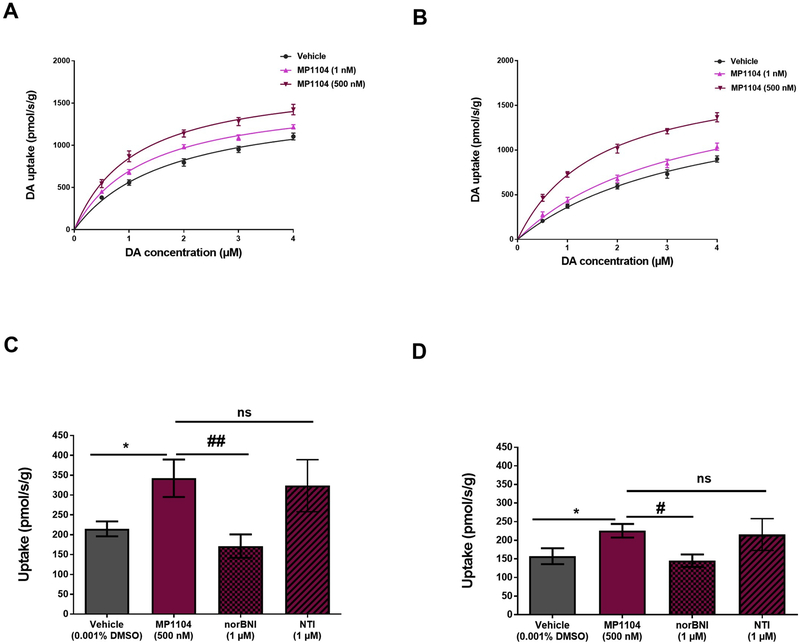
MP1104 shows increase of DA uptake in rat dStr and NAc tissues. DA uptake was measured using the low to infinite trans model. MP1104 (1 nM and 500 nM) showed a significant increase in DA uptake in dStr (A) and NAc (B) compared to vehicle-treated control (two-way ANOVA with Bonferroni’s post-test). In zero trans model, MP1104 (500 nM) increased DA uptake in the dStr (C) and NAc (D) when tested using a single 2 μM addition of DA. Pre-treatment of tissue suspensions with nor-BNI reversed the MP1104 induced increase in DA uptake, whereas NTI had no effect. One-way ANOVA with Fisher’s protected least significant difference (LSD) test, *p < 0.05 compared to the vehicle; #p < 0.05, ##p < 0.01 compared to MP1104 (500 nM). Values presented as mean ± SEM, n = 5–9 per group. DA = dopamine; dStr = dorsal striatum; NAc = nucleus accumbens; nor-BNI = nor-binaltorphimine; ns = non-significant; NTI = naltrindole.
Fig. 4.
Fig. 4.
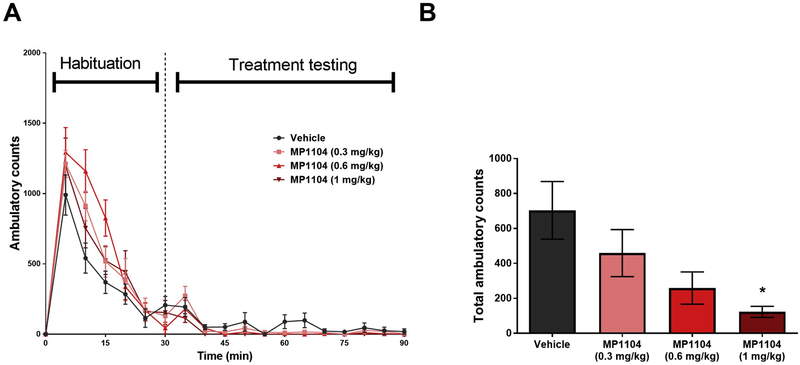
Sedative effects of MP1104. (A) Effects of MP1104 (0.3, 0.6 & 1 mg/kg, i.p.) on ambulatory counts during and following habituation are shown over time (One-way ANOVA). (B) MP1104 (0.3 & 0.6 mg/kg, i.p.) showed non-significant decrease in ambulatory counts compared to vehicle treatment during the treatment testing time (60 min). One-way ANOVA. *p < 0.05 compared to the vehicle. Values presented as mean ± SEM, n = 8 per group.
Fig. 5.
Fig. 5.
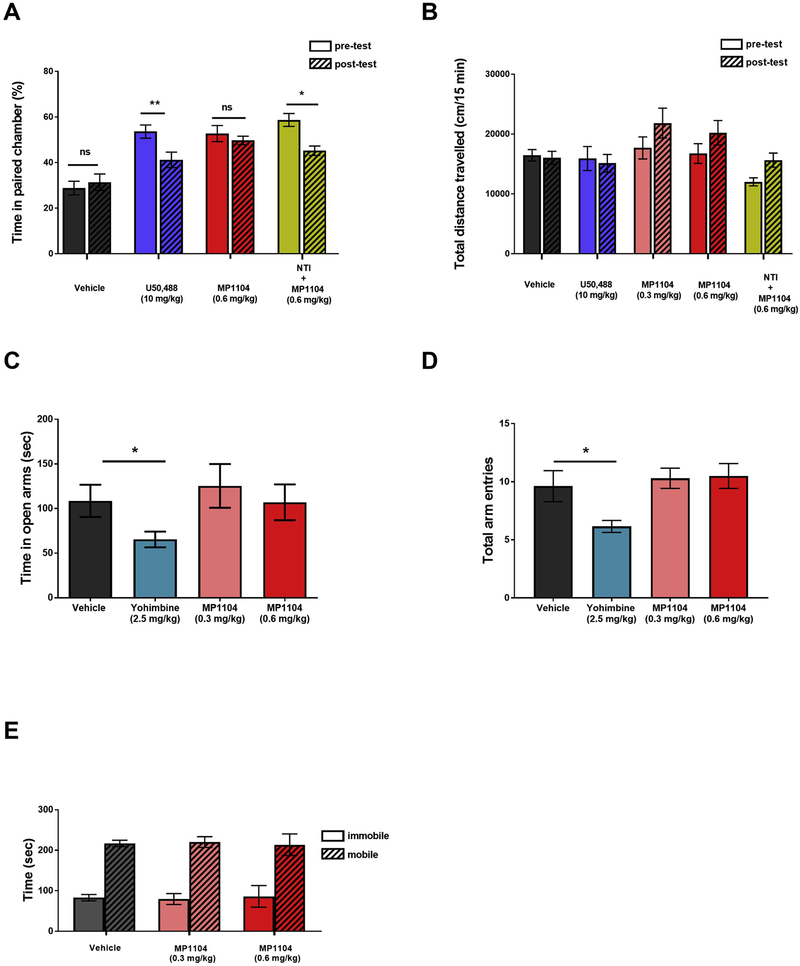
MP1104 shows reduced aversive; anxiogenic and pro-depressive effects in rats. (A) MP1104 (0.6 mg/kg, i.p.) shows no change in time spent in the MP1104-paied chamber. Pre-treatment with the delta antagonist NTI (15 mg/kg) or treatment with selective KOPr agonist U50,488 decreases the time spent in the MP1104-paied chamber. Paired Student’s t-test *p < 0.05, **p < 0.01 compared to vehicle, n = 6–7 per group. (B) Total distance travelled in CPA tests showed no significant changes in locomotion following MP1104 (0.3 and 0.6 mg/kg, i.p.) administration. (C) In EPM tests, MP1104 (0.3 & 0.6 mg/kg, i.p.) showed no effect in open arm times or (D) the total number of arm entries. (C) Yohimbine (2.5 mg/kg, i.p) showed both a decrease in time spent in the open arm and (D) arm entries. One-way ANOVA; *p < 0.05 compared to vehicle, n = 10–13 per group. (E) In the FST, MP1104 (0.3 and 0.6 mg/kg, i.p.) showed no changes in mobility (p > 0.05) or immobility (p > 0.05); One-way ANOVA; n = 7–8 per group. All data expressed as mean ± SEM. CPA = conditioned place aversion; EPM = elevated plus maze; FST = forced swim test; ns = non-significant; NTI = naltrindole.

References

    1. O’connor EC, Chapman K, Butler P, Mead AN, 2011. The predictive validity of the rat self-administration model for abuse liability. Neurosci. Biobehav. Rev 35, 912–938. 10.1016/j.neubiorev.2010.10.012. - DOI - PubMed
    1. Al-Hasani R, McCall JG, Shin G, Gomez AM, Schmitz GP, Bernardi JM, Pyo CO, Park SI, Marcinkiewcz CM, Crowley NA, Krashes MJ, Lowell BB, Kash TL, Rogers JA, Bruchas MR, 2015. Distinct subpopulations of nucleus accumbens dynorphin neurons drive aversion and reward. Neuron 87, 1063–1077. 10.1016/j.neuron.2015.08.019. - DOI - PMC - PubMed
    1. Anand JP, Montgomery D, 2018. Multifunctional opioid ligands. Handb. Exp. Pharmacol 10.1007/164_2018_104. - DOI - PubMed
    1. Ananthan S, 2006. Opioid ligands with mixed μ/δ opioid receptor interactions: an emerging approach to novel analgesics. AAPS J 8, 118–125. - PMC - PubMed
    1. Balboni G, Guerrini R, Salvadori S, Bianchi C, Rizzi D, Bryant SD, Lazarus LH, 2002. Evaluation of the Dmt− Tic pharmacophore: conversion of a potent δ-Opioid receptor antagonist into a potent δ agonist and ligands with mixed properties. J. Med. Chem 45, 713–720. - PubMed

Publication types

MeSH terms

Substances