Is There Etiologic Heterogeneity between Subtypes of Childhood Acute Lymphoblastic Leukemia? A Review of Variation in Risk by Subtype
- PMID: 30770347
- PMCID: PMC6500468
- DOI: 10.1158/1055-9965.EPI-18-0801
Is There Etiologic Heterogeneity between Subtypes of Childhood Acute Lymphoblastic Leukemia? A Review of Variation in Risk by Subtype
Abstract
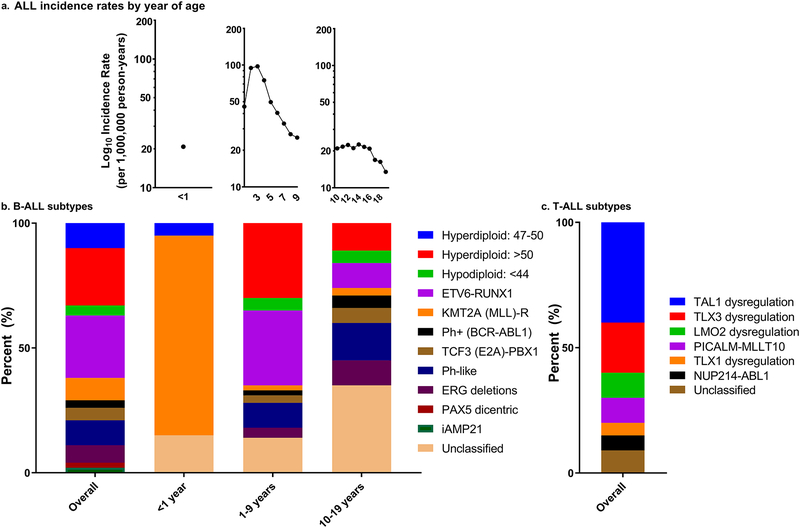
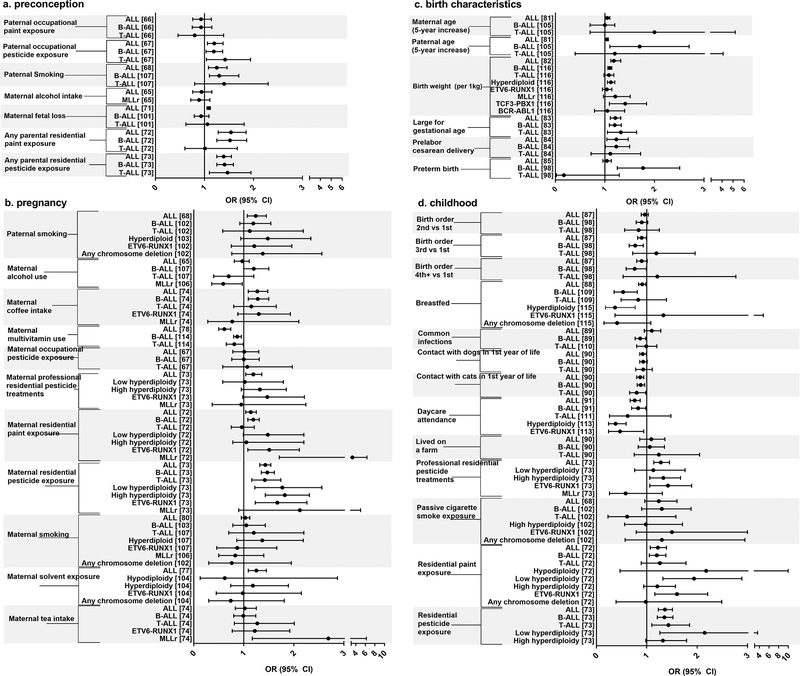
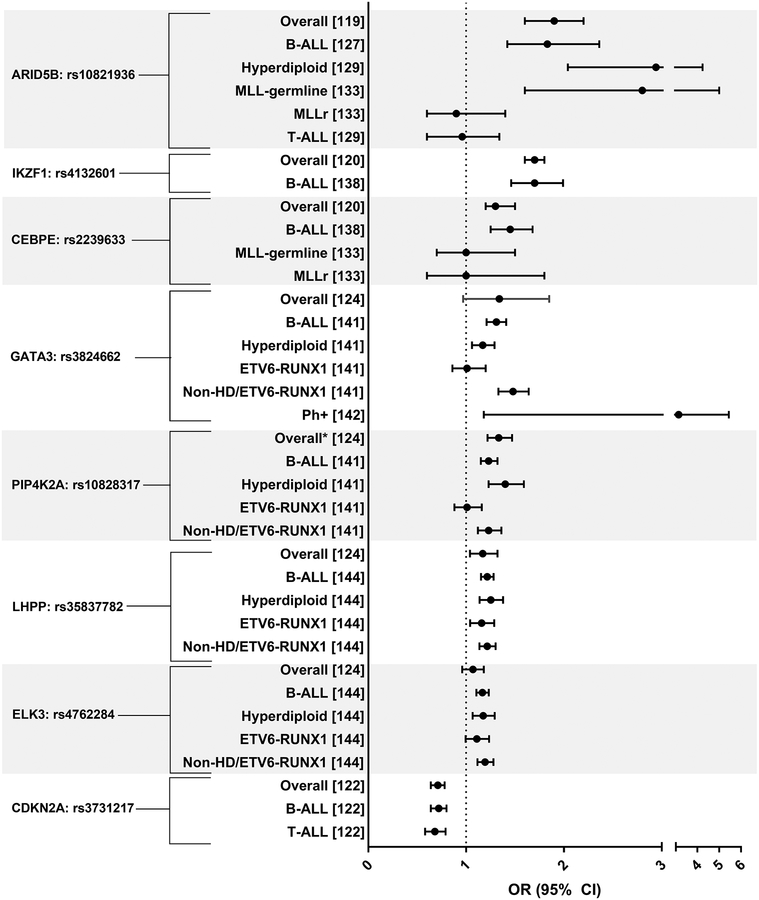
Although substantial advances in the identification of cytogenomic subtypes of childhood acute lymphoblastic leukemia (ALL) have been made in recent decades, epidemiologic research characterizing the etiologic heterogeneity of ALL by subtype has not kept pace. The purpose of this review is to summarize the current literature concerning subtype-specific epidemiologic risk factor associations with ALL subtype defined by immunophenotype (e.g., B-cell vs. T-cell) and cytogenomics (including gross chromosomal events characterized by recurring numerical and structural abnormalities, along with cryptic balanced rearrangements, and focal gene deletions). In case-control analyses investigating nongenetic risk factors, home paint exposure is associated with hyperdiploid, MLL-rearranged, and ETV6-RUNX1 subtypes, yet there are few differences in risk factor associations between T- and B-ALL. Although the association between maternal smoking and ALL overall has been null, maternal smoking is associated with an increasing number of gene deletions among cases. GWAS-identified variants in ARID5B have been the most extensively studied and are strongly associated with hyperdiploid B-ALL. GATA3 single nucleotide variant rs3824662 shows a strong association with Ph-like ALL (OR = 3.14). However, there have been relatively few population-based studies of adequate sample size to uncover risk factors that may define etiologic heterogeneity between and within the currently defined cytogenomic ALL subtypes.
©2019 American Association for Cancer Research.
Conflict of interest statement
Figures
References
-
- Millikan RC, Newman B, Tse C-K, Moorman PG, Conway K, Dressler LG, et al. Epidemiology of basal-like breast cancer. Breast Cancer Res Treat [Internet]. 2008. [cited 2013 Aug 21];109:123–39. Available from: http://www.pubmedcentral.nih.gov/articlerender.fcgi?artid=2443103&tool=p... - PMC - PubMed
-
- Phipps AI, Li CI, Kerlikowske K, Barlow WE, Buist DSM. Risk factors for ductal, lobular, and mixed ductal-lobular breast cancer in a screening population. Cancer Epidemiol Biomarkers Prev [Internet]. 2010;19:1643–54. Available from: http://www.pubmedcentral.nih.gov/articlerender.fcgi?artid=2882996&tool=p... - PMC - PubMed
-
- Li CI, Daling JR, Haugen KL, Tang MTC, Porter PL, Malone KE. Use of menopausal hormone therapy and risk of ductal and lobular breast cancer among women 55–74 years of age. 2013;18:1199–216.
-
- Williams LA, Nichols HB, Hoadley KA, Tse CK, Geradts J, Bell ME, et al. Reproductive risk factor associations with lobular and ductal carcinoma in the Carolina Breast Cancer Study. Cancer Causes Control [Internet]. Springer International Publishing; 2018;29:25–32. Available from: 10.1007/s10552-017-0977-9 - DOI - PMC - PubMed
Publication types
MeSH terms
Substances
Grants and funding
LinkOut - more resources
Full Text Sources