Review
. 2019 May;33(5):1063-1075.
doi: 10.1038/s41375-019-0404-1. Epub 2019 Feb 15.

Aberrant Wnt signaling in multiple myeloma: molecular mechanisms and targeting options

Affiliations
Review

Aberrant Wnt signaling in multiple myeloma: molecular mechanisms and targeting options

Harmen van Andel et al. Leukemia. 2019 May.

Abstract

Aberrant activation of Wnt/β-catenin signaling plays a central role in the pathogenesis of a wide variety of malignancies and is typically caused by mutations in core Wnt pathway components driving constitutive, ligand-independent signaling. In multiple myelomas (MMs), however, these pathway intrinsic mutations are rare despite the fact that most tumors display aberrant Wnt pathway activity. Recent studies indicate that this activation is caused by genetic and epigenetic lesions of Wnt regulatory components, sensitizing MM cells to autocrine Wnt ligands and paracrine Wnts emanating from the bone marrow niche. These include deletion of the tumor suppressor CYLD, promotor methylation of the Wnt antagonists WIF1, DKK1, DKK3, and sFRP1, sFRP2, sFRP4, sFRP5, as well as overexpression of the co-transcriptional activator BCL9 and the R-spondin receptor LGR4. Furthermore, Wnt activity in MM is strongly promoted by interaction of both Wnts and R-spondins with syndecan-1 (CD138) on the MM cell-surface. Functionally, aberrant canonical Wnt signaling plays a dual role in the pathogenesis of MM: (I) it mediates proliferation, migration, and drug resistance of MM cells; (II) MM cells secrete Wnt antagonists that contribute to the development of osteolytic lesions by impairing osteoblast differentiation. As discussed in this review, these insights into the causes and consequences of aberrant Wnt signaling in MM will help to guide the development of targeting strategies. Importantly, since Wnt signaling in MM cells is largely ligand dependent, it can be targeted by drugs/antibodies that act upstream in the pathway, interfering with Wnt secretion, sequestering Wnts, or blocking Wnt (co)receptors.


Conflict of interest statement

The authors declare that they have no conflict of interest.

Figures

Fig. 1
Fig. 1
Schematic representation of canonical Wnt signaling. Off state (left panel): In the absence of Wnt ligands, β-catenin is continuously phosphorylated by a destruction complex that includes AXIN, APC, GSK3β, and CK1α, which marks it for proteasomal degradation. In addition, Wnt signaling is antagonized at multiple levels. First, the secreted Wnt inhibitors sFRP and DKK1 prevent activation of Wnt signaling by sequestering Wnt ligands or preventing LRP5/6 phosphorylation, respectively. Second, in the absence of LGR4/R-spondin signaling, the E3 ubiquitin ligases ZNRF3 and RNF43 antagonize Wnt activity by ubiquitinating Wnt (co)receptors, which induces internalization and subsequent degradation. Lastly, the deubiquitinase CYLD impairs intracellular signal transduction by removing Lys-63-linked polyubiquitin chains from the adapter protein Disheveled (Dvl), which decreases protein stability. On state (right panel): Binding of a Wnt ligand to its receptor Frizzled induces phosphorylation of the co-receptors LRP5/6, which forms a docking site for AXIN. Subsequent sequestration of AXIN disrupts the destruction complex and allows stabilization and nuclear translocation of non-phosphorylated β-catenin. In cooperation with the TCF/LEF family of transcription factors and the co-transcriptional activators Pygopus (PYGO) and BCL9, this orchestrates transcription of Wnt target genes. In addition, LGR4/R-spondin signaling facilitates signaling by Wnt ligands. Engagement of R-spondin to its receptor LGR4 induces internalization of ZNRF3/RNF43, thereby alleviating the negative regulatory role of these E3 ligases on Wnt receptor stability
Fig. 2
Fig. 2
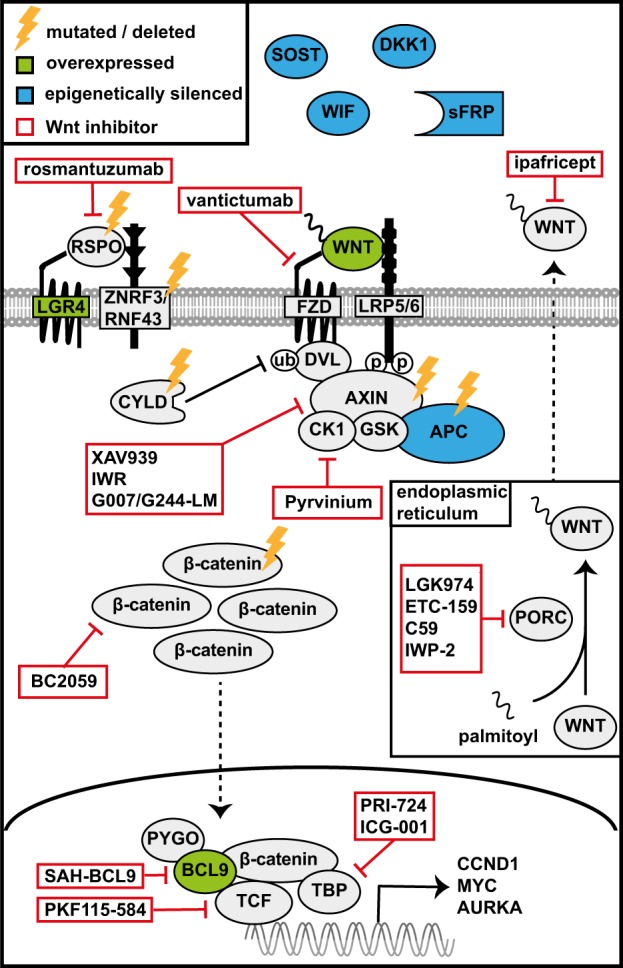
Schematic overview of genetic and epigenetic abnormalities in Wnt pathway components in MM and drugs that target canonical Wnt signaling. Aberrant canonical Wnt signaling pathway activation in MM cells is facilitated by epigenetic silencing (blue), overexpression (green), or mutation (yellow) of multiple Wnt pathway components. Notably, a variety of antibodies, small molecule, and peptides have been recently developed that target Wnt signaling at multiple distinct levels (red, see also Table 2)
Fig. 3
Fig. 3
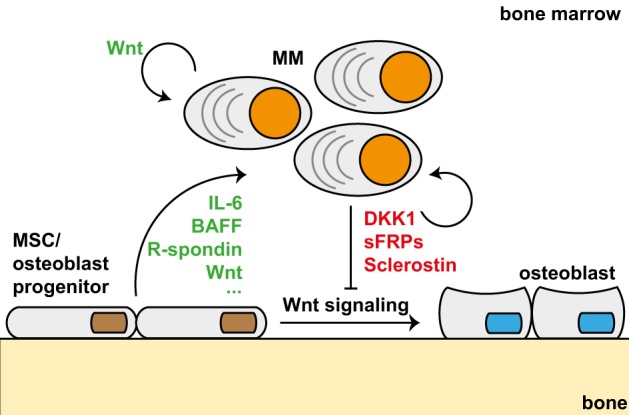
Schematic representation of inhibition of osteoblast differentiation by MM-derived Wnt antagonists. The MM-derived secreted Wnt antagonists DKK1, sFRP, and sclerostin attenuate Wnt signaling in osteoblast precursors, which impairs osteoblasts differentiation and contributes to the development of osteolytic lesions. Inhibition of osteoblast differentiation creates a tumor permissive environment, since osteoblast precursors secrete high levels of IL-6, BAFF, and other cytokines and growth factors. In addition, immature osteoblasts secrete R-spondin, which protects LGR4-expressing MM cells against secreted Wnt antagonists by enhancing sensitivity of tumor cells to autocrine and paracrine Wnt ligands

References

    1. Palumbo A, Anderson K. Multiple myeloma. N Engl J Med. 2011;364:1046–60. - PubMed
    1. Manier S, Salem KZ, Park J, Landau DA, Getz G, Ghobrial IM. Genomic complexity of multiple myeloma and its clinical implications. Nat Rev Clin Oncol. 2017;14:100–13. - PubMed
    1. Morgan GJ, Walker BA, Davies FE. The genetic architecture of multiple myeloma. Nat Rev Cancer. 2012;12:335–48. - PubMed
    1. Bergsagel PL, Kuehl WM, Zhan F, Sawyer J, Barlogie B, Shaughnessy J, et al. Cyclin D dysregulation: an early and unifying pathogenic event in multiple myeloma. Blood. 2005;106:296–303. - PMC - PubMed
    1. Derksen PW, Tjin E, Meijer HP, Klok MD, MacGillavry HD, van Oers MH, et al. Illegitimate WNT signaling promotes proliferation of multiple myeloma cells. Proc Natl Acad Sci USA. 2004;101:6122–7. - PMC - PubMed

Publication types

MeSH terms