


Whole tissue cervical mapping of HPV infection: Molecular evidence for focal latent HPV infection in humans
- PMID: 30772498
- PMCID: PMC6389775
- DOI: 10.1016/j.pvr.2019.02.004
Whole tissue cervical mapping of HPV infection: Molecular evidence for focal latent HPV infection in humans
Abstract
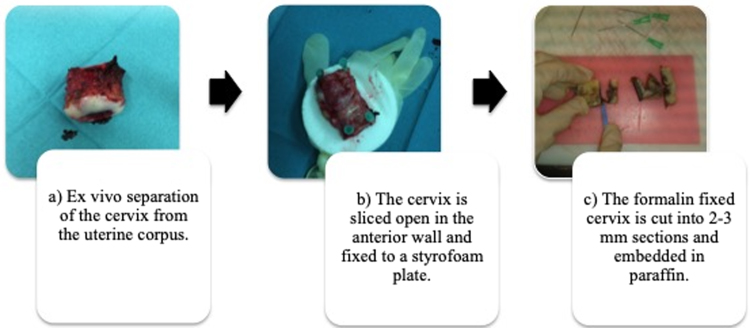
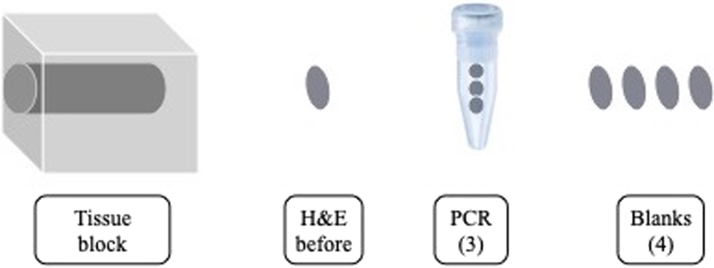
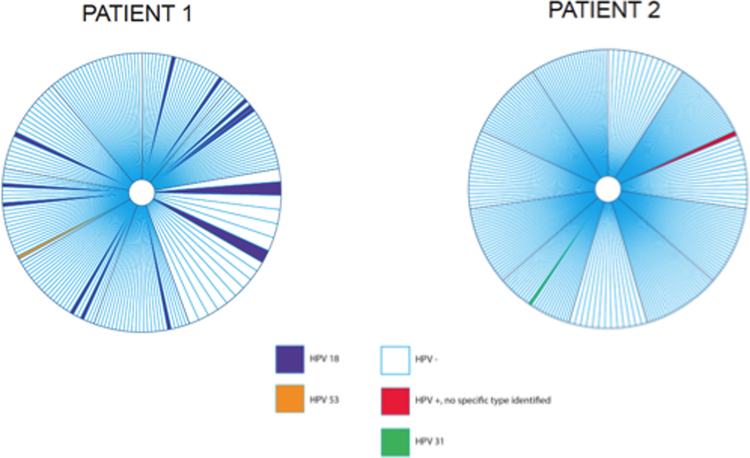
In this study, we aimed to provide molecular evidence of HPV latency in humans and discuss potential challenges of conducting studies on latency. We analyzed the entire cervix of two women who underwent hysterectomy unrelated to cervical abnormality. The cervices were sectioned into 242 and 186 sets respectively, and each set was tested separately for HPV using the SPF10-PCR-DEIA-LiPA25 system. To identify whether there was any evidence of transforming or productive infection, we used the biomarkers E4 and P16INK4a to stain slides immediately adjacent to HPV-positive sections. HPV was detected in both cervices. In patient 1, 1/242 sets was positive for HPV31. In patient 2, 13/186 sets were positive for HPV18 and 1/186 was positive for HPV53. The infection was very focal in both patients, and there was no sign of a transforming or productive infection, as evaluated by the markers E4 and P16INK4a. Had we only analyzed one set from each block, the probability of detecting the infection would have been 32.3% and 2%, respectively.Our findings support the idea that HPV may be able to establish latency in the human cervix; however, the risk associated with a latent HPV infection remains unclear.
Keywords: HPV; Humans; Molecular biology; Papillomavirus; Uterine cervical neoplasm; Virus latency.
Copyright © 2019 The Authors. Published by Elsevier B.V. All rights reserved.
Figures
References
-
- Doorbar J. Molecular biology of human papillomavirus infection and cervical cancer. Clin. Sci. 2006;110:525–541. - PubMed
Publication types
MeSH terms
Grants and funding
LinkOut - more resources
Full Text Sources
Medical
