


Recurrence and mortality 1 year after hospital admission for non-fatal self-harm: a nationwide population-based study
- PMID: 30773154
- PMCID: PMC8061131
- DOI: 10.1017/S2045796019000039
Recurrence and mortality 1 year after hospital admission for non-fatal self-harm: a nationwide population-based study
Abstract
Aims: A large number of people present each day at hospitals for non-fatal deliberate self-harm (DSH). Examination of the short-term risk of non-fatal recurrence and mortality at the national level is of major importance for both individual medical decision-making and global organisation of care.
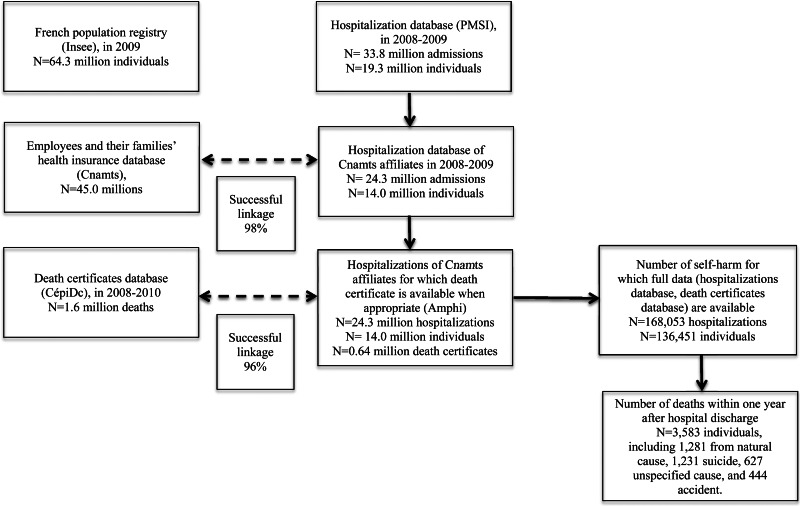
Methods: Following the almost exhaustive linkage (96%) of two national registries in France covering 45 million inhabitants (i.e. 70% of the whole population), information about hospitalisation for DSH in 2008-2009 and vital status at 1 year was obtained. Individuals who died during the index hospital stay were excluded from analyses.
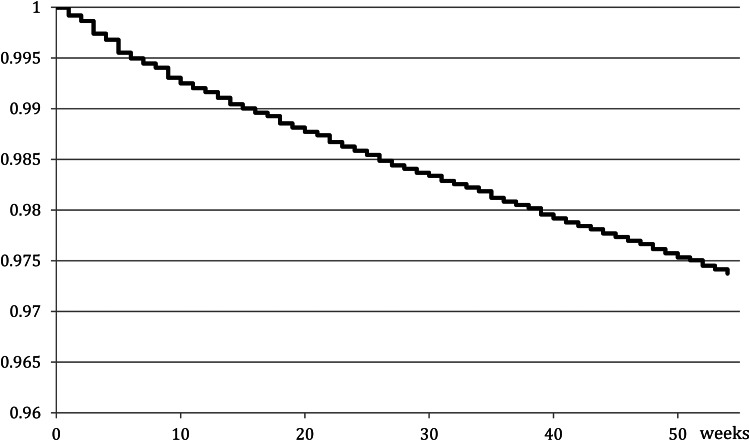
Results: Over 2 years, 136,451 individuals were hospitalised in medicine or surgery for DSH. The sample comprised 62.8% women, median age 38 in both genders, with two peaks at 16 and 44 years in women, and one peak at 37 years in men. The method used for DSH was drug overdose in 82.1% of cases. Admission to an intensive care unit occurred in 12.9%. Following index hospitalisation, 71.3% returned home and 23.7% were transferred to a psychiatric inpatient care unit. DSH recurrence during the following year occurred in 12.4% of the sample, within the first 6 months in 75.2%, and only once in 74.6%. At 1 year, 2.6% of the sample had died. The overall standardised mortality ratio was 7.5 but reached more than 20 in young adults. The causes were natural causes (35.7%), suicide (34.4%), unspecified cause (17.5%) and accident (12.4%). Most (62.9%) deaths by suicide occurred within the first 6 months following index DSH. Violent means (i.e. not drug overdose) were used in 70% of suicide cases. Concordance between means used for index DSH and for suicide was low (30% overall), except for drug overdose. Main suicide risk factors were older age, being male, use of a violent means at index DSH, index admission to an intensive care unit, a transfer to another medical department or to a psychiatric inpatient unit, and recurrence of DSH. However, these factors had low positive predictive values individually (below 2%).
Conclusions: Non-fatal DSH represent frequent events with a significant risk of short-term recurrence and death from various causes. The first 6 months following hospital discharge appear to be a critical period. Specific short-term aftercare programs targeting all people with a DSH episode have to be developed, along other suicide prevention strategies.
Keywords: mortality; recurrence; self-harm; suicide.
Conflict of interest statement
All authors have no conflict of interest to declare.
Figures

Similar articles
-
The incidence and repetition of hospital-treated deliberate self harm: findings from the world's first national registry.PLoS One. 2012;7(2):e31663. doi: 10.1371/journal.pone.0031663. Epub 2012 Feb 20. PLoS One. 2012. PMID: 22363700 Free PMC article.
-
Suicide following presentation to hospital for non-fatal self-harm in the Multicentre Study of Self-harm: a long-term follow-up study.Lancet Psychiatry. 2019 Dec;6(12):1021-1030. doi: 10.1016/S2215-0366(19)30402-X. Epub 2019 Nov 6. Lancet Psychiatry. 2019. PMID: 31706930
-
Deliberate self-harm patients in the emergency department: factors associated with repeated self-harm among 1524 patients.Emerg Med J. 2011 Dec;28(12):1019-25. doi: 10.1136/emj.2010.102616. Epub 2010 Nov 12. Emerg Med J. 2011. PMID: 21076053
-
Suicide and deliberate self-harm in Afghanistan.Asian J Psychiatr. 2017 Apr;26:29-31. doi: 10.1016/j.ajp.2017.01.004. Epub 2017 Jan 17. Asian J Psychiatr. 2017. PMID: 28483086 Review.
-
The short-term rate of non-fatal and fatal repetition of deliberate self-harm: A systematic review and meta-analysis of longitudinal studies.J Affect Disord. 2020 Aug 1;273:597-603. doi: 10.1016/j.jad.2020.05.072. Epub 2020 May 19. J Affect Disord. 2020. PMID: 32560959
Cited by
-
Hospitalization for self-harm during the early months of the COVID-19 pandemic in France: A nationwide retrospective observational cohort study.Lancet Reg Health Eur. 2021 Apr 29;6:100102. doi: 10.1016/j.lanepe.2021.100102. eCollection 2021 Jul. Lancet Reg Health Eur. 2021. PMID: 34557830 Free PMC article.
-
Effect of Obesity among Hospitalized Cancer Patients with or without COVID-19 on a National Level.Cancers (Basel). 2022 Nov 17;14(22):5660. doi: 10.3390/cancers14225660. Cancers (Basel). 2022. PMID: 36428751 Free PMC article.
-
Associating factors of suicide and repetition following self-harm: A systematic review and meta-analysis of longitudinal studies.EClinicalMedicine. 2022 May 20;49:101461. doi: 10.1016/j.eclinm.2022.101461. eCollection 2022 Jul. EClinicalMedicine. 2022. PMID: 35747199 Free PMC article.
-
Use of Data Linkage Methods to Investigate Healthcare Interactions in Individuals Who Self-harm and Die by Suicide: A Scoping Review.J Prev Med Public Health. 2025 Mar;58(2):114-126. doi: 10.3961/jpmph.24.448. Epub 2024 Nov 20. J Prev Med Public Health. 2025. PMID: 39638294 Free PMC article.
-
SAFETEL: a pilot randomised controlled trial to assess the feasibility and acceptability of a safety planning and telephone follow-up intervention to reduce suicidal behaviour.Pilot Feasibility Stud. 2022 Jul 27;8(1):156. doi: 10.1186/s40814-022-01081-5. Pilot Feasibility Stud. 2022. PMID: 35897119 Free PMC article.
References
-
- Beckman K, Mittendorfer-Rutz E, Waern M, Larsson H, Runeson B and Dahlin M (2018) Method of self-harm in adolescents and young adults and risk of subsequent suicide. Journal of Child Psychology and Psychiatry 59, 948–956. - PubMed
-
- Bergen H, Hawton K, Waters K, Ness J, Cooper J, Steeg S and Kapur N (2012a) How do methods of non-fatal self-harm relate to eventual suicide? Journal of Affective Disorders 136, 526–533. - PubMed
-
- Bergen H, Hawton K, Waters K, Ness J, Cooper J, Steeg S and Kapur N (2012b) Premature death after self-harm: a multicentre cohort study. Lancet 380, 1568–1574. - PubMed
-
- Bernal M, Haro JM, Bernert S, Brugha T, de Graaf R, Bruffaerts R, Lepine JP, de Girolamo G, Vilagut G, Gasquet I, Torres JV, Kovess V, Heider D, Neeleman J, Kessler R and Alonso J (2007) Risk factors for suicidality in Europe: results from the ESEMED study. Journal of Affective Disorders 101, 27–34. - PubMed
MeSH terms
LinkOut - more resources
Full Text Sources
Medical
