


Cardiovascular Events and Hospital Deaths Among Patients With Severe Sepsis
- PMID: 30773249
- PMCID: PMC6455964
- DOI: 10.1016/j.amjcard.2019.01.038
Cardiovascular Events and Hospital Deaths Among Patients With Severe Sepsis
Erratum in
-
Erratum: Cardiovascular Events and Hospital Deaths Among Patients With Severe Sepsis.Am J Cardiol. 2020 Jan 1;125(1):163-164. doi: 10.1016/j.amjcard.2019.10.001. Epub 2019 Nov 11. Am J Cardiol. 2020. PMID: 31727263 No abstract available.
Abstract
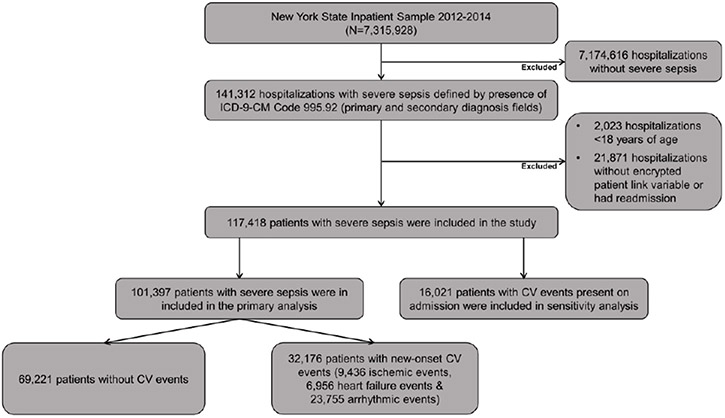
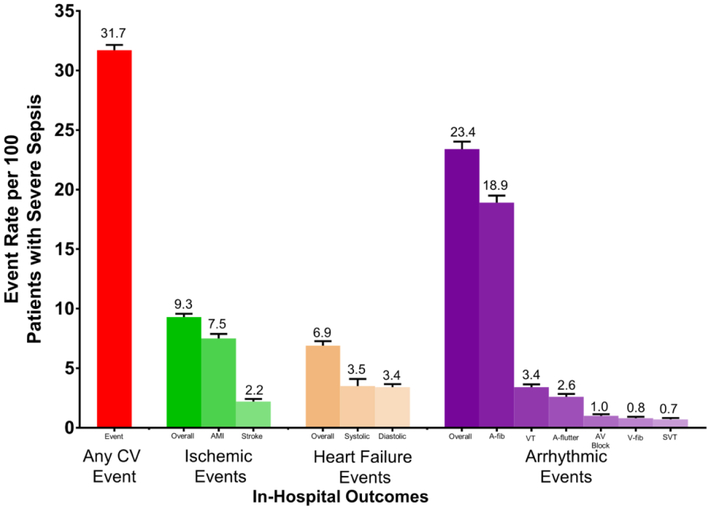
The burden of cardiovascular events among patients hospitalized with severe sepsis and the association of these events with in-hospital mortality is not well known. We examined the incidence of cardiovascular events and their association with in-hospital mortality among patients with severe sepsis. Patients with severe sepsis from the New York State Inpatient Database from 2012 through 2014 were identified using a validated International Classification of Diseases 9th Revision, Clinical Modification code 995.92. The primary outcome was the incidence of cardiovascular events during the hospitalizations, defined as a composite of ischemic, acute heart failure, or arrhythmic events and the secondary outcome was in-hospital mortality. Multivariable logistic regression models were used to compare the risk of in-hospital mortality among severe sepsis patients with and without cardiovascular events. A total of 117,418 patients (mean age, 70.8 years; 50.4% males, 59.5% whites) with severe sepsis occurred during the study period 2012 to 2014. New-onset (incident) cardiovascular event occurred in 13.1%, ischemic events in 4.5%, acute heart failure events in 2.3%, and arrhythmic events in 8.0% of patients, respectively. An estimated 32.9% of patients with severe sepsis died during their hospitalization. Severe sepsis patients with new-onset cardiovascular events were associated with 30% higher odds for in-hospital mortality (odds ratio: 1.30; 95% CI: 1.23 to 1.37, p < 0.001) as compared with patients without cardiovascular events in multivariable adjusted model. In conclusion, among patients with severe sepsis, incident cardiovascular events occur frequently. Further research is required to improve recognition and treatment of new-onset cardiovascular events in patients with severe sepsis.
Copyright © 2019 Elsevier Inc. All rights reserved.
Conflict of interest statement
Figures
References
-
- Wang HE, Shapiro NI, Angus DC, Yealy DM. National estimates of severe sepsis in United States emergency departments. Critical care medicine 2007;35:1928–1936. - PubMed
-
- Liu V, Escobar GJ, Greene JD, Soule J, Whippy A, Angus DC, Iwashyna TJ. Hospital deaths in patients with sepsis from 2 independent cohorts. Jama 2014;312:90–92. - PubMed
-
- Mouncey PR, Osborn TM, Power GS, Harrison DA, Sadique MZ, Grieve RD, Jahan R, Harvey SE, Bell D, Bion JF, Coats TJ, Singer M, Young JD, Rowan KM. Trial of Early, Goal-Directed Resuscitation for Septic Shock. New England Journal of Medicine 2015;372:1301–1311. - PubMed
Publication types
MeSH terms
Grants and funding
LinkOut - more resources
Full Text Sources
Medical
