. 2019 Mar;37(2):113-124.
doi: 10.1002/cbf.3382. Epub 2019 Feb 18.

An in vitro study of scarring formation mediated by human Tenon fibroblasts: Effect of Y-27632, a Rho kinase inhibitor

Affiliations

An in vitro study of scarring formation mediated by human Tenon fibroblasts: Effect of Y-27632, a Rho kinase inhibitor

Diah Gemala Ibrahim et al. Cell Biochem Funct. 2019 Mar.

Abstract

Scar formation is the most common cause for failure of glaucoma filtration surgery because of increased fibroblast proliferation and activation. We have now examined the effect of Y-27632, a Rho-associated protein kinase (ROCK) inhibitor, on postsurgical scarring formation in human Tenon fibroblasts (HTFs). Collagen gel contraction assay was used to compare contractility activity of Y-27632 with several antiglaucoma drugs. Immunofluorescence and western blotting were used to examine expression of scar formation-related factors. We found that Y-27632 inhibited collagen gel contraction, as well as α-smooth muscle actin and vimentin expression; these were promoted by treatment with latanoprost, timolol, or transforming growth factor (TGF)-β. To investigate the effect of Y-27632 in postsurgical scarring, we mimicked TGF-β secretion by stimulating HTFs with TGF-β prior to Y-27632 treatment. HTFs cultured in the presence of TGF-β significantly increased gel contraction. In contrast, when HTFs were treated with 10μM Y-27632, contraction was significantly inhibited. Furthermore, Y-27632 reduced TGF-β-induced phosphorylation of mitogen-activated protein kinase signalling. These results suggest that ROCK inhibitors may inhibit fibrosis by inhibiting transdifferentiation of Tenon fibroblasts into myofibroblasts and by inhibiting TGF-β signalling after surgery through mitogen-activated protein kinase pathway suppression. These results implicate that ROCK inhibitors may improve outcomes after filtering surgery with a potential antiscarring effect, while latanoprost and timolol may induce fibrosis. SIGNIFICANCE OF THE STUDY: Scar formation is the primary cause of failure after glaucoma filtration surgery. A ROCK inhibitor, Y-27632, has been introduced as a novel potential antiglaucoma treatment to reduce intraocular pressure. The aim of our study was to elucidate the effect of Y-27632 on scarring formation after glaucoma filtration surgery, in direct comparison with other antiglaucoma drugs. Our findings thus suggested that Y-27632 may inhibit fibrosis and improve outcome after glaucoma filtration surgery through inhibition of transdifferentiation of Tenon fibroblasts into myofibroblasts, and the TGF-β and MAPK signalling after surgery, while latanoprost and timolol may induce fibrosis.

Keywords: Tenon fibroblast; Y-27632; glaucoma; scarring formation; wound healing.


Figures

Figure 1
Figure 1
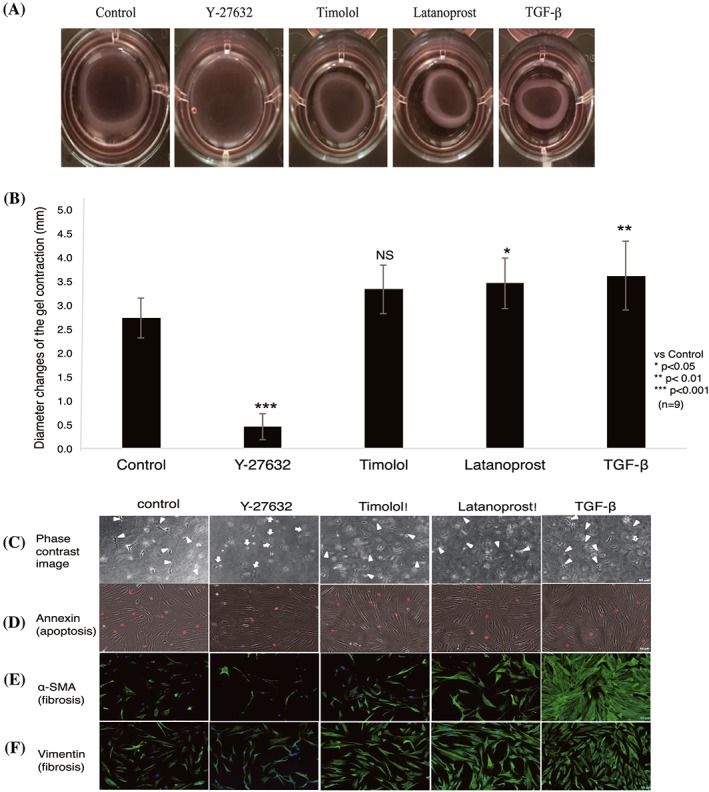
Effects of Y‐27632 and other antiglaucoma drugs on collagen gel contraction. A, Representative collagen gel photographs are shown after 24 h of treatment with 10μM Y‐27632, timolol, latanoprost, or TGF‐β. B, Gel contraction (diameter) induced by Y‐27632–treated cells and other drugs was compared with control. Y‐27632 significantly reduced collagen gel contraction, compared with control, while other groups exhibited contraction. Data shown are mean ± SD of three independent experiments in triplicate; data were analysed by one‐way ANOVA, followed by the Dunnett post hoc test. *P < 0.05, **P < 0.01, ***P < 0.001 versus control (NS: nonsignificant). C, Effects of Y‐27632 on human Tenon fibroblast cell morphology. Representative phase contrast images are shown. Y‐27632 induced rounding and retraction of cells (white arrow), while other treatments resulted in spindle‐shaped/elongated fibroblasts (white arrowhead). D, Effect of Y‐27632 on apoptotic cells. Representative images show that Y‐27632 had no effect on apoptotic cells, compared with control. E, F, Effect of Y‐27632 on α‐SMA and vimentin expression. Timolol‐, latanoprost‐, and TGF‐β–treated cells showed increased expression of α‐SMA and vimentin, compared with control. In contrast, Y‐27632 reduced the expression of both proteins. Composite images (E, F) show α‐SMA and vimentin (green) and DAPI‐stained nuclei (blue). Scale bar: 50 μm, n = 3. ANOVA, analysis of variance; DAPI, 4′,6‐diamidino‐2‐phenylindole; TGF‐β, transforming growth factor‐β; α‐SMA, α‐smooth muscle actin
Figure 2
Figure 2
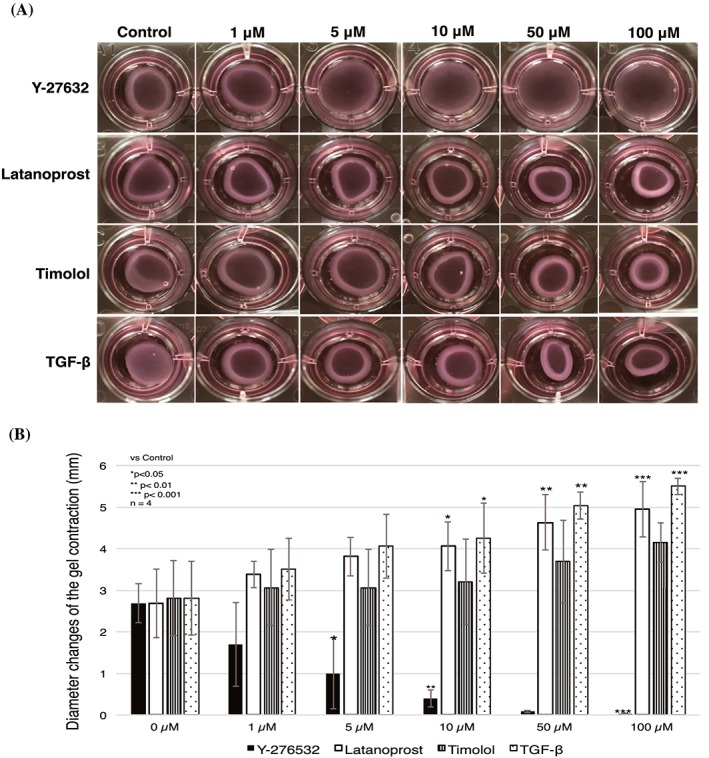
Y‐27632 induced significant dose‐dependent inhibition of human Tenon fibroblast cell‐mediated collagen gel contraction. The dose dependence of collagen gel contraction was tested with various concentrations of antiglaucoma drugs (latanoprost and timolol maleate), Y‐27632, and TGF‐β, from 0μM through 100μM, for 24 h. A, Images show representative pictures of the collagen gel. B, Contraction was significantly reduced by a minimum treatment of 5μM Y‐27632; it reached a maximum at 100μM Y‐27632. Data represent the mean ± SD (n = 4) and were analysed by one‐way ANOVA, followed by the Dunnett post hoc test. *P < 0.05, **P < 0.01, ***P < 0.001. ANOVA, analysis of variance; TGF‐β, transforming growth factor‐β
Figure 3
Figure 3
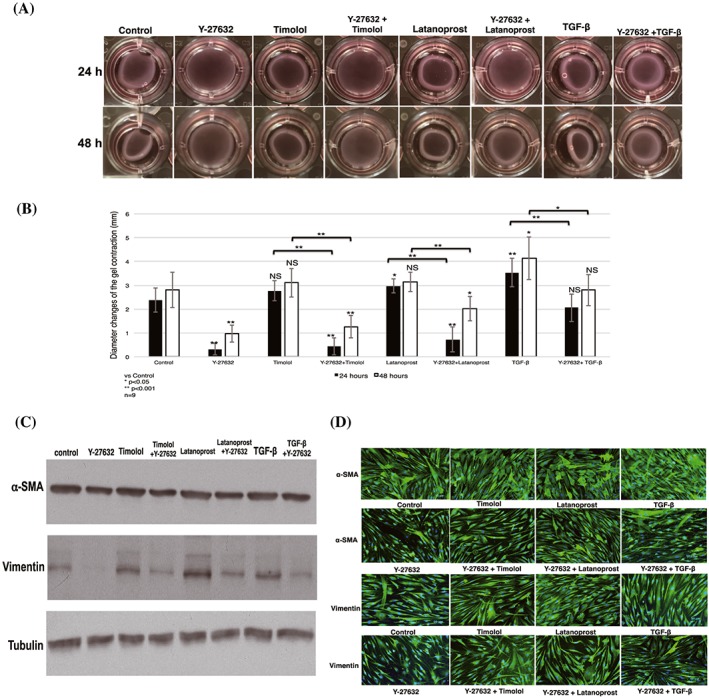
Contractility inhibitory effect of Y‐27632 on collagen gel in combination with other antiglaucoma drugs. A, Representative photographs show changes in collagen gel contraction after administration of Y‐27632 with a combination of timolol, latanoprost, and TGF‐β, compared with single treatment with timolol, latanoprost, or TGF‐β for 24 and 48 h. B, The findings of contraction analysis were analysed; results shown represent the mean ± SD (n = 9). Significant differences were determined by one‐way ANOVA, followed by the Dunnett post hoc test versus control; differences between two groups were determined with the Student unpaired t test. *P < 0.05, **P < 0.001 (NS: nonsignificant). C, D, Expression of α‐SMA and vimentin by cells stimulated with combination treatment plus Y‐27632. Total protein was extracted from collagen gels (shown in Figure 3A). Blots were analysed by western blotting (C) with anti–α‐SMA and antivimentin antibodies and verified by immunofluorescence analysis (D). Blots were probed with antitubulin antibody to confirm equal loading and transfer. Both western blotting and immunofluorescence analyses showed increased α‐SMA and vimentin expression after a single treatment with latanoprost, timolol, and TGF‐β; addition of Y‐27632 prevented expression of each protein. ANOVA, analysis of variance; TGF‐β, transforming growth factor‐β; α‐SMA, α‐smooth muscle actin
Figure 4
Figure 4
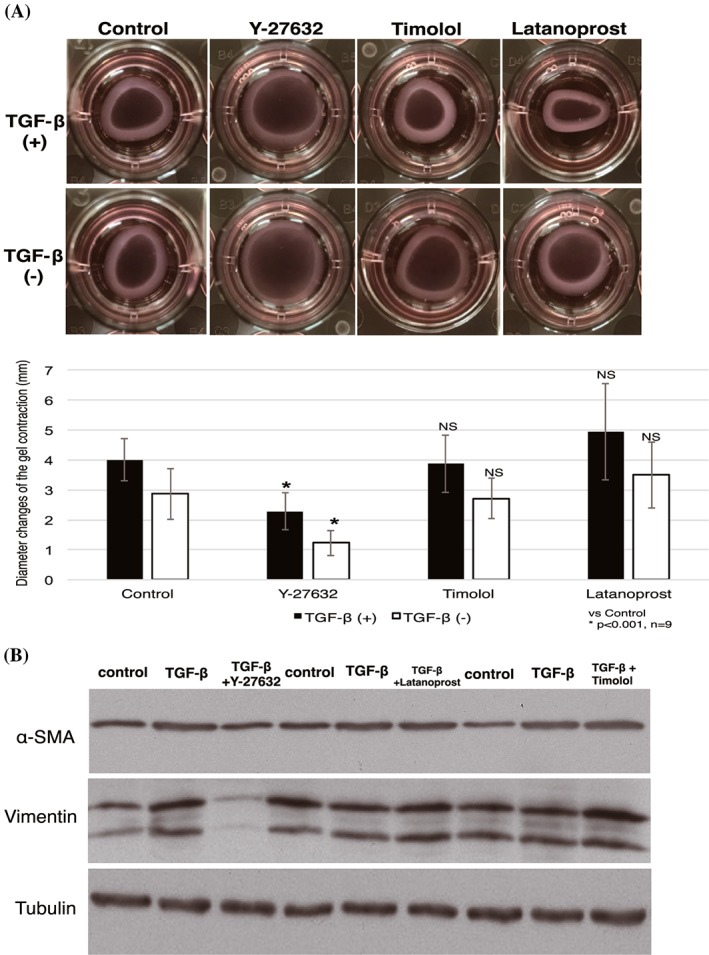
Effect of Y‐27632 on TGF‐β–induced fibrosis. A, HTFs were cultured on collagen gels before treatment with Y‐27632, timolol, and latanoprost for 24 h; HTFs were then incubated with TGF‐β (top) and without TGF‐β (bottom) for 1 day to mimic postoperative excretion of TGF‐β and to assess the ability of Y‐27632 to suppress the TGF‐β effect. The extent of contraction was then measured. Data shown are the mean ± SD; *P < 0.001 by one‐way ANOVA, followed by the Dunnett post hoc test. B, Lysates of collagen gels were prepared for western blotting with antibodies to α‐SMA, vimentin, and tubulin (loading control). Data are representative of three independent experiments performed in triplicate (NS: nonsignificant). ANOVA, analysis of variance; HTF, human Tenon fibroblast; TGF‐β, transforming growth factor‐β; α‐SMA, α‐smooth muscle actin
Figure 5
Figure 5
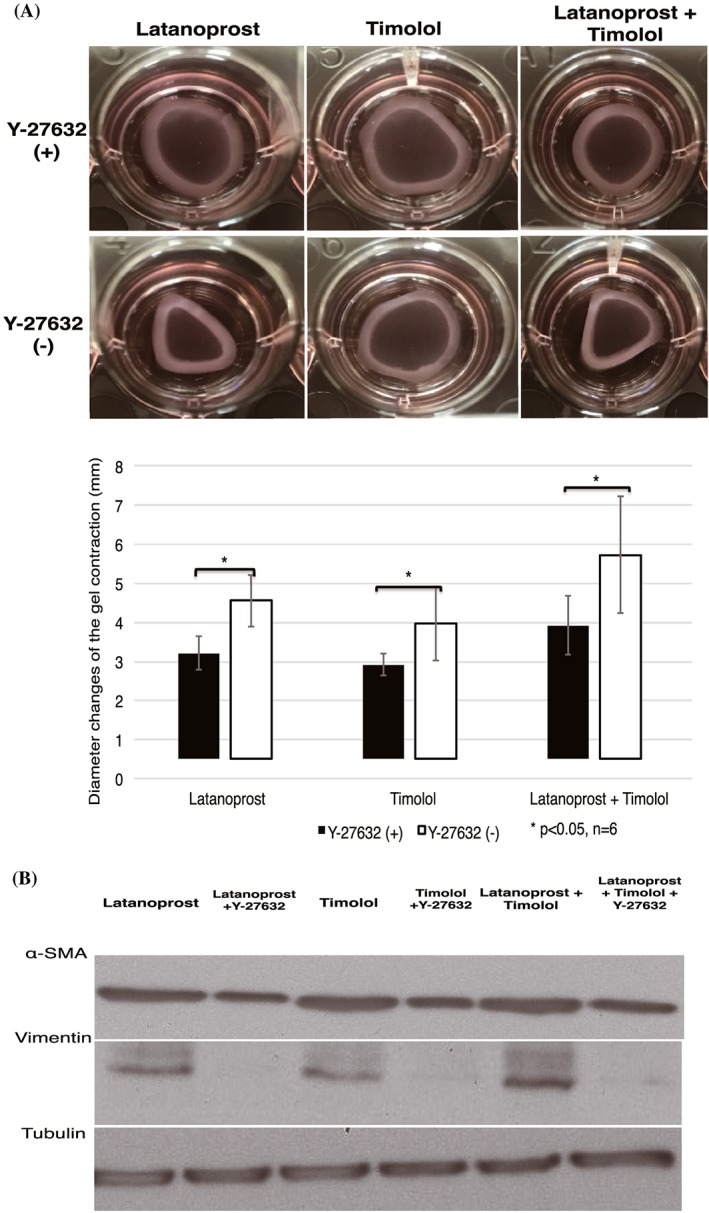
ROCK inhibitor decreased latanoprost‐, timolol‐, and combination latanoprost/timolol–induced collagen gel contraction and expression of α‐SMA and vimentin. A, HTFs were serum‐starved overnight, stimulated with antiglaucoma drugs for 24 h, and then treated with and without Y‐27632 afterwards. Diameter changes of gel contraction were observed 24 h after Y‐27632 stimulation. B, Gels were then lysed and analysed by western blotting. Blots were reprobed for tubulin as a loading control. The statistical significance of differences between groups treated and untreated with Y‐27632 was determined by the Student unpaired t test (n = 6). Differences were considered statistically significant when *P < 0.05 (NS: nonsignificant). HTF, human Tenon fibroblast; ROCK, Rho‐associated protein kinase; α‐SMA, α‐smooth muscle actin
Figure 6
Figure 6
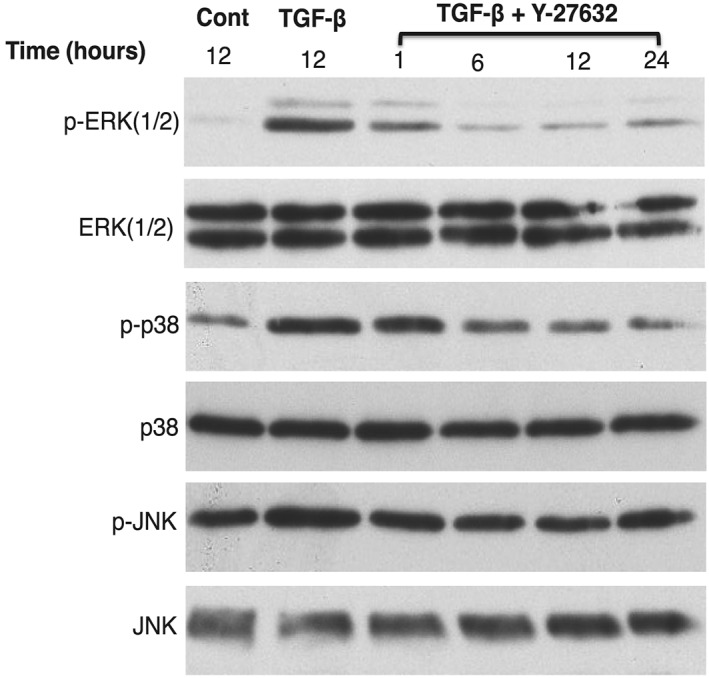
Inhibition of MAPK on TGF‐β–induced MAPK signalling by Y‐27632. Serum‐starved HTFs were untreated (negative control), treated with TGF‐β for 12 h (positive control), and treated with TGF‐β with Y‐27632 for 1 through 24 h (sample test). Cells were lysed and then analysed by western blotting. Treatment with Y‐27632 resulted in inhibition of phosphorylated (p‐) ERK 1/2, p38, and JNK, compared with the positive control. Data are representative of three independent experiments. ERK, extracellular signal–regulated kinase; HTF, human Tenon fibroblast; JNK, c‐Jun N‐terminal Kinase; MAPK, mitogen‐activated protein kinase; TGF‐β, transforming growth factor‐β

References

    1. Agarwal R, Gupta SK, Agarwal P, Saxena R, Agrawal SS. Current concepts in the pathophysiology of glaucoma. Indian J Ophthalmol. 2009;57(4):257‐266. - PMC - PubMed
    1. Weinreb RN, Aung T, Medeiros FA. The pathophysiology and treatment of glaucoma: a review. JAMA. 2014;311(18):1901‐1911. - PMC - PubMed
    1. Foster PJ, Buhrmann R, Quigley HA, Johnson GJ. The definition and classification of glaucoma in prevalence surveys. Br J Ophthalmol. 2002;86(2):238‐242. - PMC - PubMed
    1. Quigley HA, Broman AT. The number of people with glaucoma worldwide in 2010 and 2020. Br J Ophthalmol. 2006;90(3):262‐267. - PMC - PubMed
    1. Cholkar K, Trinh HM, Pal D, Mitra AK. Discovery of novel inhibitors for the treatment of glaucoma. Expert Opin Drug Discovery. 2015;10(3):293‐313. - PMC - PubMed

MeSH terms