Review
. 2019 Jan 31:8:F1000 Faculty Rev-132.
doi: 10.12688/f1000research.17039.1. eCollection 2019.

Novel systemic therapies in atopic dermatitis: what do we need to fulfil the promise of a treatment revolution?

Affiliations
Review

Novel systemic therapies in atopic dermatitis: what do we need to fulfil the promise of a treatment revolution?

Helen Alexander et al. F1000Res. .

Abstract

Patients with atopic dermatitis (AD) who do not adequately respond to topical therapy and phototherapy often need systemic immunomodulatory treatment to control their symptoms. Conventional systemic agents, such as ciclosporin, azathioprine, and methotrexate, have been used for decades, but there are concerns about their safety profile. There are now many novel systemic agents emerging through clinical trials, which may have great potential in the treatment of AD. Despite this, there are very few data comparing the performance of these drugs against each other. The purpose of this article is to review the current systemic therapies in AD and present an indirect comparison of systemic AD treatments using effectiveness and safety data from published randomised controlled trials, highlighting important remaining gaps in knowledge. Although the latest developments in systemic AD treatments are exciting and dearly needed, further work is required before the promise of a therapeutic revolution becomes reality.

Keywords: Atopic dermatitis; eczema.


Conflict of interest statement

Competing interests: CF has received investigator-led research funding from Sanofi for microbiome work. His department has received clinical trial funding from Sanofi and AbbVie to test novel therapeutics in paediatric atopic eczema patients. The views expressed are those of the authors and not necessarily those of the UK National Health Service, the UK Department of Health, or the National Institute of Health Research. HA, TP, AM, and ZKJ-L declare that they have no competing interests.Competing interests: Feldman has received research, speaking and/or consulting support from a variety of companies including Galderma, GSK/Stiefel, Almirall, Leo Pharma, BMS, Boehringer Ingelheim, Mylan, Celgene, Pfizer, Ortho Dermatology, Abbvie, Samsung, Janssen, Lilly, Menlo, Merck, Novartis, Regeneron, Sanofi, Novan, Qurient, National Biological Corporation, Caremark, Advance Medical, Sun Pharma, Suncare Research, Informa, UpToDate and National Psoriasis FoundationNo competing interests were disclosed.No competing interests were disclosed.

Figures
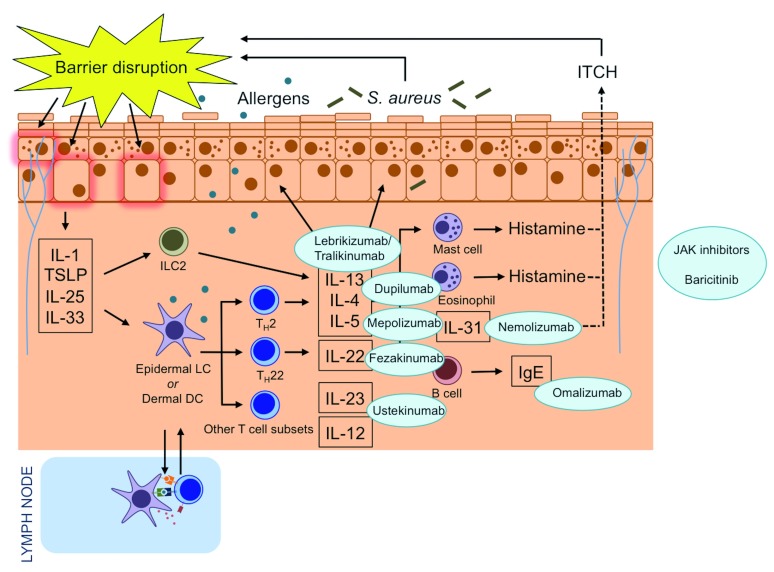
Figure 1.
Figure 1.. Atopic dermatitis pathogenesis and drug targets of novel systemic therapies.
Novel systemic therapies target immune mediators in atopic dermatitis. Mepolizumab is a monoclonal antibody to interleukin-4 (IL-4). Omalizumab is a monoclonal anti-immunoglobulin E (IgE) antibody. Dupilumab is an IL-4 receptor α-antagonist that inhibits IL-4 and IL-13 signalling. Lebrikizumab and tralokinumab are monoclonal antibodies that bind to IL-13. Ustekinumab binds to the shared p40 subunit of IL-12 and IL-23 to regulate T helper type 1 (Th1) and Th17 pathways. Nemolizumab is a monoclonal antibody against IL-31 receptor A. Fezakinumab is an IL-22 antagonist. Baricitinib is a Janus kinase 1 (JAK1) and JAK2 inhibitor. DC, dendritic cell; ILC2, type 2 innate lymphoid cell; LC, Langerhans cell; S. aureus, Staphylococcus aureus; TSLP, thymic stromal lymphopoietin.
Figure 2.
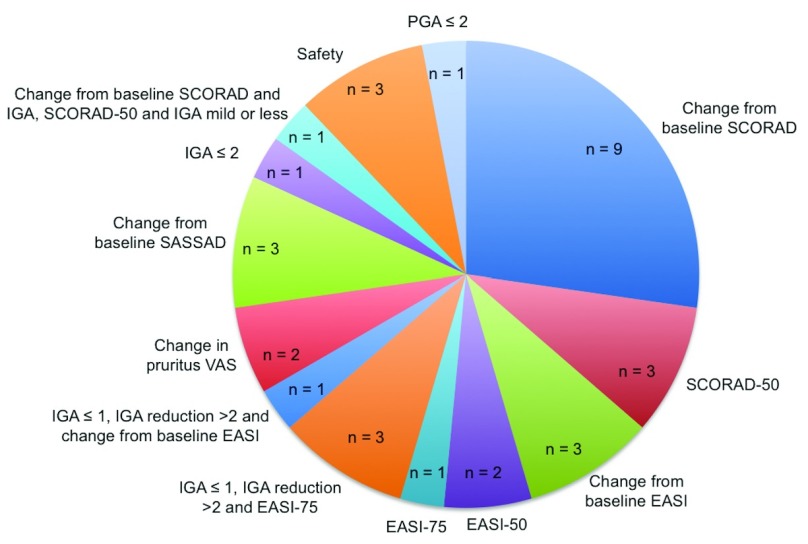
Figure 2.. Primary end points of included trials.
The diverse range of primary endpoints reported across included randomised controlled trials. EASI, Eczema Area and Severity Index; IGA, Investigator’s Global Assessment; PGA, Physician's Global Assessment; SASSAD, Six Area Six Sign Atopic Dermatitis; SCORAD, Scoring Atopic Dermatitis; VAS, visual analogue scale.
Figure 3.
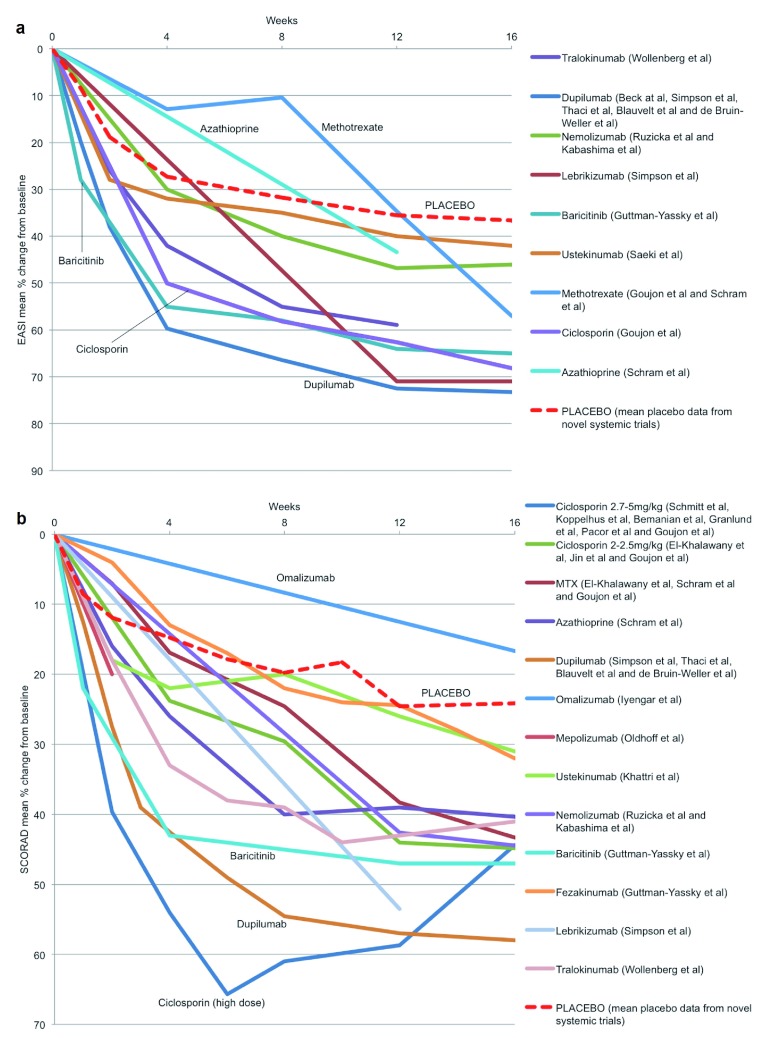
Figure 3.. Treatment effectiveness: physician-assessed severity measures.
Eczema Area and Severity Index (EASI) (a) and Scoring Atopic Dermatitis (SCORAD) (b) mean percentage change from baseline up to 16 weeks for systemic agents for which these data were reported. MTX, methotrexate.
Figure 4.
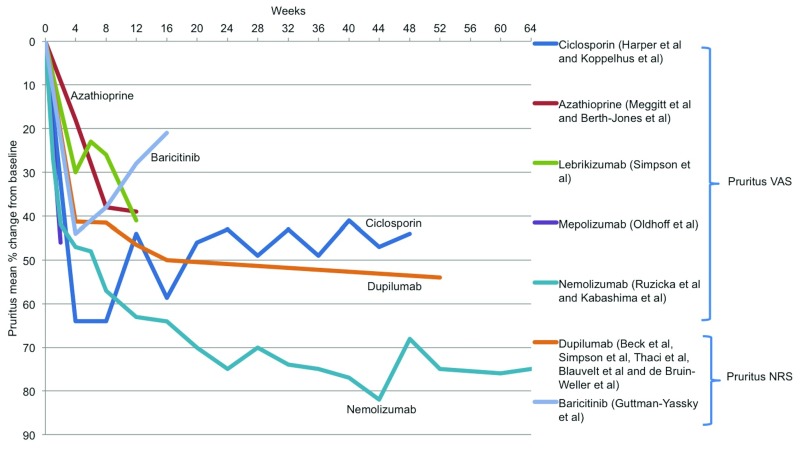
Figure 4.. Treatment effectiveness: patient-reported severity measures.
Mean percentage change from baseline in pruritus visual analogue score (VAS) and pruritus numerical rating scale (NRS) for systemic agents for which these data were reported.
Figure 5.
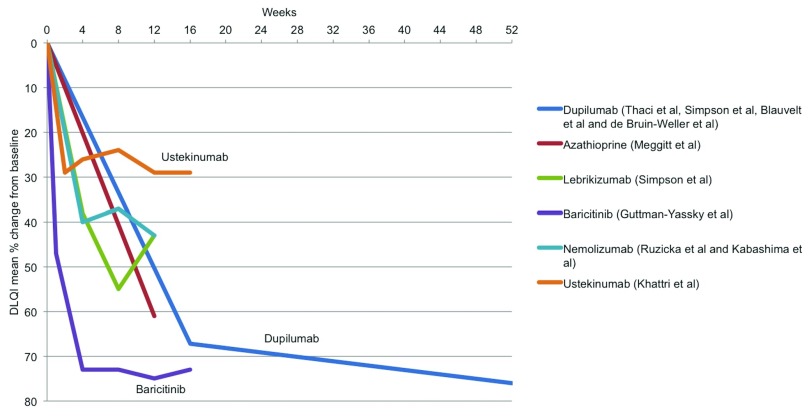
Figure 5.. Treatment effectiveness: quality of life.
Dermatology Life Quality Index (DLQI) mean percentage change from baseline for systemic agents for which these data were reported.
Figure 6.
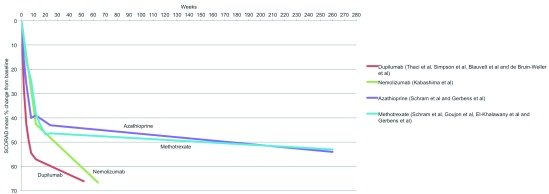
Figure 6.. Treatment effectiveness: long-term disease control.
Scoring Atopic Dermatitis (SCORAD) mean percentage change from baseline for systemic agents for which these data were reported in at least one trial that was one year or longer in duration.

References

    1. Deckers IA, McLean S, Linssen S, et al. : Investigating international time trends in the incidence and prevalence of atopic eczema 1990-2010: a systematic review of epidemiological studies. PLoS One. 2012;7(7):e39803. 10.1371/journal.pone.0039803 - DOI - PMC - PubMed
    1. Thyssen JP, Hamann CR, Linneberg A, et al. : Atopic dermatitis is associated with anxiety, depression, and suicidal ideation, but not with psychiatric hospitalization or suicide. Allergy. 2018;73(1):214–20. 10.1111/all.13231 - DOI - PubMed
    2. F1000 Recommendation

    1. Garg N, Silverberg JI: Association between childhood allergic disease, psychological comorbidity, and injury requiring medical attention. Ann Allergy Asthma Immunol. 2014;112(6):525–32. 10.1016/j.anai.2014.03.006 - DOI - PubMed
    1. McAleer MA, Flohr C, Irvine AD: Management of difficult and severe eczema in childhood. BMJ. 2012;345:e4770. 10.1136/bmj.e4770 - DOI - PubMed
    1. Flohr C, Irvine AD: Systemic therapies for severe atopic dermatitis in children and adults. J Allergy Clin Immunol. 2013;132(3):774–774.e6. 10.1016/j.jaci.2013.03.016 - DOI - PubMed

Publication types

LinkOut - more resources