Review
. 2019 Feb 8:4:3.
doi: 10.1038/s41392-019-0036-y. eCollection 2019.

Targeting growth hormone function: strategies and therapeutic applications

Affiliations
Review

Targeting growth hormone function: strategies and therapeutic applications

Man Lu et al. Signal Transduct Target Ther. .

Abstract

Human growth hormone (GH) is a classical pituitary endocrine hormone that is essential for normal postnatal growth and has pleiotropic effects across multiple physiological systems. GH is also expressed in extrapituitary tissues and has localized autocrine/paracrine effects at these sites. In adults, hypersecretion of GH causes acromegaly, and strategies that block the release of GH or that inhibit GH receptor (GHR) activation are the primary forms of medical therapy for this disease. Overproduction of GH has also been linked to cancer and the microvascular complications that are associated with diabetes. However, studies to investigate the therapeutic potential of GHR antagonism in these diseases have been limited, most likely due to difficulty in accessing therapeutic tools to study the pharmacology of the receptor in vivo. This review will discuss current and emerging strategies for antagonizing GH function and the potential disease indications.


Conflict of interest statement

The authors declare that they have no conflict of interest.

Figures

Fig. 1
Fig. 1
Endocrine regulation of GH and therapeutic blockade. GH is secreted from the anterior pituitary under the control of hypothalamic hormones, growth hormone releasing hormone (GHRH) and somatostatin (SSTN), and ghrelin, which is predominantly secreted in the stomach. Endocrine secretion of GH impacts numerous physiological systems with wide-ranging effects in various tissues. GH is also expressed in extrapituitary tissues in which it has localized autocrine/paracrine effects. Strategies to antagonize GH signaling are shown and are described in detail below
Fig. 2
Fig. 2
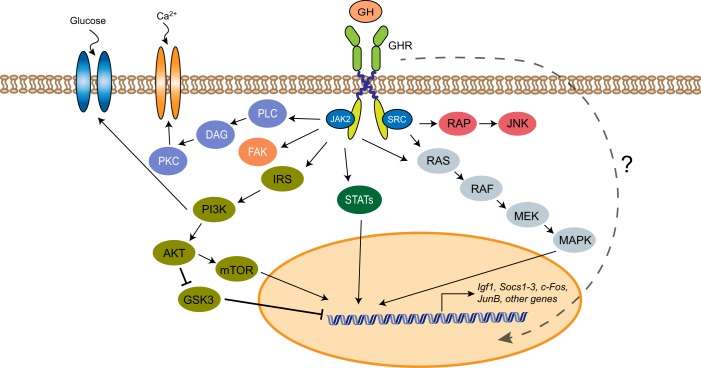
GHR signal transduction. A predimerized GHR interacts with the GH ligand and activates the associated kinases, JAK2 and SRC. Key signal transduction pathways activated by the GHR include the JAK-STAT, MEK/MAPK, PI3K/AKT/mTOR, and PLC/DAG/PKC pathways. The GHR can also translocate to the nucleus (dotted line), but the function remains unclear. GHR growth hormone receptor, GH growth hormone, JAK2 janus kinase 2, SRC SRC proto-oncogene, STAT signal transducer and activator of transcription, MEK mitogen-activated protein kinase kinase, MAPK mitogen-activated protein kinase, PI3K/AKT/mTOR phosphatidylinositol 3-kinase/AKT/mammalian target of rapamycin, GSK3 glycogen synthase kinase 3, IRS insulin receptor substrate, PLC/DAG/PKC phospholipase C/diacylglycerol/protein kinase C, FAK focal adhesion kinase, RAP rap guanine nucleotide exchanger
Fig. 3
Fig. 3
GHR crosstalk. In addition to the GHR, GH can bind and activate the PRLR, and the GHR can form heteromultimers with PRLR. Furthermore, GHR cross-talks and/or forms complexes with several other growth factor and hormone receptors, such as EphA4, EGFR, and IGF1R, which enhances the stimulation of downstream signaling pathways. GHR growth hormone receptor, GH growth hormone, JAK2 janus kinase 2, STAT signal transducer and activator of transcription, MEK mitogen-activated protein kinase kinase, MAPK mitogen-activated protein kinase, PI3K/AKT/mTOR phosphatidylinositol 3-kinase/AKT/mammalian target of rapamycin, PRLR prolactin receptor, EGFR epidermal growth factor receptor, IGF1R insulin-like growth factor 1 receptor, AR androgen receptor
Fig. 4
Fig. 4
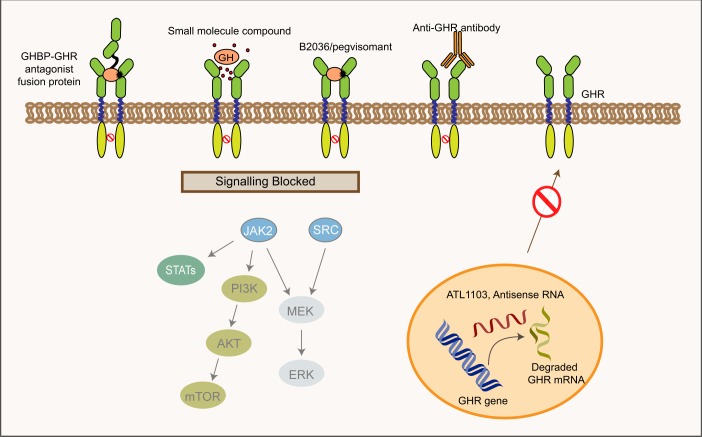
Strategies targeting the GHR One protein-derived GHR antagonist is clinically approved (pegvisomant), and several other GHR-targeted approaches are in development. These include an antagonist-GHBP fusion protein and anti-GHR antibodies, which inhibit the activation of GHR and block downstream signaling. Another approach is atesidorsen (ATL1103), an antisense oligonucleotide (ASO), that binds and induces the degradation of GHR mRNA. Small molecule compounds may also have applications; however, there are currently limited reports in this area

References

    1. Melmed S. Acromegaly pathogenesis and treatment. J. Clin. Invest. 2009;119:3189–3202. doi: 10.1172/JCI39375. - DOI - PMC - PubMed
    1. Dehkhoda F, Lee CMM, Medina J, Brooks AJ. The growth hormone receptor: mechanism of receptor activation, cell signaling, and physiological aspects. Front. Endocrinol. 2018;9:35. doi: 10.3389/fendo.2018.00035. - DOI - PMC - PubMed
    1. Brooks AJ, Waters MJ. The growth hormone receptor: mechanism of activation and clinical implications. Nat. Rev. Endocrinol. 2010;6:515–525. doi: 10.1038/nrendo.2010.123. - DOI - PubMed
    1. Perry JK, Emerald BS, Mertani HC, Lobie PE. The oncogenic potential of growth hormone. Growth Horm. IGF Res. 2006;16:277–289. doi: 10.1016/j.ghir.2006.09.006. - DOI - PubMed
    1. Thankamony GA, Dunger DB, Acerini CL. Pegvisomant: current and potential novel therapeutic applications. Expert. Opin. Biol. Ther. 2009;9:1553–1563. doi: 10.1517/14712590903449222. - DOI - PubMed