Review
. 2019 Jan;11(Suppl 1):S113-S126.
doi: 10.21037/jtd.2018.12.18.

Circulating free tumor DNA in non-small cell lung cancer (NSCLC): clinical application and future perspectives

Affiliations
Review

Circulating free tumor DNA in non-small cell lung cancer (NSCLC): clinical application and future perspectives

Guillaume Herbreteau et al. J Thorac Dis. 2019 Jan.

Abstract

Major advances in the treatment of non-small cell lung cancer (NSCLC) patients have been obtained during the last decade. Molecular testing of tumor samples is therefore mandatory in routine clinical practice. Tumor DNA is also present as cell-free molecules in blood, which is therefore a very useful and convenient source of tumor DNA. In this review, we discuss pre-analytical and analytical aspects of circulating tumor DNA (ctDNA) analysis. We also describe the use of ctDNA analysis in routine clinical practice, and discuss the potential use of ctDNA monitoring both to identify minimal residual disease and as a potential tool to early identify patients' response to treatment.

Keywords: ALK translocation; Circulating tumor DNA (ctDNA); EGFR mutation; minimal residual disease (MRD); non-small cell lung cancer (NSCLC); tumor mutation burden (TMB).


Conflict of interest statement

Conflicts of Interest: The authors have no conflicts of interest to declare.

Figures
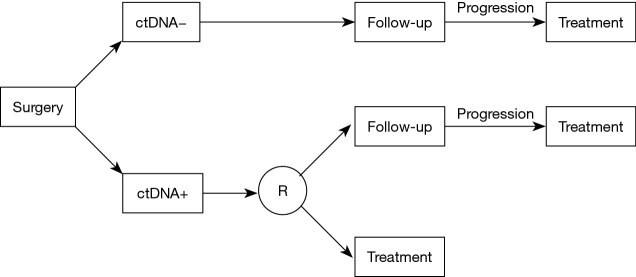
Figure 1
Figure 1
Design of a clinical trial investigating the benefit of ctDNA testing in the adjuvant setting. Following surgery, patients will be tested on plasma. If the test is negative, the patients will be followed until progression, and then treated with adjuvant therapy. If the initial plasma test is positive, patients will be randomized. In the control arm, the patients will be followed until progression, and then treated. In the experimental arm, the patients will be treated with adjuvant therapy directly. ctDNA, circulating tumor DNA.
Figure 2
Figure 2
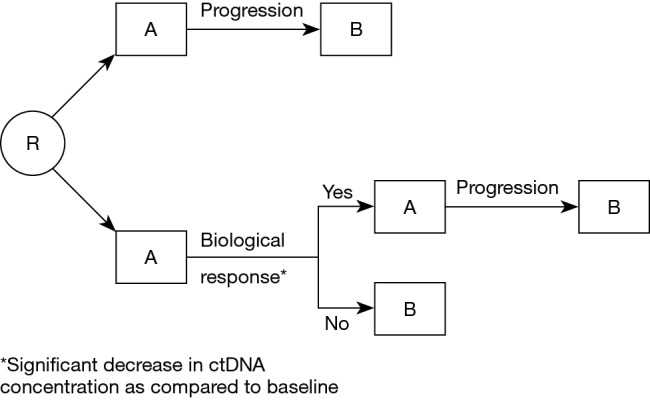
Design of a clinical trial investigating the potential of ctDNA monitoring to guide therapy in the metastatic setting. In the reference arm, patients will be treated with A, then with B following radiological or clinical progression. In the experimental arm, early ctDNA analysis (after for instance 2 or 3 weeks of treatment), will allow to identify a change in ctDNA concentration as compared to the pre-treatment assay performed. In case of significant decrease, suggesting that the patient is responding, treatment A will be continued until radiological or clinical progression. If there is no decrease in ctDNA concentration, suggesting that the patient is not responding to treatment A, the treatment will be changed to B. ctDNA, circulating tumor DNA.

References

    1. Barlesi F, Mazieres J, Merlio JP, et al. Routine molecular profiling of patients with advanced non-small-cell lung cancer: results of a 1-year nationwide programme of the French Cooperative Thoracic Intergroup (IFCT). Lancet 2016;387:1415-26. 10.1016/S0140-6736(16)00004-0 - DOI - PubMed
    1. Shames DS, Wistuba II. The evolving genomic classification of lung cancer. J Pathol 2014;232:121-33. 10.1002/path.4275 - DOI - PMC - PubMed
    1. Lindeman NI, Cagle PT, Aisner DL, et al. Updated Molecular Testing Guideline for the Selection of Lung Cancer Patients for Treatment With Targeted Tyrosine Kinase Inhibitors: Guideline From the College of American Pathologists, the International Association for the Study of Lung Cancer, and the Association for Molecular Pathology. J Mol Diagn 2018;20:129-59. 10.1016/j.jmoldx.2017.11.004 - DOI - PubMed
    1. Ettinger DS, Wood DE, Akerley W, et al. NCCN Guidelines Insights: Non-Small Cell Lung Cancer, Version 4.2016. J Natl Compr Canc Netw 2016;14:255-64. 10.6004/jnccn.2016.0031 - DOI - PMC - PubMed
    1. NLCA annual report 2015. Available online: https://www.rcplondon.ac.uk/projects/outputs/nlca-annual-report-2015