Intravenous Alpha-1 Antitrypsin Therapy for Alpha-1 Antitrypsin Deficiency: The Current State of the Evidence
- PMID: 30775428
- PMCID: PMC6373587
- DOI: 10.15326/jcopdf.6.1.2017.0185
Intravenous Alpha-1 Antitrypsin Therapy for Alpha-1 Antitrypsin Deficiency: The Current State of the Evidence
Abstract
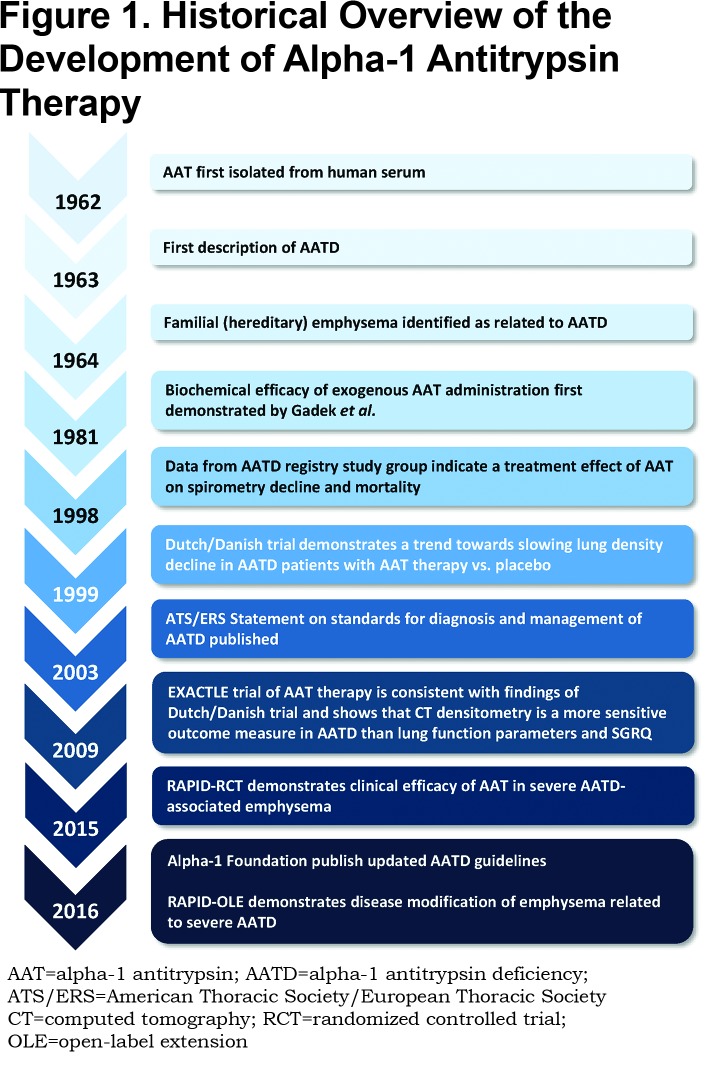
Alpha-1 antitrypsin deficiency (AATD) is a largely monogenetic disorder associated with a high risk for the development of chronic obstructive pulmonary disease (COPD) and cirrhosis. Intravenous alpha-1 antitrypsin (AAT) therapy has been available for the treatment of individuals with AATD and COPD since the late 1980s. Initial Food and Drug Administration (FDA) approval was granted based on biochemical efficacy. Following its approval, the FDA, scientific community and third-party payers encouraged manufacturers of AAT therapy to determine its clinical efficacy. This task has proved challenging because AATD is a rare, orphan disorder comprised of individuals who are geographically dispersed and infrequently identified. In addition, robust clinical trial outcomes have been lacking until recently. This review provides an update on the evidence for the clinical efficacy of intravenous AAT therapy for patients with AATD-related emphysema.
Keywords: AAT therapy; alpha-1 antitrypsin deficiency; clinical efficacy; copd; disease modification; emphysema.
Conflict of interest statement
GaryThe authors have no conflicts of interest to declare. Medical writing assistance was provided by Steven Foster of Meridian HealthComms Ltd (Plumley, United Kingdom), funded by CSL Behring.
References
-
- Stoller JK,Aboussouan LS. A review of α1-antitrypsin deficiency. Am J Respir Crit Care Med. 2012;185(3):246-259. doi: https://doi.org/10.1164/rccm.201108-1428CI - PubMed
-
- Tonelli AR,Brantly ML. Augmentation therapy in alpha-1 antitrypsin deficiency: advances and controversies. Ther Adv Respir Dis. 2010;4(5):289-312. doi: https://doi.org/10.1177/1753465810373911 - PubMed
-
- Gadek JE,Klein HG,Holland PV,Crystal RG. Replacement therapy of alpha-1 antitrypsin deficiency. Reversal of protease-antiprotease imbalance within the alveolar structures of PiZ subjects. J Clin Invest. 1981;68(5):1158-1165. doi: http://doi.org/10.1172/JCI110360 - PMC - PubMed
-
- Greene CM,Marciniak SJ,Teckman J,et al. α1-antitrypsin deficiency. Nat Rev Dis Primers. 2016;2:16051. doi: https://doi.org/10.1038/nrdp.2016.51 - PubMed
-
- Jonigk D,Al-Omari M,Maegel L,et al. Anti-inflammatory and immunomodulatory properties of α1-antitrypsin without inhibition of elastase. Proc Natl Acad Sci U S A. 2013;110(37):15007-150012. doi: http://doi.org/10.1073/pnas.1309648110 - PMC - PubMed
Publication types
LinkOut - more resources
Full Text Sources
Other Literature Sources
Research Materials
Miscellaneous