


Association of Primary Care Physician Supply With Population Mortality in the United States, 2005-2015
- PMID: 30776056
- PMCID: PMC6450307
- DOI: 10.1001/jamainternmed.2018.7624
Association of Primary Care Physician Supply With Population Mortality in the United States, 2005-2015
Abstract
Importance: Recent US health care reforms incentivize improved population health outcomes and primary care functions. It remains unclear how much improving primary care physician supply can improve population health, independent of other health care and socioeconomic factors.
Objectives: To identify primary care physician supply changes across US counties from 2005-2015 and associations between such changes and population mortality.
Design, setting, and participants: This epidemiological study evaluated US population data and individual-level claims data linked to mortality from 2005 to 2015 against changes in primary care and specialist physician supply from 2005 to 2015. Data from 3142 US counties, 7144 primary care service areas, and 306 hospital referral regions were used to investigate the association of primary care physician supply with changes in life expectancy and cause-specific mortality after adjustment for health care, demographic, socioeconomic, and behavioral covariates. Analysis was performed from March to July 2018.
Main outcomes and measures: Age-standardized life expectancy, cause-specific mortality, and restricted mean survival time.
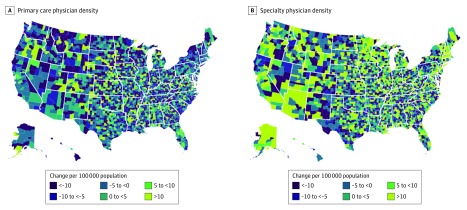
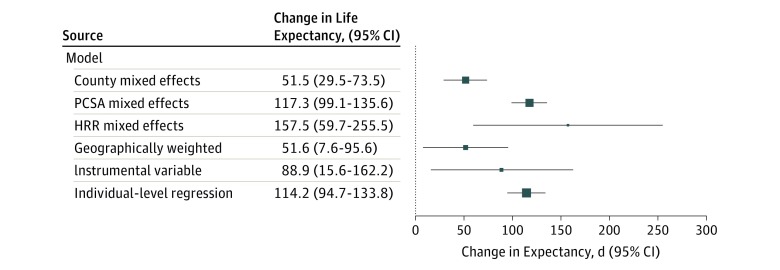
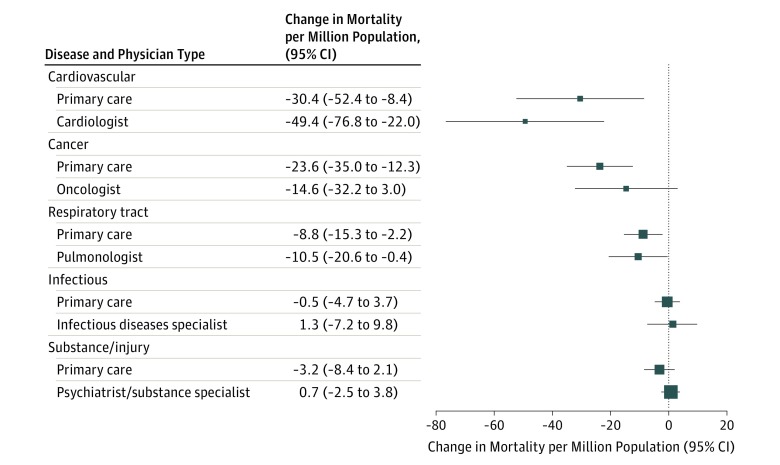
Results: Primary care physician supply increased from 196 014 physicians in 2005 to 204 419 in 2015. Owing to disproportionate losses of primary care physicians in some counties and population increases, the mean (SD) density of primary care physicians relative to population size decreased from 46.6 per 100 000 population (95% CI, 0.0-114.6 per 100 000 population) to 41.4 per 100 000 population (95% CI, 0.0-108.6 per 100 000 population), with greater losses in rural areas. In adjusted mixed-effects regressions, every 10 additional primary care physicians per 100 000 population was associated with a 51.5-day increase in life expectancy (95% CI, 29.5-73.5 days; 0.2% increase), whereas an increase in 10 specialist physicians per 100 000 population corresponded to a 19.2-day increase (95% CI, 7.0-31.3 days). A total of 10 additional primary care physicians per 100 000 population was associated with reduced cardiovascular, cancer, and respiratory mortality by 0.9% to 1.4%. Analyses at different geographic levels, using instrumental variable regressions, or at the individual level found similar benefits associated with primary care supply.
Conclusions and relevance: Greater primary care physician supply was associated with lower mortality, but per capita supply decreased between 2005 and 2015. Programs to explicitly direct more resources to primary care physician supply may be important for population health.
Conflict of interest statement
Figures
Comment in
-
The Future of Primary Care in the United States Depends on Payment Reform.JAMA Intern Med. 2019 Apr 1;179(4):515-516. doi: 10.1001/jamainternmed.2018.7623. JAMA Intern Med. 2019. PMID: 30776050 No abstract available.
