


Microglia - mediated immunity partly contributes to the genetic association between Alzheimer's disease and hippocampal volume
- PMID: 30776473
- PMCID: PMC6605284
- DOI: 10.1016/j.bbi.2019.02.011
Microglia - mediated immunity partly contributes to the genetic association between Alzheimer's disease and hippocampal volume
Abstract
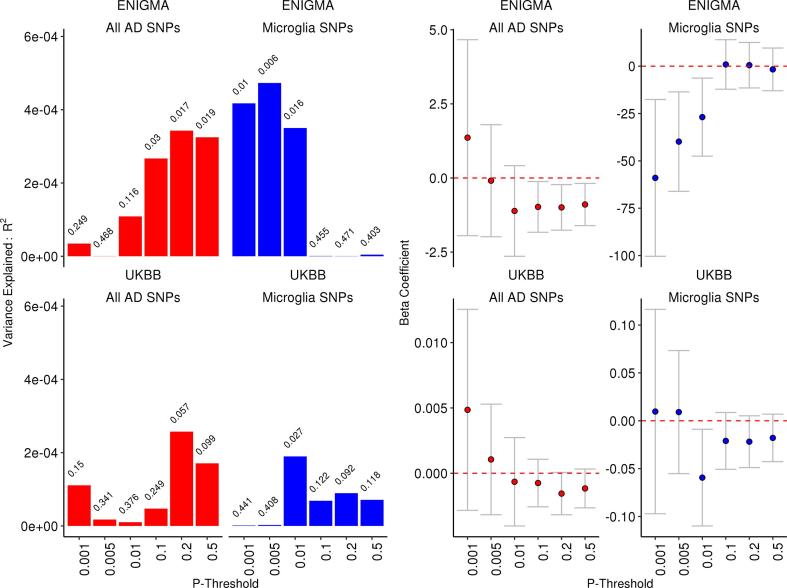
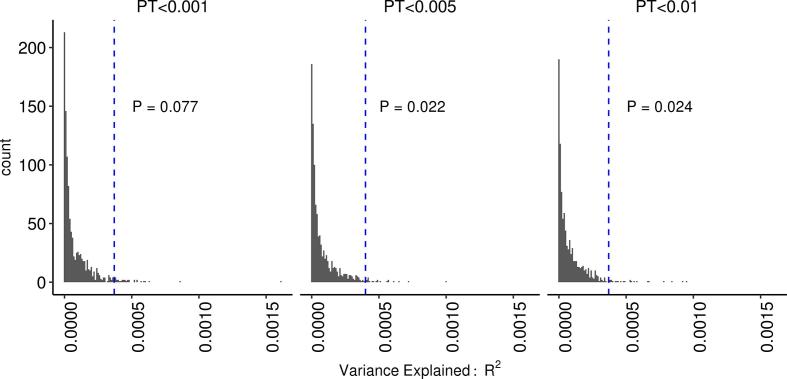
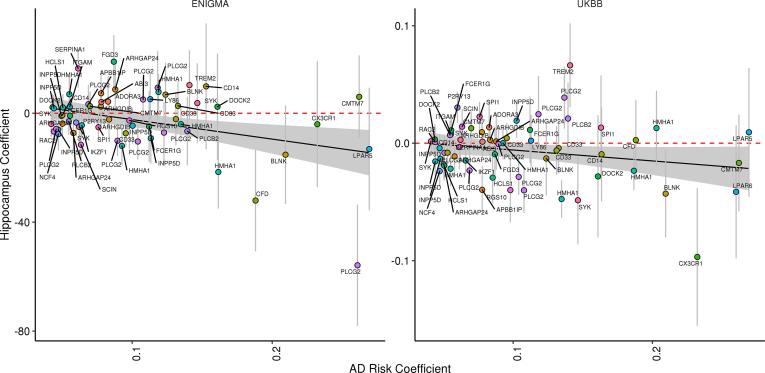
Genome-wide association studies (GWAS) suggest that Alzheimer's disease (AD) is partly explained by a burden of risk alleles (single nucleotide polymorphisms; SNPs) with relatively small effects. However, the mechanisms by which these loci cumulatively confer susceptibility remain largely unknown. Accumulating evidence suggests an association between increased AD risk allele burden (measured via a polygenic risk profile score; AD-RPS) with reduced hippocampal volume (HV) across a number of independent cohorts. These lines of research suggest that the reduced HV may be a causal mechanism of risk in the development of late-onset Alzheimer's disease (AD). However, as RPS assesses broad, cumulative genetic risk, little is known about the biological processes which may explain this observation. Here, we leverage GWAS data from i) 17,008 late onset AD cases & 37,154 controls and ii) hippocampal volume (N = 12,147; N = 9707) to explore putative pathways that may explain this association. We first demonstrate an association between whole genome AD-RPS and HV (PT < 0.5, Z = -2.07, P = 0.038), confirming previous associations. Second, we restrict our analysis to SNPs within AD genes within a microglia mediated immunity network (NGENES = 56). A microglia AD-RPS was further associated with HV (PT < 0.01; Z = -2.152, P = 0.031). Last, using a competitive, permutation based approach, we show that the common variation within this candidate gene-set is associated with HV, controlling for SNP set-size (P = 0.024). Together, the observations suggest that the relationship between AD and HV is partially explained by genes within an AD-linked microglia mediated immunity network.
Keywords: Alzhiemer’s disease; GWAS; Hippocampus; MRI; Microglia; Polygenic; Risk profile score.
Copyright © 2019 The Authors. Published by Elsevier Inc. All rights reserved.
Figures
References
-
- Albensi B.C., Mattson M.P. Evidence for the involvement of TNF and NF-kappaB in hippocampal synaptic plasticity. Synapse. 2000;35:151–159. - PubMed
-
- Axelrud L.K., Santoro M.L., Pine D.S., Talarico F., Gadelha A., Manfro G.G., Pan P.M., Jackowski A., Picon F., Brietzke E., Grassi-Oliveira R., Bressan R.A., Miguel E.C., Rohde L.A., Hakonarson H., Pausova Z., Belangero S., Paus T., Salum G.A. Polygenic risk score for Alzheimer's disease: implications for memory performance and hippocampal volumes in early life. Am. J. Psychiatry. 2018;175:555–563. - PMC - PubMed
-
- Chauhan G., Adams H.H.H., Bis J.C., Weinstein G., Yu L., Toglhofer A.M., Smith A.V., van der Lee S.J., Gottesman R.F., Thomson R., Wang J., Yang Q., Niessen W.J., Lopez O.L., Becker J.T., Phan T.G., Beare R.J., Arfanakis K., Fleischman D., Vernooij M.W., Mazoyer B., Schmidt H., Srikanth V., Knopman D.S., Jack C.R., Jr., Amouyel P., Hofman A., DeCarli C., Tzourio C., van Duijn C.M., Bennett D.A., Schmidt R., Longstreth W.T., Jr., Mosley T.H., Fornage M., Launer L.J., Seshadri S., Ikram M.A., Debette S. Association of Alzheimer's disease GWAS loci with MRI markers of brain aging. Neurobiol. Aging. 2015;36 1765 e1767-1765 e1716. - PMC - PubMed
Publication types
MeSH terms
Grants and funding
- G0300429/MRC_/Medical Research Council/United Kingdom
- G0902227/MRC_/Medical Research Council/United Kingdom
- MR/L501517/1/MRC_/Medical Research Council/United Kingdom
- G0800509/MRC_/Medical Research Council/United Kingdom
- MR/L023784/1/MRC_/Medical Research Council/United Kingdom
- MC_PC_17112/MRC_/Medical Research Council/United Kingdom
- WT_/Wellcome Trust/United Kingdom
- G0600237/MRC_/Medical Research Council/United Kingdom
- G9810900/MRC_/Medical Research Council/United Kingdom
- 513688/WT_/Wellcome Trust/United Kingdom
- MR/K013041/1/MRC_/Medical Research Council/United Kingdom
- MR/M009076/1/MRC_/Medical Research Council/United Kingdom
- G0801418/MRC_/Medical Research Council/United Kingdom
- MR/L023784/2/MRC_/Medical Research Council/United Kingdom
- MR/L010305/1/MRC_/Medical Research Council/United Kingdom
LinkOut - more resources
Full Text Sources
Medical
