


Race/Ethnicity Does Not Moderate the Relationship Between Adverse Life Experiences and Temporal Summation of the Nociceptive Flexion Reflex and Pain: Results From the Oklahoma Study of Native American Pain Risk
- PMID: 30776495
- PMCID: PMC6689448
- DOI: 10.1016/j.jpain.2019.02.006
Race/Ethnicity Does Not Moderate the Relationship Between Adverse Life Experiences and Temporal Summation of the Nociceptive Flexion Reflex and Pain: Results From the Oklahoma Study of Native American Pain Risk
Abstract
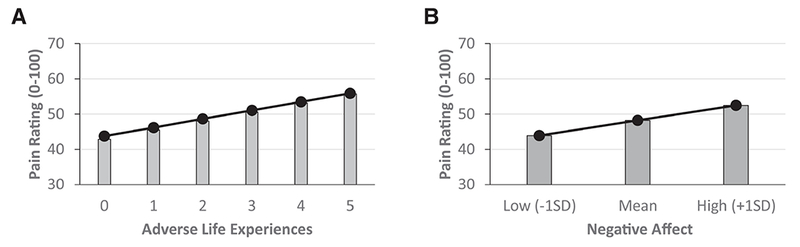
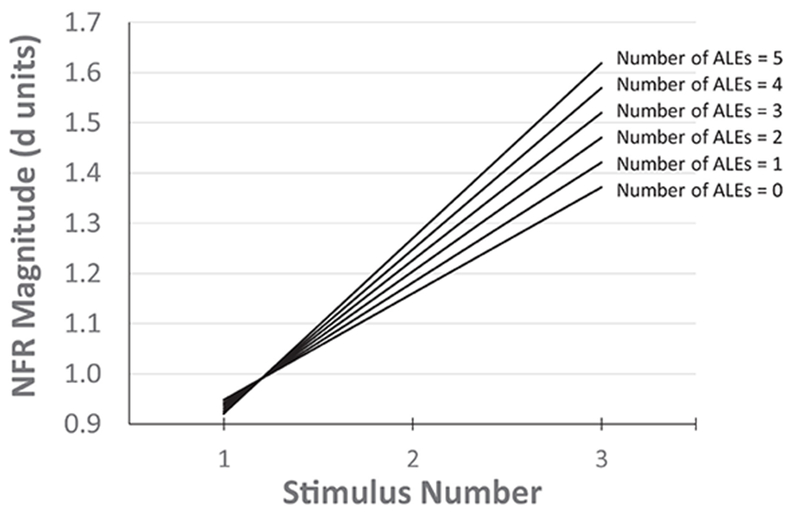
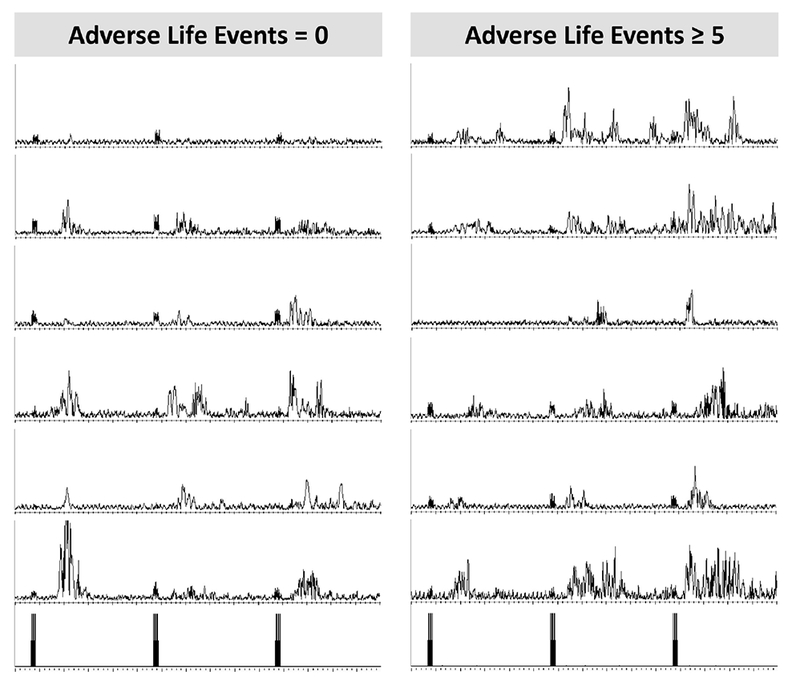
Adverse life experiences (ALEs) are associated with hyperalgesia and chronic pain, but the underlying mechanisms are poorly understood. One potential mechanism is hyperexcitability of spinal neurons (ie, central sensitization). Given that Native Americans (NAs) are more likely to have ALEs and to have a higher prevalence of chronic pain, the relationship between ALEs and spinal hyperexcitability might contribute to their pain risk. The present study assessed temporal summation of the nociceptive flexion reflex (TS-NFR; a correlate of spinal hyperexcitability) and pain (TS-Pain) in 246 healthy, pain-free non-Hispanic whites and NAs. The Life Events Checklist was used to assess the number of ALEs. Multilevel growth models were used to predict TS-NFR and TS-Pain, after controlling for age, perceived stress, psychological problems, negative and positive affect, and painful stimulus intensity. ALEs and negative affect were significantly associated with greater pain, but not enhanced TS-Pain. By contrast, ALEs were associated with enhanced TS-NFR. Race did not moderate these relationships. This finding implies that ALEs promote hyperalgesia as a result of increased spinal neuron excitability. Although relationships between ALEs and the nociceptive flexion reflex/pain were not stronger in NAs, given prior evidence that NAs experience more ALEs, this factor might contribute to the higher prevalence of chronic pain in NAs. PERSPECTIVE: This study found a dose-dependent relationship between ALEs and spinal neuron excitability. Although the relationship was not stronger in NAs than non-Hispanic whites, given prior evidence that NAs experience more ALEs, this could contribute to the higher prevalence of chronic pain in NAs.
Keywords: Temporal summation; adverse life experiences; ethnic differences; negative affect; nociceptive flexion reflex; pain; trauma.
Copyright © 2019 the American Pain Society. Published by Elsevier Inc. All rights reserved.
Conflict of interest statement
Figures
References
-
- Anda RF, Whitfield CL, Felitti VJ, Chapman D, Edwards VJ, Dube SR, Williamson DF: Adverse childhood experiences, alcoholic parents, and later risk of alcoholism and depression. Psychiatric services 53:1001–1009, 2002 - PubMed
-
- Arendt-Nielsen L, Brennum J, Sindrup S, Bak P: Electrophysiological and psychophysical quantification of temporal summation in the human nociceptive system. Eur J Appl Physiol 68:266–273, 1994 - PubMed
Publication types
MeSH terms
Grants and funding
LinkOut - more resources
Full Text Sources
Medical
